

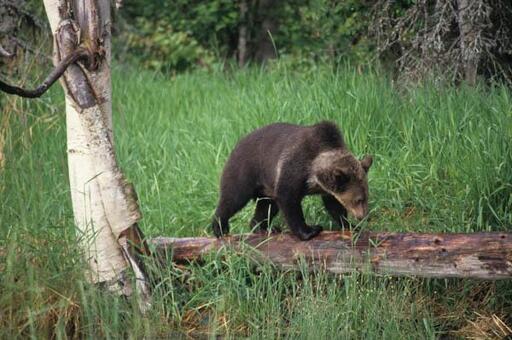
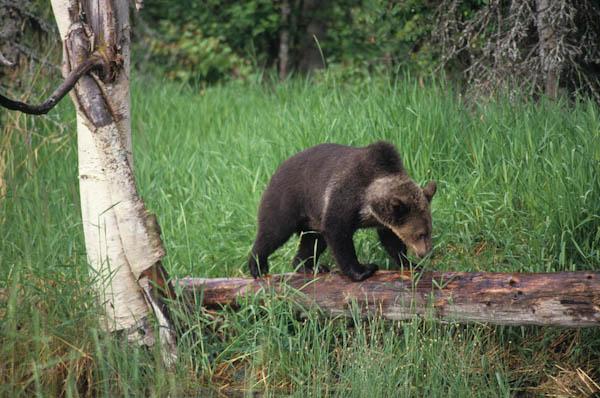
Young Grizzly Bear in Glacier National Park. Photo: George Wuerthner.
The Hungry Horse Ranger District on the Flathead National Forest in Montana recently announced the Moccasin Granite Project to “treat” a 67,536-acre area along the Wild and Scenic Middle Fork of the Flathead River which it alleges will reduce wildfire threat and “promote forest health.”
Among the lands that will be affected are roadless lands recommended for addition to the Great Bear Wilderness and roadless lands along the river corridor.

Peaks of Great Bear Wilderness, Montana. Photo by George Wuerthner
This corridor is within core grizzly bear habitat and will include the construction of 7.6 miles of new “temporary” roads. Access created by roads are a major source of mortality for grizzly bears. Roads also provide access to humans who are responsible for 84% of all wildfires.
The Forest Service uses its usual justification that it needs to fix our forests and control evolutionary processes and natural mortality caused by disease, insects and wildfire. Apparently, the only mortality the Forest Service finds acceptable is death caused by chainsaw medicine.
The entire project, besides compromising the scenery with logging along a “scenic corridor,” is based on flawed assumptions about the effectiveness of “fuel treatments” in protecting homes, as well as an anti-scientific view of the ecological value of natural selection and forest evolution.

The dominant tree species along the corridor include western larch, lodgepole pine, subalpine fire and Engelmann spruce. All of these forest types have long fire rotations of many decades to hundreds of years between any significant blaze.
Though the Forest Service correctly admits that nearly 70% of the project area falls within a “stand-replacing fire regime,” meaning that while large fires are infrequent. They note such blazes: “tend to burn with higher intensity, replacing mature forest stands with younger trees,”.
Stand replacement fires only occur when the right climatic and weather conditions line up that include high temperatures, low humidity, combined with drought and high winds. These extreme wildfire weather conditions are infrequent and occur many decades to hundreds of years apart.
Nevertheless, the agency does not consider the very low probability of any large blazes occurring any time soon. As a result, any treatment the agency does is unlikely to affect or preclude a major wildlife because vegetation rapidly grows back, negating any fuel reduction.
So the public immediately gets the negatives from logging including loss of secure grizzly bear habitat, more sedimentation in to streams from logging roads, loss of carbon storage by removal of logs and snags, loss of scenic value and potential loss of proposed additions to the Great Bear Wilderness, all at great cost to taxpayers (such logging projects are always money losers to taxpayers) without clear benefits.

Izzak Walton Lodge, Essex, Montana. The best way to protect structures is to reduce the flammability of the building and nearby surrounding landscape, typically no more than 100 feet. Photo by George Wuerthner
The other problem with the proposal is that research by the Forest Service’s own scientists has concluded that fuel removal more than 100 feet or so from any structure provides no additional benefit. Most structure fires result from embers tossed sometimes a mile or more ahead of a fire front. This is one reason why “solutions” like creating fire breaks, or thinning forests fails to protect property under extreme fire weather conditions.
Indeed, there is even evidence that thinning, and other “active management” can exacerbate fire spread by opening up the canopy which promotes soil and fuel drying, while making it easier for wind to penetrate and carry embers beyond the treated areas. One review study of 1500 wildfires found that fire severity was higher in areas with “active forest management” compared to areas off limits to logging like wilderness and roadless lands.
Furthermore, most wildfires occur within a few hundred feet of roads. So rather than constructing new roads, the best policy the agency could promote is to close roads—at least during extreme fire weather red flag conditions.
Finally, the Forest Service is using the emergency authorities authorized by the Secretary of Agriculture under section 40807 of the Infrastructure Investment and Jobs Act (IIJA) as a way to avoid any public scrutiny and objections over how our public lands are managed or mismanaged by the agency that is nothing more than a handmaiden of the timber industry.
The best way to protect structures is to reduce the flammability of the buildings themselves and the immediate area surrounding them. One can send your concerns to District Ranger Robert Davies by January 15th.
The post Trump’s Forest Service Wants to Log Next to Glacier National Park appeared first on CounterPunch.org.
From CounterPunch.org via this RSS feed
You must log in or # to comment.