


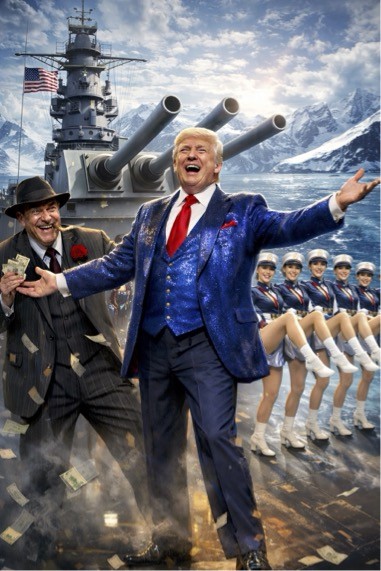
Jeff and Don’s Greenland Follies (David Yearsley and AI Art Generator)
There’s little to laugh at in 2026. Yet humor is more vital than ever, even if comic barbs and palliatives aren’t enough to stop the U.S. invasion of Greenland. Ironically, insane American adventures stock the arsenal of late-night talk show hosts. It is a very unequal arms race and, therefore all the more crucial to return fire.
In this combat zone, music can have a particularly potent charge. “Send the Marines” by Tom Lehrer, who died at the age of ninety-seven this past July, has remained true and necessary and funny ever since he penned and performed it in the 1960s, as the war in Vietnam was expanding.
This week’s tragic events in Minneapolis and the ongoing ICE invasion of American cities cast a shattering light on Lehrer’s line dispatching marines “To the shores of Tripoli / But not to Mississippoli.” The original reference pointed up the absence of federal troops in the American South to protect and further the cause of civil rights while American soldiers were dispatched overseas. Precisely because of the seemingly bizarre presence of boots now thumping the ground in the homeland and abroad, the message of Lehrer’s song rings out, bitter below its blithe sheen.
Shakespeare’s fools sang truth to power—to the characters in the drama and to the lords listening out in the theatre and acting in their plays of statecraft skullduggery.
The first self-styled philosopher of humor—as unlikely as it may seem, he was a German—writing in the middle of the eighteenth century, put it this way: “A harsh, disagreeable Truth, a Reproof, can in no better Manner be couched … than as a jest.” Even more unlikely, his treatise Gedancken von Schertzen was translated into English as The Merry Philosopher in 1764. That in itself counts as a joke: that the English sense of humor might be illuminated by one Georg Friedrich Meier, who prided himself on being coldly unfunny and therefore ideally equipped to analyze the chaotic essence of joking.
As Lehrer showed, music has a special status in comedy. It can clad the message, especially if an unwelcome one, in pleasing sonorities. But this cladding also provides a kind of parallel, sometimes subliminal text. Raw pitches without words—instrumental music—have difficulty projecting specific meaning, though we all have internalized a slew of meanings, for example, the notion (not always correct) that a minor key is supposed to be “sad.” Lehrer’s musical humor operates on multiple levels: in “Send the Marines,” the Gilbert-and-Sullivanesque feel of it—the jaunty melody and plain delivery of the words, along with his own music-hall piano backing—summons thoughts of other empires (e.g., the British) and/or good clean fun at home or in the community hall, or perhaps before the roaring tavern fire. The music seems automatic, easy, unthreatening, as if Lehrer’s unerring hands and unwavering, smiling voice are incapable of, and uninterested in, criticism or rocking any boat, whether landing craft or cruise ship. There is both lilt and wallop in this song that seems to assure, even as it unsettles.
The counterpoint between the blithe parade-ground march and the upbeat patter and the reality of military intervention stokes the hilarity. The interplay between elements could rightly be called polyphonic, even if the compositional procedures are not. (Lehrer never seems to have set his text for “Fugue to Scientists” to music.)
And yet, even as he sings so forthrightly, turned outward on the bench to his audience, smilingly and full-throatedly delivering his devastating wit, the military interventions come as if every eight bars out in the song of the real world. The marines still get sent, and the song will go on.
One also hopes for grander musical entertainments that pillory the psychopathic president. Masks are not only necessary in dealing with tear gas attacks, but in comedy—mistaken identities, put-on voices, whether sung or spoken, emanating from behind the wrong face. These deceptions are increasingly digital.
The surreal, self-satirizing comedy now playing at the Kennedy Center has spurred a rogue wave of fakery. After the self-appointed chair of the institution, Donald Trump, illegally added “TRUMP” to the façade of the building itself, placed before that of John F. Kennedy, scheduled performers—from banjo virtuoso Béla Fleck to opera diva Renée Fleming—have cancelled by the dozen. The best and biggest that the Trump–Kennedy Center can serve up now is the world premiere of Melania, coming the night before the film’s “global” release on January 30 under the auspices of MGM and Amazon. The trailer has some horrifyingly hilarious snippets accompanied by campy, pseudo-Slavic dance tunes à la bad Brahms. This mélange de Melania explores new realms of exoticist idiocy.
A clandestine insurgent comedy is underway in the jungle of the internet. South Park producer Toby Morton recently told The New York Times that for the past five years, he has been “grabbing domains tied to politicians and authoritarian figures and turning them into blunt, often uncomfortable reflections of what they actually represent.” Morton now owns the domain name trumpkennedycenter.org, which greets visitors to the site with the slogan “A National Institution Devoted to Power and Loyalty.” Ringing in the New Year are “The Epstein Dancers.” The very idea of song and dance, as yet unheard but readily imagined, energizes the satire.
Across the Atlantic in Britain, where the Special Relationship recently bared its lurid underbelly during Trump’s state visit, another group of humor activists has occupied an adjacent virtual space, separated from the American one by a mere dash: trump-kennedycenter.org.
This website launches its satirical disinformation campaign with promises of staging a show worthy of White House criminal excess: “Saucy Jeff – a Rock ’n’ Roll Musical: a new adaptation of the St. Hubbins/Smalls-penned rock opera Saucy Jack, which brings this musical about friendship and sex crimes right up to date in the new location of Little Saint James, featuring Jeffrey Epstein as the protagonist. Adapted by beloved genius Marti di Bergi and produced by E. Jean Carroll.” The latter hasn’t seen a penny of the $88 million she’s owed by Trump for raping and defaming her. But Carroll would be ready to put that cash toward this spectacle, should she ever get it.
Devotees of that timeless comedy Spinal Tap, some of whose best bits come in its musical numbers, will remember the lead singer and bassist (played by Michael McKean and Harry Shearer) musing on the time they will no longer have to pursue their grandiose plans for an opera based on the life of Jack the Ripper called Saucy Jack after the band has self-destructed during a disastrous American tour. Spinal Tap was directed by Rob Reiner, who appears in the film as rockumentarian Marti de Bergi, a Tap fan whose greatest cinematic success up to that point was a Chuck Wagon dog food TV ad.
Spinal Tap was Reiner’s first film as director. Tragically, his last was the sequel, Spinal Tap II: The End Continues, which came out last year, not long before his murder less than a month ago. Trump, plunging to new depths of savagery even for him, blamed Reiner for his murder at the hands of his own son.
I loved the first Tap movie from the moment I saw it in the theatre more than four decades ago and have watched it dozens of times since, ever thankful for Rob Reiner’s contributions to, and crafting of, this collaborative masterpiece.
The trump-kennedycenter.org parody counts as a poignant elegy to Reiner’s spirit and art. I hope someone brings the idea to the stage. Now is the time for no-holds-barred asymmetric sonic humor: sung and played, shouted and whispered, acoustic or ear-splitting, cacophonous or contrapuntal.
We need to be liberated. Send in the Musical Marines!
The post Sing a of Song of $1.5 Trillion appeared first on CounterPunch.org.
From CounterPunch.org via this RSS feed