
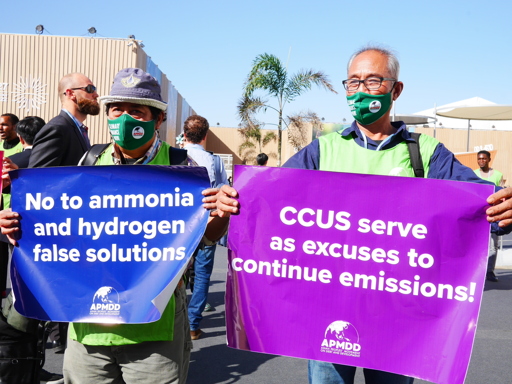
From cross-border pipelines for green hydrogen that can also carry natural gas, to sustainable aviation fuel that threatens forests, and costly carbon capture projects that are used to recover more oil, “false solutions” to climate change have gained ground in recent years, often backed by fossil fuel firms.
A new research paper, published last month in the journal Energy Research and Social Science, shines a light on this trend, exploring such projects that have also caused environmental injustices such as air pollution or depriving communities of their source of income.
The study by the Institute of Environmental Science and Technology at the Universitat Autònoma de Barcelona (ICTA-UAB), in collaboration with the University of Sussex, is based on 48 cases of environmental conflicts around the world, contained in the ICTA-UAB’s Global Atlas of Environmental Justice (EJAtlas).
The selected cases range from Norway’s Trollvind offshore wind farm, built partly to decarbonise the power supply to the Troll and Oseberg oil and gas fields; to US fossil fuel firms working with the dairy industry to turn manure into biogas; and a tree plantation in the Republic of Congo proposed by TotalEnergies, where locals say they have been prevented from accessing their customary farmland.
“House of cards”: Verra used junk carbon credits to fix Shell’s offsetting scandal
The researchers argue that “false solutions” – which also include large-scale carbon offsetting projects, many of which have been discredited – help to reinforce the political and economic power of the industry that is responsible for the climate crisis, and are undermining the global energy transition.
Climate Home News spoke to co-author Freddie Daley, a research associate at the University of Sussex’s Centre for Global Political Economy, about the paper’s findings and implications for climate policy.
Q: What was your motivation in exploring these types of “false solutions” to the climate crisis?
A: It’s very much a reaction to the fossil fuel industry insisting these technologies are solutions, rather than us creating a typology of things that are not working. All of the [paper’s] authors are very keen on a habitable planet – and we’re not going to let perfection be the enemy of the good.
But this is a call [to] arms to say that governments need to be very careful about what they’re giving public subsidy to, because in a complex situation – where there’s an urgency for reducing emissions but also for creating sustainable livelihoods and for ensuring that the needs of people living in and around these projects are met – I think it’s very important to scrutinise the viability of these schemes.
The starting point was off the back of oil majors – or so-called integrated energy companies – coming out and being very bullish on sustainability and net zero, and alongside this, proffering that they were part of the solution to climate mitigation, energy transition, job creation, green growth. And we took this as a problem statement to begin our analysis: How can fossil companies be part of the solution?
Q: What did your work reveal about “false solutions” and how can it deepen understanding of them?
A: “False solutions” is a term that’s been used for many, many years by Indigenous groups and by frontline communities – so we wanted to formalise it because it’s not really been engaged with in academic literature so far. We thought it was quite a big gap that needed to be filled.
We thought how can we categorise it? How can we help redefine it? What are the characteristics of these false solutions? So we dug into the data, the EJ Atlas, across many technologies – from hydrogen through to carbon offsets and biofuels, but also renewable energy projects, because we were finding that renewable energy projects causing conflicts were either being used to fuel fossil fuel production, such as solar panels or wind turbines to run rigs, which we thought was an interesting pattern – and also utility-scale renewable energy projects which were operated by fossil fuel firms.

Out of total energy generation, fossil fuel companies’ production of renewables is a tiny, tiny fraction. Why do these projects exist, and how do they operate within the broader energy system? We wanted to look at what their function was – and going through the data and the lived experience of the communities on the frontlines of these projects, we found that they’re very much used to legitimise fossil fuel expansion or just continued operation.
Is the world’s big idea for greener air travel a flight of fancy?
And then we also looked at the governmental role within the institutions as well – so fossil fuel firms using these technologies and these false solutions as ways to garner public subsidy, particularly for carbon capture and storage (CCS) and hydrogen, to some degree.
And what we found across all these cases was they did very little to reduce emissions and generated environmental conflicts… and they ultimately delayed an energy transition, or the sort of industrial transformation that’s required to deliver deep and rapid emissions cuts.
Q: Shouldn’t fossil fuel companies be able to use all the climate solutions available to help reduce their emissions while the world is transitioning away from coal, oil and gas?
A: My response [to that argument] is to actually look at the data. When people say hydrogen and CCS are very important and they’re crucial, I don’t disagree with the idea that we might need some sort of technology to suck carbon out the atmosphere at some point in the future. But currently, the operational projects are not delivering that, and fossil fuel projects should not be expanded on the premise that future technologies can undo their emissions.
Just a few weeks ago, the Financial Times ran a very big story about how most of the oil majors have cancelled all their hydrogen projects because the scale of it’s not there yet, and they don’t think it’s going to stack up. These are companies with huge amounts of capital in an easy-to-abate sector – energy – saying we’re not going to do this. So you have to question the plan of hydrogen as a solution, if even the people that have the expertise and the capital to make it work are saying we’re not going to do this because we cannot make it work.
Likewise with carbon capture, many of the large energy projects and energy producers that have garnered vast amounts of public subsidies on the promise that they will do carbon capture are cutting those research projects down.
So at this stage in the energy transition – which some people call the “mid transition”, the difficult part – I think we need to scrutinise these technologies and look at what they do deliver on a project-by-project basis, and then on an aggregate basis.
Q: High-carbon industries say they need government subsidies to cover the high cost of researching, developing and creating markets for new technologies to help combat climate change. Is this justified?
A: I’m a big believer in the idea that the energy transition – the ideal energy transition, which is one of scaling up new industry while phasing out an old one – is going to require not only public money, but public coordination. That means states actively stewarding investment, picking winners and sequencing what is going to be a highly disruptive process.
I think public subsidy is necessary. We need to see deep and rapid decarbonisation, especially in wealthy industrialised states, but it should be used in a very targeted way to scale up technologies which have a marked impact on emissions and also uplift welfare as well – so heat pumps insulating homes in poorer communities. With these sort of things, you get your bang for your buck.
Comment: The battle over a global energy transition is on between petro-states and electro-states
You don’t get bang for your buck giving BP and Shell money to pilot a carbon capture and storage facility. It’s an extension of existing relationships between big business and government that needs to be looked at closely in the context of energy transition, because ultimately, these companies are not serious about transitioning at the requisite speed or scale to stave off climate disaster.
Look at both oil and gas companies’ ownership of renewable assets (1.42% of operational renewable projects around the world) and the renewables share of their primary generation (0.13%). They have the capital, and they have the know-how to do this. They haven’t done it. The question is, why do they need more public subsidy to continue not doing it?
This interview was shortened and edited for clarity.
The post Q&A: “False” climate solutions help keep fossil fuel firms in business appeared first on Climate Home News.
From Climate Home News via this RSS feed