

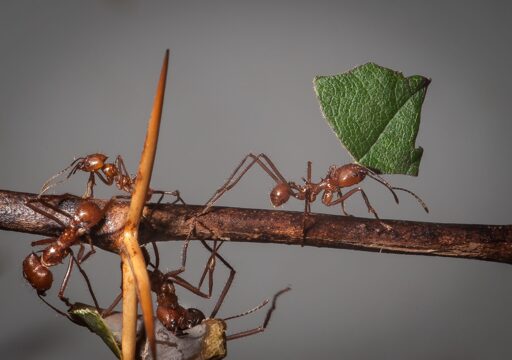
As the recent seizure of more than 5,000 endemic ants in Kenya reveals, ants have become part of a thriving global wildlife trade. Transnational traffickers are mopping up ants from the wild to sell them to hobbyists and collectors worldwide. In a recently published letter, conservationists are now calling for greater trade protections for all ant species under CITES, the global wildlife trade treaty. Ants play an important ecological role as seed dispersers and soil engineers and are essential components of soil biodiversity, said Sérgio Henriques, a letter co-author from CCMAR, the Algarve Centre of Marine Sciences at the University of Algarve, Portugal. But they are being harvested “at an alarming rate for a global market that is operating almost entirely in the shadows and moved across the world,” he told Mongabay by email. While the Kenyan seizure garnered international attention, Henriques said data show similar cases in Central Africa, South America and Southeast Asia, where traders target “visually striking” or “ecologically interesting” ant species. “Many of these are range-restricted endemics that are particularly vulnerable to disturbance by poaching,” he added. Ants can also become invasive pests when introduced in areas outside their range. On Australia’s Christmas Island, for instance, yellow crazy ants (Anoplolepis gracilipes) from Asia have wiped out native red crabs (Gecarcoidea natalis). Meanwhile, little fire ants (Wasmannia auropunctata) from Central and South America cost a whopping $170 million in damages in Hawai`i annually. “Any of these places that have invasive ant problems are spending bazillions,” Chris Shepherd,…This article was originally published on Mongabay
From Conservation news via this RSS feed
You must log in or # to comment.