

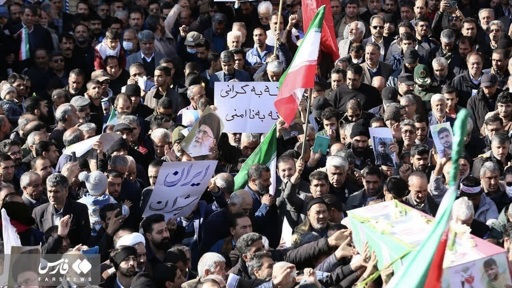
Hundreds of thousands of people marched in various parts of Iran on Monday, January 12, denouncing widespread violence over the weekend in the country and threats of foreign intervention.
The rallies were in response to calls of national unity given by various officials including Supreme Leader Ayatollah Ali Khamenei and President Masoud Pezeshkian, who have each highlighted the attempts by external forces to destabilize the country amid widespread protests over the economic situation.
US President Donald Trump and members of his administration have said in interviews and on social media that they fully support the protests in the country and would not hesitate to intervene militarily to show this support. “I tell the Iranian leaders: You better not start shooting, because we’ll start shooting too,” Trump said in a meeting.
The rallies were organized in all major cities across the country, such as Ardabil, Qom, Khuzestan, Lorestan, Yazd and the capital, Tehran. In Tehran, demonstrators marched towards Enghelab Square in the city. The rally was attended by various officials of the state, including President Pezeshkian.
شکوه حضور مردم تهران در میدان انقلاب pic.twitter.com/WULl0RJPnT
— خبرگزاری تسنیم
(@Tasnimnews_Fa) January 12, 2026
People waved national flags and chanted slogans against the US and Israel, alleged to be involved in instigating the violence during the protests which began in the last week of December over people’s economic suffering.
Monday was the second straight day when large pro-government rallies were organized in Tehran. On Sunday, thousands took part in the funeral procession of security officers and civilians killed during the violent protests earlier.
خروش کرمانیها برای محکومیت حوادث تروریستی pic.twitter.com/PAFK4bKTBK
— خبرگزاری فارس (@FarsNews_Agency) January 12, 2026
On Monday, the Iranian government also declared three days of national mourning for those killed during the protests so far.
Khamenei praised the popular participation, calling it a “historic day” which foiled the “plot of foreign enemies”.
Sanctions and Iran’s economic woes
Speaking in a TV interview on Sunday, Pezeshkian appealed for an end to the violence in the country. He claimed that his government has accepted the economic sufferings of the people and is ready to address them urgently.
The protests in Iran began on December 28 when scores of shopkeepers in Tehran protested the massive depreciation of the national currency, the rial. The fall of the currency and high inflation has created a massive standard of living crisis for the majority of Iranians, prompting the protests.
The Iranian economy, highly dependent on exports of oil and gas, of which it is one of world’s largest producers, has been crippled by harsh economic sanctions unilaterally imposed by the US since 2018. Iran has been demanding the withdrawal of these measures calling them illegal, unilateral, and punitive. It has termed them a crime against humanity, given their impact on the common people and demanded international action.
In the wake of the protests, such sanctions have only intensified. On Monday, US President Donald Trump announced the imposition of 25% tariffs on all countries doing trade with Iran. The EU also announced it will impose new sanctions on Iran in the coming days for its alleged repression of protests.
Situation escalates
While the Pezeshkian government acknowledged the economic suffering of the people and called for dialogue with the protesters, the protests took a violent turn in the first week of this month.
As per reports, the protesters have attacked public facilities and private property, killing some bystanders. It has been claimed by the Iranian government that protesters targeted dozens of mosques and deliberately attacked security forces.
According to Iranian media, a large number of public properties, including mosques, have been vandalized by what it calls “rioters” and more than 100 security forces have been killed so far while performing their duty.
There are different estimates quoted in various reports about the number of people killed in the protests so far. However, no official figure exists yet.
On Tuesday, the UN claimed it was unable to give an exact figure of people killed during the protests.
External intervention
On Sunday, Pezeshkian repeated the accusation that the protesters indulging in violence are aided and encouraged by foreign elements.
Similar claims have been made by several other state officials in Iran who have also claimed a large number of foreign “saboteurs” have been arrested by the Iranian security forces.
Earlier on Monday, Foreign Minister Abbas Araghchi briefed foreign delegates in Tehran about the weeks-long protests in the country, reiterating his government’s claims of foreign instigation to violence.
Acknowledging the economic worries, Araghchi claimed that the protests gradually turned violent after US President Donald Trump warned of military strikes if Iran attempted to control them.
Several countries in the West, including the US, Germany, and others openly supported the protesters, encouraging them to go for “regime change”.
US President Donald Trump has repeatedly threatened military intervention if the Iranian government tries to take action against the protesters and ironically voiced great support to the protests.
On Tuesday, Trump called for more protests in Iran, asking them to take over institutions, claiming he has suspended all diplomatic engagements with Iran over the alleged “senseless killing of protesters”.
German Chancellor Friedrich Merz even predicted the Iranian government may not last long.
Araghchi, in an interview with Al-Jazeera on Monday, warned Trump, claiming Iran will retaliate if the US or any other external force tries to intervene inside Iran’s domestic affairs.
Araghchi and others have also pointed at Israel for aiding the “rioters” inside the country with the vice president of the country, Mohammad Reza Aref, claiming the violent protests to be the second phase of Israel’s war against Iran.
In June, Israel launched massive military strikes inside Iran, killing top scientists, military leadership and hundreds of civilians. The US also joined the 12-day-war, as it is called by the Iranians, and bombed three of Iran’s nuclear sites.
The post Mass mobilizations continue across Iran against threats of US intervention appeared first on Peoples Dispatch.
From Peoples Dispatch via this RSS feed