

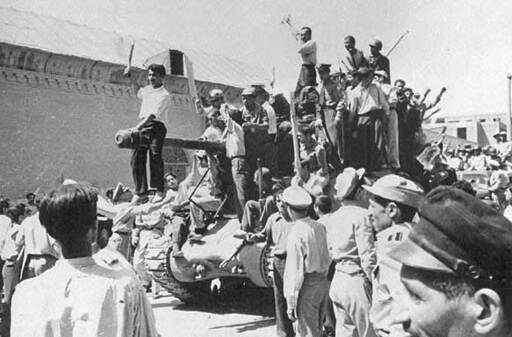
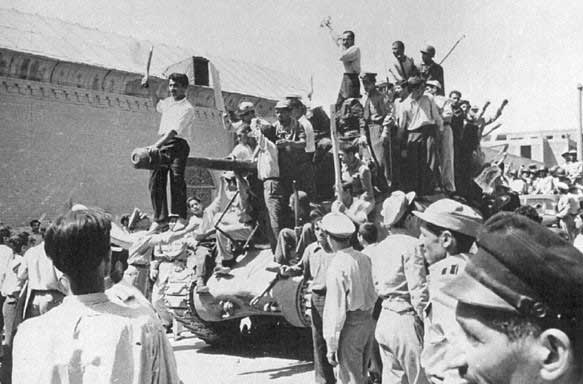
Tanks in the streets of Tehran, 1953 – Public Domain
In 1974 and 1975, I was part of a group of US leftists in the Baltimore-DC area working with a chapter of the Iranian Students Association (ISA). I was registered as a student at the University of Maryland’s College Park campus at the time. Mostly, I was engaged in political organizing as a member of the Revolutionary Student Brigade on campus. I was also working a full-time job as a short order cook. I attended a few meetings of the ISA as a liaison. I learned a lot by hanging out and talking with some of the group’s members, who were mostly a few years older than me and considerably better read in terms of Marxist literature and debate. One of the most lasting things I learned was that no people are monolithic in their politics, not even when their politics are founded in opposition to a clear and present danger. At that time, the clear and present danger facing the Iranian people was US imperialism and dictatorship, personified in the government of the Shah; a government installed in 1953 by the Central Intelligence Agency (CIA) and supported by the United States since then. That support increased dramatically after the 1973 oil embargo by Arab nations reacting to US support for Israel in its 1973 war. In fact, Iran became a cornerstone of the US empire under Nixon and Kissinger, along with Israel. Part of that money went to expanding and arming the Shah’s secret police, known as the SAVAK.
By 1974, the monarchy’s repressive regime was in full operation. In Iran, thousands of Iranian nationalists were in prison and most others were underground, operating in the shadows. They included members of religious and secular organizations, with many of the secular groups being socialist and communist. Armed guerrilla groups had begun organizing after the Shah’s brutal crackdown on pro-democracy activists and organizations in 1963. The SAVAK also operated in the United States and in countries around the world, especially in Europe, where its agents had been involved in helping local police put down protests against the Shah. At least one of those police/SAVAK exercises resulted in the killing of a protester—Benno Ohnesborg of Berlin in 1967. Ohnesborg’s murder was a crucial antagonist in the growth of the West German student movement.
One of the groups operating in Iran at the time that enjoyed the support of some of the Iranian students I knew was the People’s Fedayeen el-Khalq. This leftist organization was under severe attack in Iran, mostly because of its successful attacks on the state, including the assassinations of a top general and a top industrialist who had brutalized striking workers in his employ. Another group supported the Iranian communist party, or Tudeh. Then there were also ISA members in DC who supported the Mujaheddin el-Khalq (MEK), a leftist group that were also Muslim.[1] Finally, there were a couple Iranians in the group who supported the more religious elements of the opposition to the Shah; it’s likely that these members supported the people holding up the banner of Khomeini. I mention these differences to point out the nature of the movement against the Shah and its mirror among its DC members. Little did I know at the time, but divisions within the movement were already threatening to divide its unanimity—a unanimity that would crack in the wake of the mass movement of 1978-1979 that eventually threw the Shah’s regime out.
On February 1, 1979, Ayatollah Khomeini returned from exile to Iran. His return was met with massive demonstrations around the country. These protests were part of a series of mass struggle that had captured the world’s attention. Washington, which had been communicating with Khomeini through back channels, was somewhat relieved that his return seemed to turn the revolution underway away from socialism and communism. While it worked to prevent a military coup in Tehran, the US government was also trying to work out an arrangement between Khomeini and the Iranian military. None of these elements—Washington, Khomeini, or the Iranian military—wanted communists to have the most power in any future coalition government. The Soviet Union, meanwhile, was working with the Tudeh Party in an effort to consolidate the role of the party in revolutionary Iran. Ultimately, Tudeh would end up supporting Khomeini in what was certainly a political mistake, if not a moral one; Khomeini would return the favor by okaying the party’s repression in the 1980s. Ten months later, members of an Islamic revolutionary group (Muslim Student Followers of the Imam’s Line) led a occupation of the US Embassy in Tehran, demanding that he US return the Shah, who was in exile, to Iran for trial. This action would intensify divisions between the west and Iran, while also serving to help solidify the Khomeini faction’s support in Iran.
At the time of the occupation, the Iranian government of national unity was led by the socialist Bani-Sadr and was focused on re-establishing daily life—food provision, education, health care and so on. He had begun as an ally of Khomeini’s, but as the divisions between the secularists and religious fundamentalists became wider as Khomeini and the mullahs attempted to impose their reactionary social agenda on all of Iran. Like most nations, a cultural divide existed between Iran’s rural population and its urban one. As far as the mullahs were concerned, anything that didn’t go along with their conservative religious beliefs was heresy and must be wiped from Iranian culture. This meant Marxism as much as it meant western culture; women unveiled and homosexuality.
Meanwhile, the United States was in an election year. The Democrat Jimmy Carter was facing off against the right-wing Republican Ronald Reagan, with the latter reviving Cold War rhetoric of the 1950s and calling for a resurgence of US militarism (not that it had really gone anywhere). Jimmy Carter was negotiating with Bani-Sadr’s government trying to get the Embassy hostages released. His hope was that this could take place without casualties. The Reagan campaign was (illegally) conducting its own negotiations, with his people offering to supply parts for Iranian weapons procured by the Shah and now in the revolution’s arsenal in exchange for the hostages. The deal would have Israel providing the hardware to Iran with Washington then resupplying Israel. It would be that Khomeini-Reagan deal that would end up as the only deal. That decision seemed to represent a power play by Khomeini against the secular elements of the Iranian revolution that would ultimately give Khomeini and the mullahs the upper hand. In 1981, Bani-Sadr called for a referendum on democratic governance; a call designed to limit the expanding power of the religious fundamentalists. In response, Khomeini removed Bani-Sadr from power. The mullahs impeached him and he went into hiding, calling for resistance to the Khomeini takeover. Despite popular resistance and the forming of a coalition comprised of MEK, the Kurdistan Democratic Party, and the communist Organization of People’s Fedayeen Guerrilla (one of at least three offshoots of the aforementioned Fedayeen el-Khalq), the Revolutionary Guard (which was under Khomeini’s direction) began arresting members of this coalition and killing its members. This convinced Bani-Sadr and most of the remaining leadership of MEK and People’s Fedayeen to leave Iran.
Jumping ahead to 2026, the muddied waters of what’ being called the Iranian resistance are even muddier. In large part, this is related to the existence of a monarchist faction that hopes to put the Shah’s son back on the throne. I’m not sure what this signifies, but I do know that this element would never have been considered part of the Iranian resistance at any time until now. One can speculate as to how much of its presence in the public sphere is related to its support from various US and Israeli supporters and intelligence agencies. Reading in between the lines of reports from the western media, emails from Iranian exiles in the United States and Europe not affiliated with the MEK or other former guerrilla organizations, and reading online reports from the latter sections, it seems fair to say that there is a reasonably sized group of protesters who want democratic political reforms in Iran, including severe restrictions on the role of the so-called morality police. A considerably smaller number appear to want a return to the monarchy, while it seems an even smaller number hope for a socialist economy and at least some of the aforementioned political reforms. If any single group or some combination of these political impulses were to succeed in diminishing the power of the mullahs, they would have to deal with the US-Israeli alliance. Those already in debt to the alliance, among which I would include the monarchists and the MEK, would probably have an easier time adjusting to its demands. Any other group would probably fare little better than the current government, given their hostility to US imperialism and its Israeli manifestations. If the US-Israeli alliance decides to send in bombers, missiles and perhaps troops, the Iranian people would be forced once again to bear the brunt of Washington’s imperial military.
An offshoot of the Fedayeen el-Khalq was founded in 1980 and existed as Iran’s largest communist organization from 1980-1991. It currently exists in exile and supports the overthrow of the current Islamic Republic. On a more public scale, Mujaheddin el-Khalq also exists in exile. It works with Israeli and US intelligence and is funded by many western sources, many of the Zionist, in its desire to overthrow the government in Tehran. ↑
The post Iran and the US: Then to Now appeared first on CounterPunch.org.
From CounterPunch.org via this RSS feed