

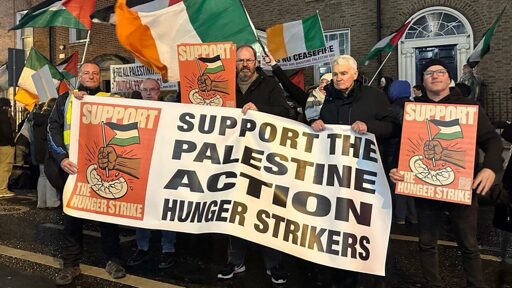
Three Palestine solidarity hunger strikers in Britain – Heba Muraisi, Kamran Ahmed, and Lewie Chiaramello – ended their action late on January 14, announcing significant progress on the strike’s demands. At the time the action ended, medical professionals had warned that the activists were at risk of “imminent death,” with Muraisi having refused food for 73 days.
The hunger strike began in early November and focused on demands related to prisoners’ civil rights, as well as calls to cease Britain’s complicity in Israel’s genocide in Palestine. One of the key demands was an end to the operations of Israeli arms manufacturer Elbit Systems in the United Kingdom.
Read more: Elbit Systems at center of NATO corruption investigation, reports suggest
A major development in the final phase of the strike was thus marked by news that Elbit Systems UK had lost a government contract that would have allowed the company to train approximately 60,000 British troops annually. The deal was not greenlit despite reported backroom efforts by corporate representatives and former army officials, suggesting that Elbit’s position has been weakened by months of mobilization and documentation of its role in the genocide in Palestine.
“The abrupt cancellation of this deal is a resounding victory for the hunger strikers, who resisted with their incarcerated bodies in order to shed light on the role of Elbit Systems, Israel’s largest weapons manufacturer, in the colonization and occupation of Palestine,” the group Prisoners for Palestine stated. Over the past 15 years, Elbit had won dozens of contracts worth millions of pounds, the group stressed. “The loss of this £2 billion contract marks a significant shift in this sordid ‘strategic alliance’,” they said. “With this victory it has never been clearer that Elbit’s days in Britain are numbered.”
Read more: Nationwide campaign against Elbit Systems launches in Romania
Although Keir Starmer’s Labour government refused to acknowledge or engage with the strikers’ demands throughout the action, progress was achieved in recent weeks. Earlier in January, prison healthcare officials finally met with representatives of the prisoners. According to Prisoners for Palestine, all activists who required supervised refeeding under official medical guidelines have now begun the process, improving their chances of recovery.
Breakthroughs were also reported regarding requests for transfers closer to families and support networks, as well as improved access to mail and education materials. In their pursuit of a fair trial, the hunger strikers had demanded disclosure of export licenses granted to Elbit Systems over the past five years. That demand was also met when the Department for Business and Trade released the information to independent researchers as the strike was taking place.
Read more: Amid mass protests in the West, Israel’s military footprint expands in Eastern Europe
Prisoners for Palestine emphasized that one of the most significant outcomes of the strike has been the surge in public support. An unprecedented number of people have signed up to participate in direct action since November 2025. “In the past few weeks alone, 500 people have signed up to take direct action against the genocidal military-industrial complex, more than the amount of people who took action with Palestine Action over its 5 year campaign,” the group wrote. “During that five-year campaign, four Israeli weapons factories were shut down. Elbit Systems is living on stolen time – we will see it shut down for good, not because of the government, but because of the people.”
“Our prisoners’ hunger strike will be remembered as a landmark moment of pure defiance; an embarrassment for the British state. It exposed to the world [that] Britain has political prisoners in service of a foreign genocidal regime,” Prisoners for Palestine added. “While these prisoners end their hunger strike, the resistance has just begun. Banning a group and imprisoning our comrades has backfired on the British state, direct action is alive, and the people will drive Elbit out of Britain for good.”
The significance of the hunger strike within the broader Palestine solidarity movement has also been emphasized by progressive MPs who supported the strikers’ demands. “The fight is far from over,” wrote MP Zarah Sultana. “We demand immediate bail for all prisoners on remand, the de-proscription of Palestine Action, and an end to all arms sales to the genocidal apartheid state of Israel.”
Similarly, MP Jeremy Corbyn said: “We know this is not the end. We will keep campaigning to end all arms sales to Israel, and we will never give up until justice has been achieved for the people of Palestine.”
The post Britain’s Palestine solidarity hunger strike ends, momentum grows for direct action appeared first on Peoples Dispatch.
From Peoples Dispatch via this RSS feed