

In a flagrant disregard for international law and national sovereignty, the Trump administration invaded and kidnapped Venezuela’s President Maduro and First Lady Cilia Flores. Rather than being an isolated event, the increasing bravado of and remarks from President Donald Trump open the terrifying possibility that, if not opposed, Trump’s war machine will proliferate its aggressions, with next possible targets being Cuba, Mexico, and Colombia or Greenland. US hyper-imperialism is dividing and unraveling the world at a time when we should be coming together to address our most existential crises.
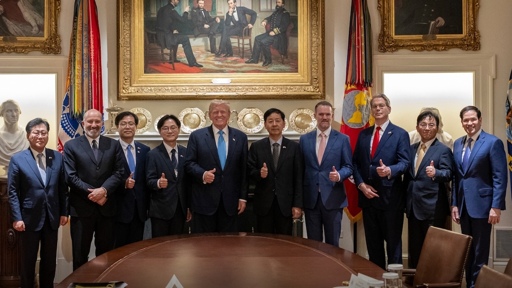
Key in this strategy for military domination are “AI, quantum computing, and autonomous systems, plus the energy necessary to fuel” them. South Korea’s pledge of USD 350 billion dollars in factories, manufacturing know-how, and technology in these sectors will strengthen Trump’s war machine. Opposing this memorandum of understanding is one front in resisting the Trump administration’s hyper-imperialism.
Robbing the mouse
Since his “Liberation Day”, Trump’s tariff war has extorted pledges for trillions of dollars from the rest of the world, accusing it of taking advantage of the US and creating the US trade deficit. This narrative conveniently ignores the ultra-rich in the US whose trillion dollar companies were built on these global supply chains. More specifically, over 70% of the US S&P 500 companies rely on global supply chains (as noted by COVID-19’s impact on them). Most spectacularly, Apple grew into a USD 3.8 trillion company by selling products manufactured by the rest of the world. If it were a country, Apple would be the 7th largest. Amazon grew into a USD 2.6 trillion company (greater than Italy’s GDP, the 8th globally) by trading mostly (71%) goods manufactured in China. If countries, nonetheless, developed and industrialized by producing US goods, they did so despite earning pennies on the dollar. For instance, China earned 2 pennies for every dollar from the sale of an iPhone; Apple earned over 50 cents. The bulk of the US trade balance went not into the coffers of countries around the world but into those of the ultra-rich in the US, who took the lion’s share of the wealth. Now, Trump is gunning for the mouse’s share.
Much has been made of the fact that the EU’s USD 600 billion investment pledge lacks enforceability, with most investment happening on its own through the markets. Yet, the enforcement mechanism for Japan and South Korea’s investment pledges of USD 550 billion (42% of Japan’s foreign reserves) and USD 350 billion (83% of South Korea’s foreign reserves) is far more direct and brutal. Both countries must invest in Trump’s projects or risk reciprocal tariffs. More specifically, the Trump administration will propose investments in strategic sectors. If they refuse, Trump can simply impose the reciprocal tariffs and, despite South Korea’s bragging that it has gotten a better deal than Japan (through assurances that the US would consider the destabilizing effects of investments and would limit investments to USD 20 billion a year), it still has the same unequal profit sharing scheme: South Korean and Japanese investors would bring all their capital and manufacturing know-how into a project, but contrary to the principles of the market, they would still hand over 50% and, once the investment is recovered, 90% of the project’s profits to the US. In effect, the US gets 50% and then 90% of profits without putting a penny of its own money. Furthermore, it’s not yet clear what impact the funneling out of such massive investments from South Korea and Japan will have on their people. By building factories for and training future competitors, it’s hard not to rule out a hollowing out of each country’s industrial base and a dulling of their competitive advantages.
Upgrading the war machine
Worst of all, these investments do not build a world centered on the needs and interests of people in the United States or of the world nor make the world safer or more sustainable. On the contrary, they help Trump preserve and advance “cutting-edge military use technology and dual-use technology” to intimidate, bully, and invade other countries. More specifically, South Korea will be investing USD 150 billion to expand the US capacity (which is suffering from backlogged orders) to build warships and, potentially, nuclear-powered submarines. Additionally, South Korea will invest up to USD 20 billion a year for 10 years on sectors Trump’s National Security Strategy has identified as deciding “the future of military power”. Semiconductor factories would create the chips for the data centers that will allow the US to dominate AI, which is becoming central to waging war. To power these electricity-hungry data centers, South Korea will provide the nuclear power plants. Finally, South Korea will be providing smelting technology and know-how for refining critical minerals for defense.
Read more: Trump met with popular protests in South Korea over tariff war and coercive policies
Not set in stone
While Trump has managed to extract many concessions through his tariff war, the memorandum of understandings (MOUs) that are reached are not set in stone. Not only are the legality of Trump’s tariffs (the extortion mechanism) being deliberated upon by the Supreme Court, the MOUs are not legally binding. In other words, their enforceability will be determined by a struggle between Trump’s tariff pressure and a government’s (and more importantly, its people’s) willingness to resist Trump’s extortion and war machine.
South Korean progressive political parties and civil society created the Organizing Committee of the International People’s Action Against Trump’s 1st Year Anniversary to resist Trump’s aggressions. Jeong-eun Hwang of the organizing committee explains, “The US doesn’t need more submarines, warships, and AI to get better at intimidating, bullying, and destroying the world. Opposing South Korea’s USD 350 billion investment offers one specific way to resist Trump.”
Dae-Han Song is a part of the International Strategy Center and the No Cold War collective and is an associate at the Korea Policy Institute.
This article was produced by Globetrotter.
The post How South Korea’s billions will upgrade Trump’s war machine appeared first on Peoples Dispatch.
From Peoples Dispatch via this RSS feed
You must log in or # to comment.