

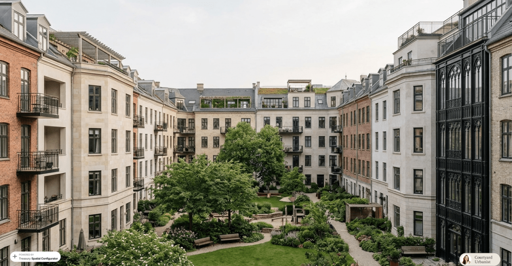

Render of an apartment courtyard block generated by Alicia Pederson with the Courtyard Composer. | © Courtyard Urbanist, Treasury Spatial Data
The root of America’s housing affordability crisis isn’t complicated in the abstract: We need to build more homes (4 million more, to be more or less precise). More sprawl isn’t working — our dependence on it is part of what’s gotten us into a housing crisis in the first place.
We’re nowhere close to climbing out of this hole. Tariffs certainly aren’t helping, and making things more challenging is, as ever, the vocal minority of residents across American cities and suburbs who oppose new apartments, duplexes, or anything denser than a detached single-family home being built near them.
Inside this story
America has a shortage of millions of homes, and needs to build quickly. Growing evidence suggests that aesthetic distaste plays an important role in driving opposition to new housing.A new working paper by housing researchers finds that aesthetic concerns — i.e., people thinking that new housing looks ugly — is highly predictive of whether they’ll support legalizing more of it.All that might sound obvious. But the US (and much of the rest of the world) really struggles to build the beautiful buildings that we used to. Why?We can reform housing policy so that it’s much easier to build lots of new homes and create incentives to build beautifully.
Housing advocates and social scientists alike have long attributed NIMBYism to, at best, personal financial stakes (like property value) or logistic concerns (like traffic), at worst deeply rooted racism or classism. And all of those explanations are, to varying degrees, surely an important part of the picture.
But there might also be something more foundational at play here. People like neighborhoods with consistency and, it turns out, style.
Which may come as a surprise, given that for most of the last century, the US has been mostly building places that are ugly and a bit soul-deadening. You know the ones: sprawling subdivisions, giant strip malls and parking lots, 10-lane highways. It’s a strange feature of our age that although we now have spectacular wealth and greater technological means to create anything we can imagine than at any point in human history, *“*all of our buildings look like boring squares and rectangles,” as journalist Derek Thompson said on a recent episode of his podcast.

Alicia Pederson, a Chicago-based researcher, writer, and advocate for beautiful, livable cities who founded the organization Courtyard Urbanist, put it even more bluntly: The way we build today has gone fundamentally wrong and swung out of alignment with human needs, she told me in an email. “That disorder expresses itself in buildings that are widely experienced as grotesque and alienating.” Her words surface something that pervades American life yet is rarely confronted so directly: Is this really how we want to live?
All of this points to a tantalizing possibility: If modern sprawl shoulders a lot of the blame for both our housing crisis and our epidemic of ugliness, then perhaps we could start to repair both at the same time, with the same tools. Maybe housing abundance should be not just about building more of what we already have, but also about transforming and beautifying the way we build for the future.
What do looks have to do with solving the housing crisis?
It might feel a bit frivolous to fixate on aesthetics at a time when we face an acute housing crisis and urgently need to build lots of housing in the high-opportunity places where people want to live. But beauty matters, even if it’s harder to translate into wonk language than is something like floor area ratio. Our built environment is the physical container for our lives, shaping our entire daily existence and our interactions with our families and communities. A beautiful, humane habitat can be emotionally uplifting, inspire awe and lower the ambient stress of daily life; a bad one does the opposite. And NIMBYs are not wrong to feel that even if we are not the ones living in a new building, if it’s in our neighborhood or broader daily environment, we still live with it.
There is empirical evidence that beauty matters for making housing abundance work, too. A recent working paper contributes to a growing body of research finding that aesthetic concerns play a meaningful role in driving public opposition to new housing. People seem to oppose buildings that break the mold of what’s surrounding them, and they are less likely — a lot less likely — to support building new homes if they think they’ll be visually distasteful.
Traditionally, as University of California Davis law professor Chris Elmendorf put it to me, social scientists have theorized that people oppose new housing construction out of economic self-interest (their property values rise when housing is scarce) or NIMBYism — a broad desire to avoid change in their neighborhoods because of whatever negative externalities that might come with it (like increased traffic congestion or demand for local schools). But there are limits to those explanations — for one thing, it’s not obvious that making it legal to replace single-family houses with, say, small condo buildings lowers property values. A property in a desirable area can sell for more money if it’s possible to redevelop it into multiple homes.
It might seem obvious that aesthetic tastes have something to do with attitudes toward new housing — “neighborhood character” is a watchword of NIMBYs everywhere, something I can witness every day in my local neighborhood Facebook group in Madison, Wisconsin. But it’s hard to rigorously show whether these aesthetic preferences are, as Elmendorf put it, “real or just covering up for some other concern that people are reluctant to state directly.” Those might be racist or classist attitudes or antipathy toward renters, who are usually presumed to be the residents of multifamily homes.
Aesthetics is, of course, a complex concept that may not be fully disentangle-able from other things. It is in large part born out of one’s cultural milieu and upbringing. And to some degree, people’s aesthetic preferences are going to remain subjective, irreconcilable, and incomprehensible to one another. There are people in this country who will mourn the replacement of an empty parking lot with a set of what I think are pretty attractive new homes. There are even people who love brutalist architecture, and that’s fine — we’re a big, diverse polity that can accommodate many tastes.
In the new study (which hasn’t yet been through peer review), Elmendorf, along with co-authors David Broockman, a political scientist at UC Berkeley, and Joshua Kalla, a political scientist at Yale, set out to understand how aesthetic tastes might be shaping public views on housing development.
To get at the heart of the aesthetics question scientifically, the researchers ran large-scale survey experiments (with 5,999 participants broadly representative of the US population, including people across the political spectrum as well as homeowners and renters) where they manipulated the design of buildings and neighborhood context. The findings, they argue, suggest that aesthetic preferences are sincerely held, rather than mere pretexts, and that support for new apartments is strongly predicted by aesthetic factors in a number of different ways. “Aesthetic tastes are typically far more predictive of support for developing new apartment buildings than measures of other beliefs, attitudes, and preferences, such as beliefs about the relationship between development and prices or racial attitudes,” the authors write.
Respondents were far more likely to support allowing the construction of five-story apartment buildings when they’re located near buildings of a similar scale rather than near single-family houses. (Sometimes derisively called “gentrification buildings,” the wide, five-story buildings known as five-over-ones have become one of the most common building types for new apartments in the US.) That particular objection appears to be less about what apartment buildings look like than the fact people simply don’t think apartments look harmonious next to houses. And in a country where the vast majority of residential land is zoned exclusively for detached single-family homes, the possibility that people don’t like the look of apartments buildings near those houses seems like a big problem for addressing our housing crisis that calls for further investigation.
That finding was also true for people who live in the high-density areas that would be near the new apartments — in other words, mere NIMBYism doesn’t seem to be what’s going on here. Participants even judged the same photo of an apartment building as less attractive if it was to be located near a single-family home rather than another apartment building — a piece of evidence that helped convince Elmendorf that the aesthetic preferences are real, not just pretextual.
Respondents were also no less opposed to office buildings of similar size to the apartment buildings than they were to apartment buildings themselves, suggesting that these views had something to do with their opinions on larger buildings and their placement generally — and not just about the renters who would presumably live in those apartments.
The aesthetic qualities of individual buildings, regardless of their surroundings, also mattered a lot. Whether a building would be designed by an architect recognized for excellent design or an architect who received an “Aesthetic Atrocity Award” for bad design showed very large effects on participants’ willingness to support it, as did showing the respondents photos of apartment buildings of varying aesthetic quality.
You might still suspect that something more complicated is going on than pure aesthetics. The researchers tested for some of the most obvious potential confounders: Respondents who indicated more negative racial attitudes (as measured by a commonly used metric in social science research) showed no preference for office buildings over apartments. Meanwhile, aesthetic distaste for apartments — holding the belief that “new apartments are ugly” or that cities look better without them — was more strongly predictive of opposition to new buildings than were racial attitudes.
The paper is part of a broader turn in research on the politics of housing that explains attitudes toward development in terms of gut-level preferences and identities — whether a person sees themselves as someone who likes cities and density, whether they think a proposed development looks nice — rather than intellectual factors like “how will this impact my property value?” The general public has “very weak intuitions,” Elmendorf said, about how new home construction will impact housing price levels (and they are often wrong about it), but beauty and ugliness are visceral.
Of course, it’s one thing to call for right-scale, beautiful housing in just the right places. It’s quite another to make it happen.
Why don’t we build pretty things anymore?
Americans have long ago stopped gracing our cities with anything like the majestic brownstones of New York City, the charming six-flats of Chicago, or the Spanish-tiled courtyard apartments of Los Angeles. But why?

It’s hard to answer with certainty: There may be economic explanations, as well as cultural ones (put simply, modernist ideas in art and architecture have done a number on us). Organizing our society around cars has also created a lot of problems, aesthetic not least among them.
Perhaps the most important explanation for those trying to change things, however, is regulatory. The construction of pretty much everything in modern life — homes, as well as shops, offices, and other businesses — is subject to a degree of regulation far more extreme than in the days when we were actually building beautiful things. Over the last century and especially post-World War II, the complex bureaucratic regimes of zoning and building codes have made it illegal to build walkable districts and appealing buildings across much of the country.
That has had the effect not just of making it too hard to build enough housing overall, but also of making it extremely expensive to build anything, let alone anything with particularly thoughtful design. “It just costs SO MUCH more to build today that it really is not economically rational to invest in great materials and style,” Pederson wrote.
In a conversation last summer, M. Nolan Gray, an urban planner and senior director of legislation and research at the nonprofit California YIMBY, told me that the labyrinthine permitting procedures that govern housing in our cities in suburbs have squeezed out competition among homebuilders and rewarded developers for their ability to navigate red tape rather than for building the highest-quality, most visually pleasing homes.
“We’ve created a world where it’s really large national and international companies that are heavily capitalized that can fight these fights to get their permits and deal with the crazy design reviews,” he said. “I want to live in a world where we have lots of people competing, and they’re competing on the margin of building more beautiful buildings. And I think we get there by allowing for more flexibility.”
Maybe beautiful housing could turn more of us into YIMBYs
It can be much too easy for urbanists to wax nostalgic about the past, but nothing in this piece should be mistaken for a call to return to it. By today’s standards, much of the prewar housing stock lacked the rudiments of habitability, like plumbing, flush toilets, and fire safety. And there may be a survivorship bias at work — it’s primarily the highest-quality old homes that have survived into the present.
But aesthetics in the built environment matter to people — and there’s far too little of it on offer in America. Our longing for elegance in our buildings finds expression today not in a flowering of lovely new building styles, but in dysfunctional regulation like historic preservation laws, which may safeguard beloved neighborhoods, but at the cost of worsening housing scarcity and unaffordability. These policies reflect a “strong feeling that we have a finite stock of beautiful things, and that every time we lose one, we’re just losing something that is completely irreplaceable,” Samuel Hughes, an editor for Works in Progress magazine, recently said.
How might city governments and builders leverage all this to actually build more housing that the public will like? Among the policy ideas discussed by Elmendorf and his co-authors are reforms to make it easy to “incrementally” densify neighborhoods with homes that are not radically out of proportion from their surroundings. That could mean, for example, building duplexes or small apartment buildings rather than big buildings next to single-family homes. Another is passing policies to allow the redevelopment of entire blocks or neighborhoods at once, so they can be densified in an aesthetically cohesive manner and developers have an incentive to prioritize good design.
That idea harmonizes with what is maybe the most inspiring vision I’ve seen for housing abundance: courtyard blocks, a housing form that occupies an entire city block, with a perimeter of mid-rise buildings on the outside and interior green space. These are already widespread in Europe, and Pederson devotes herself to advocating for adapting courtyard blocks for an American context because they could solve so many of our housing problems at once. They can supply lots of dense new housing, but they are also, she points out, especially ideal for families because they have built-in semiprivate green space that functions like a backyard.
Their structure allows the residences to draw abundant natural light, and they can accommodate three- and four-bedroom apartments that, as Vox’s Rachel Cohen Booth has written, are badly needed in American cities if they are to have any hope of retaining families with children. They “offer the functional equivalent of a ‘big house with a yard’ while preserving the density and mixed-use character essential for walkable, affordable urban neighborhoods,” Pederson wrote on her Substack last year. And they are made up of relatively smaller individual buildings rather than very large ones that read to some people as bland and overbearing.

And they don’t just have to be Copenhagen cosplay — they can be built with any architectural style. Here is one I generated inspired by the red-brick architecture of Boston (using an AI-powered visualization tool created by a collaboration between Courtyard Urbanist and the design technology company Treasury):

Accommodating beautiful new housing forms like these would require cities to scrap needlessly burdensome regulations. Widespread rules that often require apartment buildings to have multiple staircases, for example, make it more difficult to build small, multi-unit buildings while adding significantly to construction costs.
It also calls for pairing deregulation with carrots that encourage the kinds of buildings people want to live in and around — cities can, for instance, offer developers density bonuses in exchange for adding features like greenery, or create pre-approved design templates (Elmendorf and his co-authors point to the latter idea). Cities could re-legalize traditional architectural forms and create a catalog of blueprints for building them (old triple-deckers, for example, exist all over the Boston area, yet are strangely difficult to build new in the city today). The goal ought not to be to swap one gauntlet for another — YIMBYs are right to hate design-review purgatory — but rather to make building easier with a predictable, good-faith process.
Pederson is no fan of how we build in America today, so I was taken aback by what she said when I asked if she’s hopeful about our ability to fix it. “I am SO optimistic!” she wrote to me. “It’s going to be a perfect convergence of great new tech, great new visions and ‘vibes,’ and regulatory reform. Prepare yourself for a fantastic chapter in American urbanism.”
I’m under no illusions that even the prettiest designs can overcome the formidable forces of NIMBYism in America overnight. Still, the moment seems right for a paradigm shift, away from the charmless, unaffordable status quo. Our housing crisis is a nightmare for millions of Americans, but it is also, perhaps, a rare invitation to rebuild the way we live.
From Vox via this RSS feed
fuck off with your titles again?