

This article by Antonio Heras originally appeared in the January 19, 2026 edition of La Jornada, Mexico’s premier left wing daily newspaper.
San Quintín, Baja California. Most ranches in the San Quintín region hire day laborers on a piece-rate basis, under the “going out and paying” scheme, without benefits or social security, according to Venustiano Hernández, one of the leaders of the region’s labor movement, during which employees protested in 2015 about the terrible working conditions in southern Baja California.
That is now a serious problem in San Quintín, because the ranchers – not the agribusiness companies, which are monitored – are the ones who employ day laborers in this way and do not take responsibility for any aspect, said Fermín Salazar, one of the five spokespeople of the Alliance of Organizations for Social Justice, which emerged from that movement.

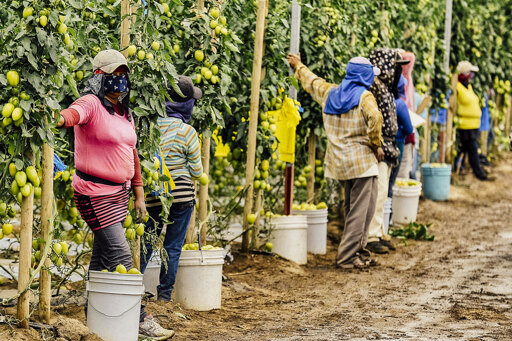
Day laborers arrive at the ranches in the early morning and begin harvesting agricultural products on a piece-rate basis until they finish their work, without benefits or social security, in a completely illegal scheme.
The relationship is with the person who takes them to the fields, who at the end of the day receives the money to pay them and gets a percentage from each worker, as well as the charge for the transportation service.
“Those who work on a piece-rate basis, with greater skill and strength, are the ones who earn a little more,” they say.
For Venustiano Hernández, who has traveled throughout the agricultural fields of the area in the last decade, “this situation is our fault for accepting illegal payments from employers, who take advantage of the need of the day laborer, and the government, which does not ensure compliance with the Labor Law or is complicit, because it even warns the ranches when they will be conducting inspections.”
He reiterated that in those ranches there are no contracts between workers and employers; furthermore, there are companies that sign agreements for only three months, without protection for the employee.
A decade after the conflict of farmworkers, who stopped agricultural production and blocked the transpeninsular highway, the leaders participate in the podcast Ten Years Later: Farmworkers Between Agreements and Reality, to reflect on what this movement left behind, based on an idea by the education teacher Lenin Escobar, president of the Finance and Municipal Heritage Commission of the San Quintín City Council.
The broadcast offers a collective reflection from those who led the farmworkers’ movement on March 17, 2015, to demand wage improvements in the fields of the San Quintín Valley, social security, an end to sexual harassment of employees and harassment of workers by foremen and supervisors.
It also presents the perspective of the different leaders who participated in the fight for rights in San Quintín, so that new generations can learn why the social movement erupted, what the government omitted, and the responsibilities incurred by the companies.

Transpeninsular Highway Strikes & Blockades
It has been the most important in the region, as ranches were shut down from Colonet to Vicente Guerrero, and the Transpeninsular Highway, which connects Baja California with Baja California Sur, was blocked.
Fermín Salazar, a teacher of Mixtec origin, was one of the five spokespeople for the farmworkers during the protests and participated in meetings with representatives of the Mexican and Baja California governments. This was during the presidency of Enrique Peña Nieto (PRI) and the governorship of Francisco Vega de Lamadrid (PAN).

Movement Brought Together More Than 70,000 Workers
The movement brought together more than 70,000 farmworkers from San Quintín to demand fair wages and decent working hours.
Back then, workers were paid 70 or 80 pesos a day, with shifts of eight to twelve hours, in deplorable health and working conditions. “Today we see things differently as a result of the historical movement, because there were many workers who earned 80 pesos a day, while in other companies they earned from 90 to 115 pesos; there were different wages,” Fermín commented.
“I come from the fields and I was part of this movement that represented the largest strike of farmworkers in the history of San Quintín, nobody had done one from Colonet to the bridge of Rancho de Los Pinos,” he added.
He recounted that the mobilization began due to low wages, but other demands were included. “I had in my hands a file of 132 complaints from female workers regarding harassment and workplace and sexual harassment,” recalled Fermín, who pointed out that the foremen and supervisors were the ones being accused. He explained that “that rate dropped, and we hear few complaints now.”
He noted that the protest “began with the defense of labor rights: Christmas bonus, holidays, overtime, training, weekends off, and affiliation with the Mexican Social Security Institute, since very little money was being earned. The transportation of farmworkers has improved; they are no longer transported in flatbed trucks but in buses.”
“The employers themselves realized it and we talked to them to adjust to the laws,” he said.
“The Alliance of Organizations for Social Justice is still alive, but not with the same strength or ability to mobilize, since we split into two parts and although we managed to register the Independent Democratic Union of Agricultural Day Laborers, we made a mistake with the appointment of the first general secretary (Lorenzo Rodríguez), because he stopped fighting for workers’ rights,” Salazar concluded.

7.4 Times Increase in Adult Literacy Program Graduates
January 20, 2026
For the governments of the Fourth Transformation, literacy is considered a national priority and a strategic action of the Mexican State to reduce inequalities, strengthen social inclusion and expand development opportunities throughout the country.

Mexican Grains Crisis Persists: Farmers Threaten More Protests
January 20, 2026
Producers in the Bajío region report they have at least 1.5 million tons of corn unsold, while in Zacatecas, 80% of bean producers cannot sell their harvest.

San Quintín: Exploitation of Agricultural Day Labourers Persists
January 20, 2026January 20, 2026
Baja California day labourers arrive at ranches in the early morning and begin harvesting agricultural products on a piece-rate basis until they finish, without benefits or social security, in a completely illegal scheme.
The post San Quintín: Exploitation of Agricultural Day Labourers Persists appeared first on Mexico Solidarity Media.
From Mexico Solidarity Media via this RSS feed
You must log in or # to comment.