

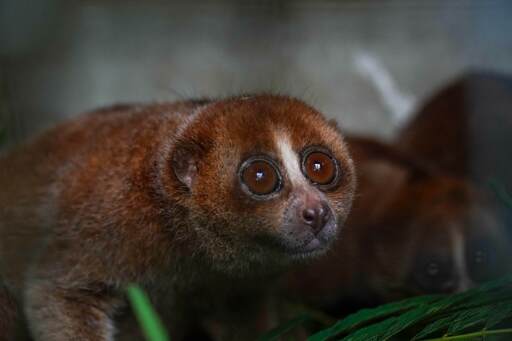
Between Nigeria’s Cross River and Cameroon’s Sanaga River lies one of West Africa’s largest remaining blocks of intact rainforest. Noisy groups of Preuss’s red colobus monkeys (Piliocolobus preussi) move through this forest’s canopy in bands 20-to-60-strong, feeding mainly on the young leaves of just a few tree species, including Lecomtedoxa klaineana (known locally as oguomo) and Xylopia aethiopica (“grains of Selim”). The leaf-heavy diet of these social monkeys helps shape forest structure, and declines in their numbers often foreshadow wider losses of wildlife across the forest. Half a world away, a very different primate lurks in the trees on the small, relatively isolated Indonesian island of Bangka. Readily identified by its pale facial mask, the Bangka slow loris (Nycticebus bancanus) is arboreal, nocturnal, and venomous, with large eyes and deliberate movements. Not much formal scientific knowledge has been gathered about this species since it was first described in 1937, but local conservationists have rehabilitated and released several dozen of the animals over the past decade. Both species feature on the “Primates in Peril”, a roll call of the world’s 25 most endangered primates, a call for careful, focused conservation action. The future prospects for either primate illustrates how a threatened species’ survival may depend on very specific conditions: the health and protection of a single small island, or a particular forest type, or a few key plant species within that forest, or a single small island can make the difference between persistence and disappearance. Korup National Park, Cameroon. Image by…This article was originally published on Mongabay
From Conservation news via this RSS feed