

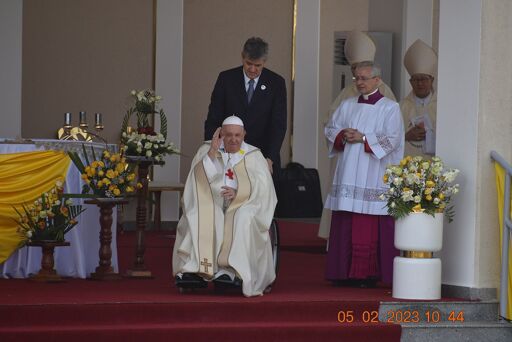
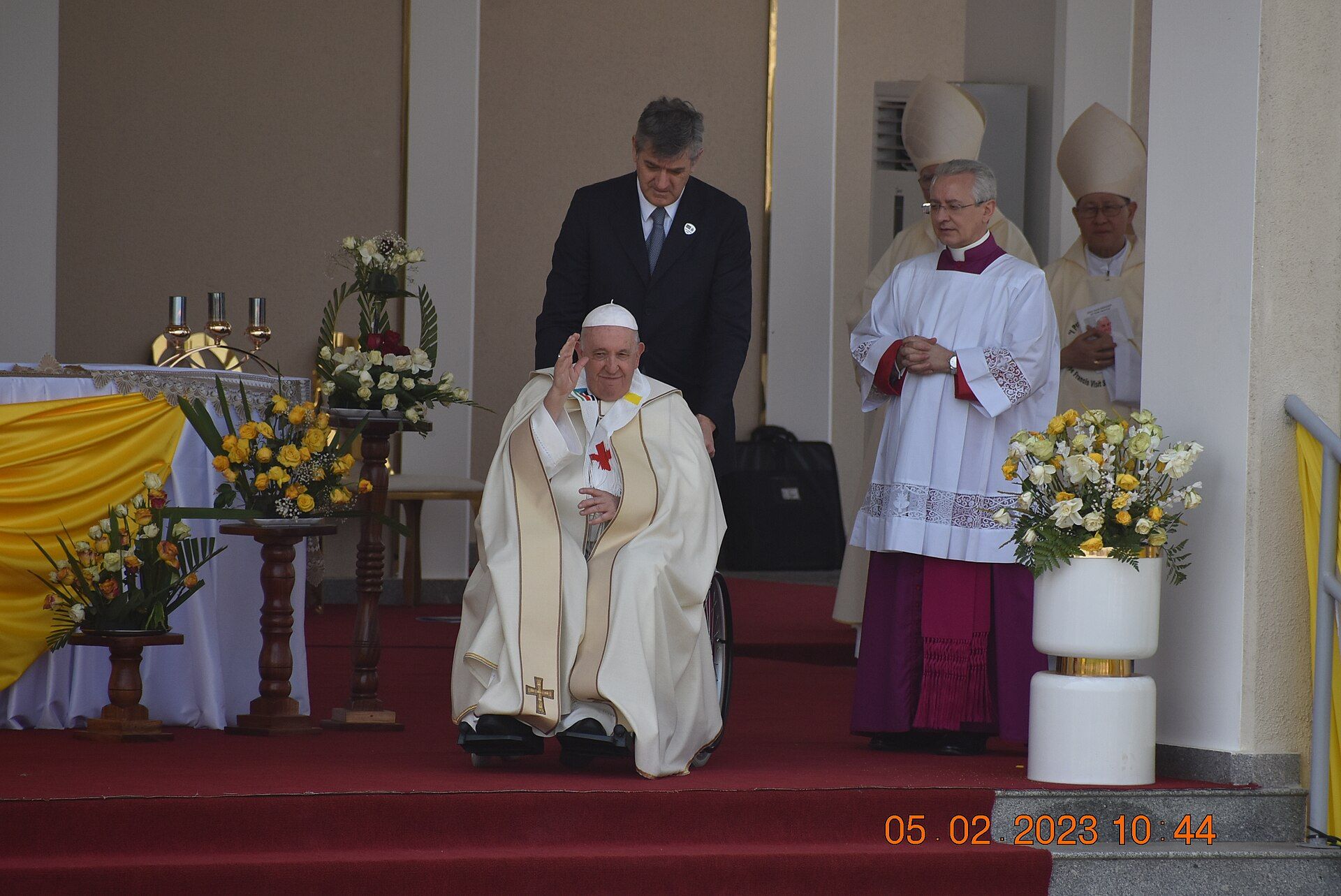
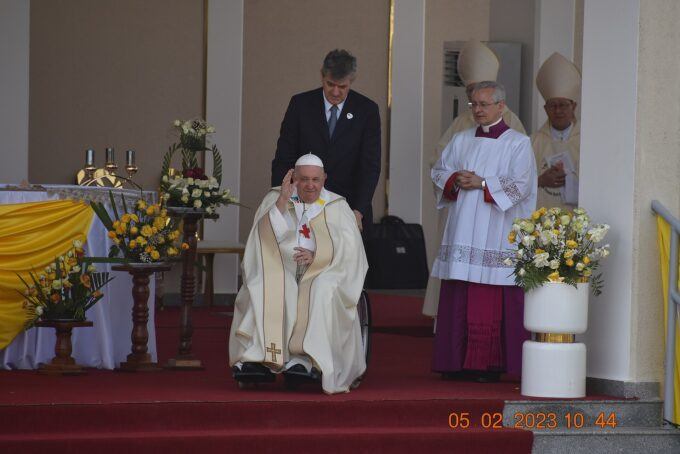
Pope Francis visiting South Sudan. Photograph Source: Alfadil Attiya Abuanja – CC BY-SA 4.0
Nearly two years after Pope Francis’s unprecedented ecumenical pilgrimage to South Sudan, the country is once again sliding towards violence, underscoring the futility of moral attention without political follow-through.
The February 2023 visit, undertaken alongside the then Archbishop of Canterbury, Justin Welby, and the Moderator of the General Assembly of the Church of Scotland, Iain Greenshields, was meant to jolt not just South Sudan’s leaders but the international community into action.
It carried extraordinary symbolic weight in a country where churches really do wield moral and social authority. But without any sustained enforcement, real incentives, or evidence of accountability, the visit now badly risks becoming yet another of those global moments in the sun that illuminate only briefly.
The danger appears not that South Sudan has been forgotten because no one cares. It is that care was never properly organised into pressure. South Sudan’s tragedy is not invisibility so much as displacement.
It is also overshadowed by larger crises. Global attention is consumed daily by the barbed-wire brocade of Ukraine, Gaza, Sudan to the north, and Ethiopia. Compared with these, South Sudan slips quietly down the list. As one Sudanese exile remarked in Leeds after the 2023 visit, “this is a story too often heard across South Sudan.”
If ever there were a chronic but “non-breaking” conflict, this is it. Violence in the still-young, landlocked country is typically localised and cyclical rather than dramatic enough to command international attention. Yet this pattern has long been recognised. International officials warned years ago that “the current cycle of revenge will get the people of this country nowhere.” The warning has gone largely unheeded.
In early 2025, armed clashes broke out between the South Sudan People’s Defence Forces (SSPDF) and the loosely organised White Army militia, a community-based armed group drawn largely from the Nuer ethnic group. The fighting displaced tens of thousands and revived fears that the country was sliding back towards full-scale war.
In places such as Unity and Jonglei states, shifting military control and militia mobilisation continue to be reported locally. These are driven by intense disputes over land, leadership, and community security.
Across Warrap, Lakes, and Central Equatoria, cycles of revenge killings, cattle raids, and ethnic reprisals flare up periodically. These are often triggered by local incidents but are said to feed deep, unresolved grievances. Even the national army recognises this.
Nor is violence confined to rural areas. In Juba and other urban centres, crackdowns on youth and gangs have led to arbitrary arrests, extortion, and rising gender-based violence—harms that are serious but often recorded only locally. Attacks on hospitals and other key civilian infrastructure do occur, but they rarely register in mainstream global news cycles.
The 2018 Revitalised Peace Agreement succeeded in reducing large-scale war, but its implementation has stalled. Security sector reform, elections, and institutional responses to past abuses remain largely on hold. Political elites are absorbed by relentless power struggles inevitably consuming state resources, leaving governance weak and services threadbare. After decades of conflict—including before independence—many donors and agencies show signs of fatigue, reducing the sense of urgency despite continuing needs.
This inertia is all the more striking given South Sudan’s natural wealth. The country has substantial oil reserves, yet weak institutions and persistent corruption prevent any kind of broad-based development. Even President Salva Kiir has acknowledged the fragility of the economic base, conceding that “it is no secret that the war in Sudan has negatively contributed to the decline in South Sudan oil production and has negatively affected our economy.”
Climate shocks compound such pressures. Flooding and drought have devastated livelihoods. As one government minister put it, “farms are completely washed out… houses and homesteads are completely submerged under water.” Yet everyone knows that climate-driven disasters in poor countries rarely command attention, and South Sudan is no exception.
At the international level, regional and global players often prioritise short-term stability over reform, making life easier only for those at the top. Unlike the conflict next door, South Sudan lacks a large, influential diaspora lobby abroad, though there is resolve among some of the communities in cities such as London, Bradford, and Leeds in the UK.
Meanwhile, the war in neighbouring Sudan absorbs much of what little diplomatic bandwidth remains. Nor is it that the issues of Sudan hog the limelight. They struggle to find any light at all. Some global policymakers are blunt enough to say that if they do finally focus their efforts, they will have to concentrate only on Sudan—where progress has remained elusive. The effect is that displacement, hunger, and violence in South Sudan have come to seem routine. South Sudan has become catastrophe’s poor relation.
Against this backdrop, the February 2023 visit led by Pope Francis stood out because it cut through that level of indifference. It was an unprecedented pilgrimage for peace. Pope Francis explained its purpose simply: “We undertook this ecumenical pilgrimage of peace after hearing the plea of an entire people.”
For South Sudan’s leaders, the visit carried additional weight because of earlier gestures. President Kiir reflected on the Pope’s extraordinary act in Rome in 2021—kneeling to kiss the feet of rival leaders—saying it “did not go in vain.” Expectations were high that this intervention would finally unlock political movement.
As a guest of a diplomat friend, I heard discussions of that promise first-hand at Lambeth Palace. Yet the aftermath has been limited. Church leaders can inspire and shame, but they cannot compel political elites to do their bidding. Public gestures of reconciliation are unmatched by either reforms or compromises.
Crucially, the visit was not paired with enforcement. There were no new sanctions, incentives, or monitoring frameworks from the United Nations or major powers. Media coverage spiked briefly, then faded—like a doused flare—removing sustained external pressure. No campaign followed, nor was there a clear roadmap.
The risk now is not merely renewed violence, but managed decay. A state held together through habit and fear. President Salva Kiir has so far kept the country intact, but he will not rule indefinitely. When succession comes, the absence of reform will hurt. Is now therefore not the right time to revitalise these efforts?
An effective follow-up would treat the 2023 visit not as a pilgrimage completed, but as a mandate begun. None of this requires religious faith to recognise. As one expert on the region told me only last week, “It is time we help deliver the promises of independence to the people of South Sudan.” Without that, the fear is that neglect will harden into deliberate inaction.
The post South Sudan After the Pilgrimage: When Moral Attention Isn’t Enough appeared first on CounterPunch.org.
From CounterPunch.org via this RSS feed
You must log in or # to comment.