

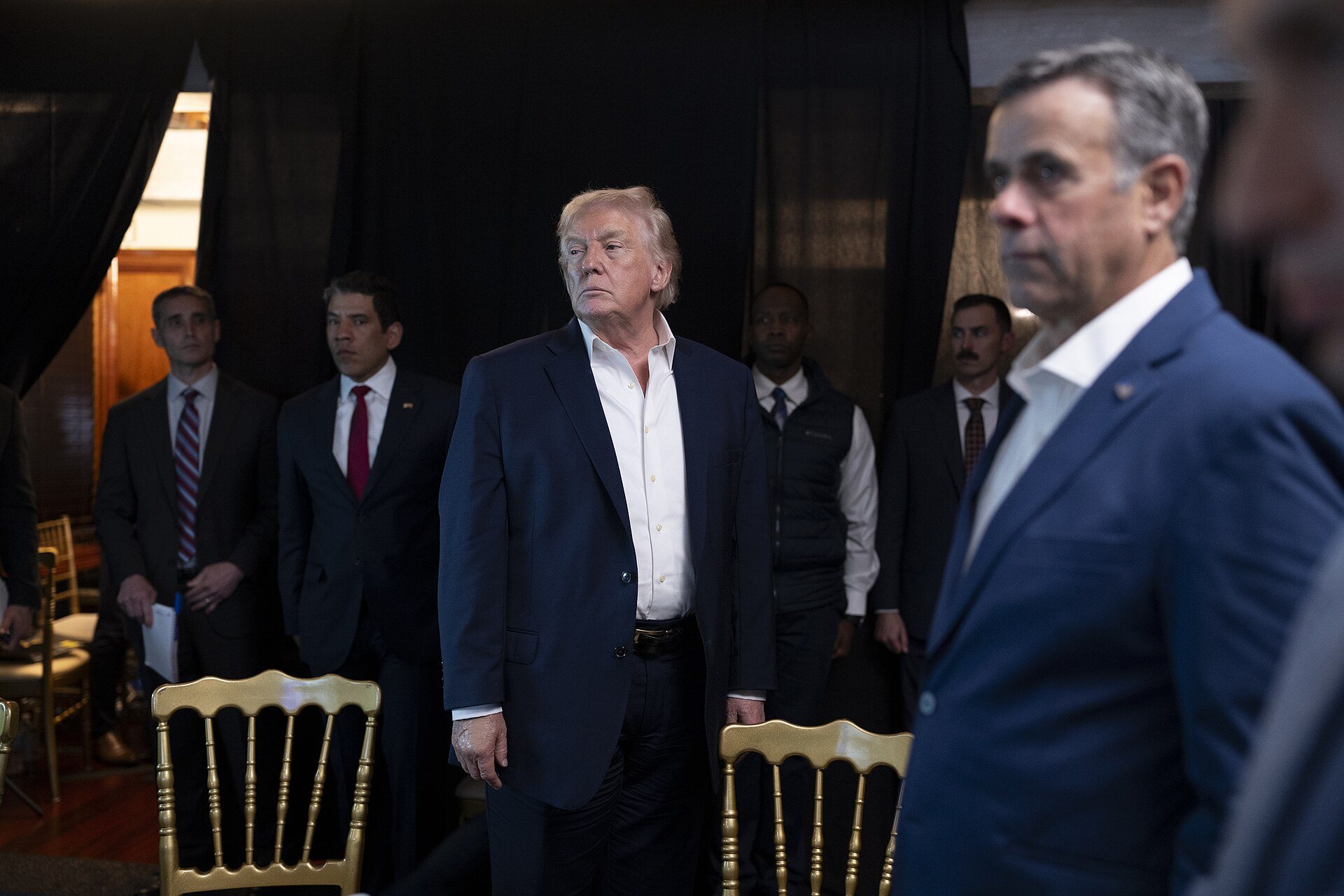
Photograph Source: Official White House Photo by Molly Riley – Public Domain
Shortly after Donald Trump was elected president for the first time, someone asked me in a public forum whether I thought he was a fascist. I replied that Trump was an ultra-nationalist conservative who would attempt to privatize public services, further empower the oligarchs, and reverse many liberal social policies – but that two essential aspects of fascism were missing from his MAGA agenda. One was a commitment to conduct aggressive wars against “inferior” nations deemed to threaten the security of the Sacred Homeland. The second was the militarization of domestic society, accompanied by uncontrolled executive power, widespread denials of civil rights, and campaigns of state terror against the Leader’s real or fancied opponents.
These two aspects of fascism, as Hannah Arendt pointed out 50 years ago in The Origins of Totalitarianism, are organically related. Techniques of conquest and domination of subject populations used in imperialist wars are brought back home by the warmakers and become essential tools of domestic governance. First the fascists decapitate, divide, and conquer the “shithole” nations (to quote Mr. Trump.) Then they do the same to “shithole” elements of their own nation’s population.
This process has not, in my view, been completed in the United States. Despite Trump’s gross misuses of executive power, MAGA’s dehumanizing policies, and the violent excesses of ICE, domestic militarization has not yet reached the point of state terror against most American citizens. But the direction of these policies is unmistakable. The attack on Venezuela on the heels of U.S.-financed genocide in Gaza is a clear step in the direction of a fascistic foreign policy whose pursuit generates global warfare.
What obscures this reality at present and muddles media coverage of the situation is Trump’s invocation of the Monroe Doctrine (aka the Don-Roe Doctrine) to justify his sharp turn toward interventionism. Yes, he has abducted the Maduros, killed Venezuelan and Cuban soldiers, declared himself the owner of Venezuela’s oil, destroyed or captured ships and crews sailing from Venezuelan ports, threatened the rulers of Colombia, Cuba, Mexico, and Brazil, and promised to take over Greenland. He has also intervened directly and through proxies in the Middle East, Ukraine, Africa, and elsewhere. Even so, many commentators conclude that Trump’s intention is to exercise military power primarily in the U.S.’s Caribbean and Latin American “backyard,” while other regional hegemons such as China and Russia do as they wish in their own spheres of influence.
This bully-boy version of multipolarity may satisfy members of the MAGA coalition who want to believe that the would-be Nobelist will remain true to his original promise to avoid “endless wars.” It has even gained acceptance among some analysts at the mainstream foreign policy journals and NGOs. To accept this regional focus, however, means shutting one’s eyes to the history and dynamics of imperialism.
History. Amid the deluge of articles and broadcasts covering Trump’s Venezuelan adventure, one finds few analyses comparing U.S. aggression with the imperial wars of the 1930s: in particular, Japan’s seizure of Manchuria, Mussolini’s invasion of Ethiopia, and Hitler’s interventions in Central Europe and in the Spanish Civil War. But the analogy is startling. Like Trump’s recent actions, these were short-term, asymmetrical assaults against nations resisting domination by a regional hegemon. Their impact was minimized by characterizing them as limited wars conducted in some imperial power’s sphere of influence. But today we understand that they were also significant steps toward world war.
How come? Why doesn’t this sort of violence remain in the regional backyard instead of generating global conflict? The first reason is that these interventions target imperial competitors, not just local resistors. Italy’s war in Ethiopia was aimed at British interests in the Horn of Africa, Japan’s aggression in Manchuria at Chinese and Russian interests, and Germany’s machinations in Europe at Western and Russian interests. Forty years later, Richard Nixon and Henry Kissinger overthrew the Allende regime in Chile and installed Pinochet’s dictatorship because they considered Allende a potential Soviet (and Cuban) ally. Similarly, Trump’s overarching aim in Latin America is to limit the growing influence of China (and the less substantial influence of Russia) on that continent.
Dynamics. Don-Roe doctrines aside, the apparent local focus of operations like the Venezuela attack is an illusion. The fact that the major target is a competing empire compels other nations in the affected region to choose sides – a polarizing process that tends to create armed multinational blocs and a bipolar world order. Barbara Tuchman’s classic work, The Guns of August, shows exactly how this operated to produce the unbelievably destructive “war to end all wars” in 1914. We are likely to see such polarization take place with increasing intensity over the next few years in Latin America, Africa, and East Asia.
But that’s not all. Imperial powers prevented from acquiring essential industrial resources in regions claimed by their competitors tend to retaliate by seizing control of other regions where those resources can be obtained. In 1931 Western attempts to weaken and contain the Japanese led the Tokyo regime to manufacture a “false flag” incident in Manchuria to seize that nation’s coal and iron. A decade later, Japanese imperialists conquered Vietnam, Indonesia, and Malaya to secure the oil, rubber, tin, and other industrial materials monopolized by French, Dutch, and British imperialists in what had been considered up to then a European backyard.
The moral? All modern empires are global. The U.S and its rivals are not like the ancient empires that conquered weaker nations as a kind of sport, extracting tribute from their rulers, but generally leaving subject peoples to their own devices. Modern empires are late-capitalist powers driven to compete globally for essential industrial materials, markets, and investment opportunities, and compelled to “develop” or transform the societies that they dominate. There is no way that their ruling classes can remain in their own backyards – and when they go abroad (as they must, to maintain their own viability), they go armed to the teeth.
Liberal as well as conservative commentators may hate to admit it, but Lenin’s work on imperialism got this right. For limited periods of time, while issuing threats of violence and engaging in covert operations, the empire-builders may manage to negotiate their differences “peacefully.” But these periods of relative quiescence do not last. Unable to solve global problems that their own profit-dominated systems exacerbate – problems like radical social inequality, human-caused climate change, and mass migration – they employ threats of war and war itself as their favored methods of conflict management. They call this strategy “peace through strength,” but we understand that what they really mean is Empire First, by any means necessary.
The fact that warfare is now entirely industrialized and that weapons of mass destruction, including nukes, are proliferating at a dizzying pace does not alter these dynamics. Nor does the existence of a sadly weakened United Nations provide much hope that inter-imperial conflicts can be controlled before they become part of another run-up to global violence. Once again, history sets off alarm bells that anyone not deafened by present-day cacophony should be able to hear. It was precisely when the League of Nations proved unable to stop Japan’s, Italy’s, and Germany’s localized aggression that the Kellogg-Briand Pact outlawing war as an instrument of national policy – a treaty signed by almost all the world’s nations – became a dead letter. Then and now, intensified regional imperialism was a symptom of impending global war.
Donald Trump’s interventionism thus represents a significant turn toward fascism – but its significance is already being minimized not just by MAGA cultists, but also by a large cross-section of establishment liberals, centrists of both parties, foreign policy mavens, and the corporate media. Devoted to the dogma of “peace through strength,” Democratic Party leaders like Chuck Schumer and Hakeem Jeffries are unable to criticize Trump’s military adventures, except to complain that he doesn’t consult Congress as he should and sometimes acts “recklessly.” With Iraq in mind, the New York Times editors warn that attempting to occupy nations that don’t want to be occupied is a bad idea. But if Trump gets away with seizing Venezuelan oil without provoking a guerrilla war, destabilizing Cuba without a new Bay of Pigs attack, setting up his colonialist “Board of Peace” for ruined Gaza, or absorbing Greenland by means of threats and bribes, we will not hear a word of serious criticism from the advocates of U.S. “world leadership.”
Whether anti-Trump or pro-Trump, our imperial misleaders and their corporate partners ignore the connections between regional warmaking, the militarization of domestic society, and the increasing likelihood of world war. That’s the bad news. The good news is that Trump’s increasingly unhinged and unapologetic interventionism is waking people up on a wide variety of fronts. Empire, imperialism, and the military-industrial complex are no longer taboo words and concepts. Even Marjorie Taylor Greene understands that Trump’s promise to be a good isolationist was a lie and that the current frenzy of U.S. military interventions is a symptom of an empire in decline.
Meanwhile, the citizens of Minnesota and several other American states are learning what it feels like to be subjects of imperial domination. The masked, armed agents of ICE, acting out of fear and rage in an increasingly hostile environment, could as well be descending on Fallujah as on Minneapolis. It will take a while longer before our awakening becomes general, but this will happen, I hope and pray, before Trumpian violence generates an irreversible movement toward world war. To quote the banner that appears at the conclusion of Stanley Kramer’s 1959 anti-nuke movie, “On the Beach,”
“THERE IS STILL TIME . . BROTHER.”
The post Trump’s Ignoble Interventions: How “Regional Imperialism” Leads to World War appeared first on CounterPunch.org.
From CounterPunch.org via this RSS feed