

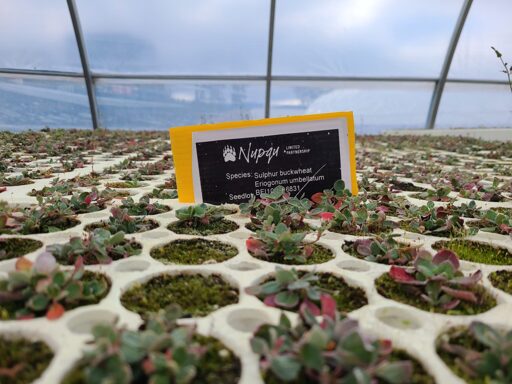
CRANBROOK, British Colombia | At the Nupqu Native Plant Nursery in the Canadian province of British Columbia, sulfur buckwheat seedlings fill Styrofoam trays. It’s October, the end of the growing season, and each is just a small cluster of dark-green, waxy, oval leaves, undersides bleeding to purple. Sulfur buckwheat (Eriogonum umbellatum) is a high-altitude grassland species and one of the most in-demand species for restoration of highly degraded land, says Melanie Redman, the nursery’s seed specialist. But it’s also notoriously tricky to propagate. It usually takes two to three years to coax the plant from seed to seedling. This year, however, the nursery has managed to get the whole process down to just one year. Nupqu, which means “black bear” in the Ktunaxa language, is a wholly Ktunaxa-owned land and natural resource management company, part of a number of businesses jointly owned by the four Ktunaxa First Nations in Canada and the Ktunaxa Nation Council. Five years ago, the company acquired an existing native plant nursery, located on the ʔaq̓am reserve, and has since been building up expertise and capacity. The Nupqu Native Plant Nursery, which says it’s the largest Indigenous-owned native plant nursery in Canada, now cultivates more than 60 plant species. Most are grown from seeds collected on the Canadian portion of the Ktunaxa’s traditional territory, which stretches over 70,000 square kilometers (27,000 square miles) across the Kootenay region of what is now British Columbia. It’s a land of jagged peaks, high alpine meadows, grasslands, dappled forests, fish-bearing…This article was originally published on Mongabay
From Conservation news via this RSS feed