

This is an edition of The Atlantic Daily, a newsletter that guides you through the biggest stories of the day, helps you discover new ideas, and recommends the best in culture. Sign up for it here.
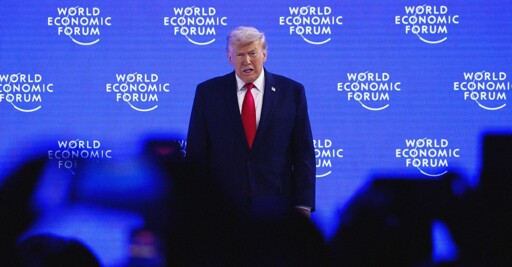
“Without us, right now you’d all be speaking German,” Donald Trump scolded European leaders at the World Economic Forum this morning. Perhaps the Germans have a word for the experience of watching your country’s leader embarrass himself and the country on the global stage.
Where does one start in summarizing such a speech? The straightforward racism? The economic illiteracy? The determination to alienate allies? The many moments where the president said things that were blatantly, provably false? And because he rambled through more than an hour, he covered a lot of ground.
The most anticipated section was about Trump’s ongoing effort to acquire Greenland. Trump argued that only the United States could defend the island, which he perplexingly also dismissed as “a giant piece of ice” and accidentally called “Iceland” on a few occasions. He also said Greenland was essential for the “golden dome” missile-defense system he claims he will build. (He denied that the U.S. is after rare-earth minerals in Greenland.)
Although Trump insisted that he has the utmost respect for both Danes and Greenlanders, nothing else he said evinced any. He accused them of being ungrateful for the U.S. defense of Greenland during World War II and argued that the American government erred when it “gave it back” after the war. Trump delivered a classic mafioso threat to take Greenland by force, saying that U.S. military might was irresistible, before adding nonchalantly that he would not do such a thing. This was not as reassuring as some headlines might lead readers to believe. And he said that if European leaders didn’t acquiesce, “we will remember.”
More broadly, he assailed NATO, saying that the U.S. had spent heavily on the alliance and gotten nothing in return. Although Trump’s push to get NATO countries to spend more on defense has been successful, he still does not grasp that NATO is an expression of American might, not a drain on it. The group has made much of Europe into vassal states that have supported and extended American foreign policy around the globe. Trump also repeatedly said he doubted that the NATO allies would aid the U.S. if called to do so. This statement must come as a surprise to the many members who supported the United States after 9/11—the only time in history that NATO’s mutual-defense clause has been invoked. (My colleague Isaac Stanley-Becker reported last week on the Danish soldiers who died in Afghanistan.)
Trump seemed determined to alienate allies. He mockingly imitated French President Emmanuel Macron’s accent. He took a swipe at Canadian Prime Minister Mark Carney. He ridiculed the United Kingdom as too incompetent to extract oil from the North Sea. “Sitting on one of the greatest energy sources in the world, and they don’t use it,” he said. But he continued his administration’s outreach to Europe’s far right, blasting immigration to the continent. “Certain places in Europe are not even recognizable, frankly, anymore—they’re not recognizable, and we can argue about it, but there’s no argument,” he said. He claimed that prosperity and progress in Europe and North America were a result of a shared culture that was incompatible with immigration. (Never mind that Trump seems eager to demolish the pillars of cooperation between the U.S. and Europe.)
But Trump’s speech also had a domestic audience; in the lead-up, the White House insisted that his aim was to talk about affordability, which is fast becoming the “infrastructure week” of the second Trump term: frequently promised, never delivered. Trump did meander through some talk of the economy, though his explanations were often too circuitous or false to be very persuasive. Like his predecessor Joe Biden, whom he repeatedly insulted during the speech, he hasn’t figured out how to validate voters’ dim view of the economy without taking blame for it. He celebrated oil drilling (while lying about gas prices); he flogged his plan to cap credit-card interest rates (which Republican congressmen have criticized); he bragged about killing clean energy (while falsely claiming that China does not use wind farms). Most of all, he defended his use of tariffs (which raise costs for American consumers) and complained about trade deficits. Like Trump’s skewed understanding of NATO, this obsession fails to grasp that trade deficits are evidence of America’s massive wealth, not a sign of weakness. His efforts to reduce them, though, are likely to isolate the U.S. and sap that wealth.
Naturally, the president didn’t stay on message. Trump also announced (without offering details) that he would soon prosecute people for a supposedly “rigged” 2020 election. He reprised a racist riff from yesterday’s White House press conference about Somalis having low IQs, and he called Representative Ilhan Omar, a Somali immigrant and Minnesota Democrat, a “fake congressperson.”
After all of this, the president abruptly delivered a boilerplate conclusion about unity and cooperation among nations. This kind of swerve is baffling unless you’ve spent a lot of time watching Trump campaign rallies, in which case it’s very familiar. Trump has no interest in calibrating his tone or approach to different audiences. This can make his speeches painful to watch, but it may also be illuminating in this case. Global leaders in politics and finance who otherwise wouldn’t spend their time watching full Trump stump speeches got the stump speech to come to them—providing a good reminder of exactly who the president is.
From The Atlantic via this RSS feed
You must log in or # to comment.