


By Aaron Kirshenbau, World BEYOND War, January 21, 2026
Early on Saturday, January 3rd, Venezuela was attacked on behalf of oil, mineral, tech, and weapons profiteers in a regime change operation. Since then, the Trump administration has threatened Iran, Greenland, Cuba, Colombia, and Mexico. What unites these threats? The U.S.’s quest for endless resource extraction to power its increasingly deadly global empire. And it’s not slowing down. These resource wars and “operations” are emerging as the AI drive also ramps up. In July, Palantir and the Pentagon signed a 10-year, $10 billion agreement. This increasingly inextricable partnership between AI and the war economy is throwing us into a fast track of climate and environmental chaos that threatens us all.
In August, I learned about an AI program created by the U.S.-armed Israeli military called “Where’s Daddy.” The program is designed to track individuals Israel is targeting in order to kill them at home with their families. In October 2023, the AI war giant Palantir entered into a contract with the Israeli military. Since 2021, the Israeli Occupation Forces have been working with tech companies like Google on AI programs such as Project Nimbus, used to surveil and murder Palestinians. “Where’s Daddy” and other overlapping systems represent the newest phase of this. The program characterizes the families of these alleged combatants as “collateral damage” and is often far from accurate, killing entire families without the “intended targets” even being there. The tech companies developing these programs do not have anyone’s “safety” or “security” in mind; they are solely motivated by profit. This cruelty is no surprise— these companies are the same ones building toxic data centers across the U.S., largely in Black and Brown communities, in the newest phase of environmental injustice.
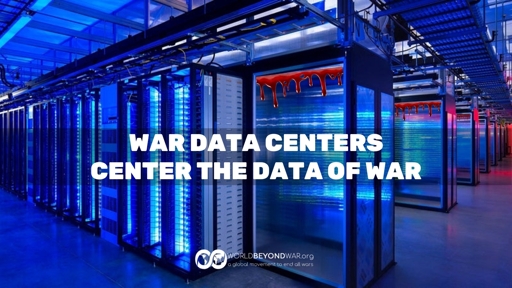
We’ve been hearing about AI more and more as it enters the commercial market in increasingly pervasive ways. In particular, much has been reported on about AI data centers entering communities and the opposition to them. Many of these fights have been taken up by environmental organizations; it’s estimated that data centers could consume approximately 21% of global energy by 2030. In order to sustain this energy use, data centers need cooling. Mid-sized data centers use as much water as a city of 50,000 people. Meta’s Hyperion data center in Louisiana is projected to use as much water as the entire city of New Orleans. Another Meta center in Cheyenne, Wyoming, is projected to use more power than the state of Wyoming itself.
These centers not only increase electricity bills for communities that can’t afford them, but they also generate significant air, water, and noise pollution. Some centers regularly use diesel “emergency” generators to meet increased demand. Each generator is the size of a railcar, and thousands are littered across data center hotspots like Northern Virginia. As a result, toxic chemicals are seeping into the lungs of residents, causing asthma and long-term illness. Data centers are known to create noise pollution, with constant hums that can lead to hearing loss, anxiety, cardiovascular stress, and a host of other long-term issues. Furthermore, equipment is certain to break down and lead to toxic waste and electronic pollution.
“Critical” minerals are required for the operation of these data centers. The process of obtaining these minerals, supposedly also used for green technology, requires the militarization, destabilization, and total plunder of mineral-rich regions. These minerals are supposedly “critical” for energy transitions, and some have advocated more “sustainable” methods for maintaining data centers through “green” technologies.
The use of these minerals is clear: The Pentagon recently became the largest shareholder in MP Minerals, one of the largest mining companies in the Western Hemisphere. Why? Aluminum for fighter jets. Titanium for missiles. And copper, lithium, cobalt, and many others for data center batteries and semiconductors. The more data centers are built, the more minerals are needed. This process of extraction has murdered millions in the Congo, destroying the soil, water, and forest: one of the largest “lungs” of the planet. It has led to the newest phase of imperialist aggression on Venezuela, a mineral-rich country with the largest oil reserves in the world (oil, of course, is also essential for data centers). Additionally, it has led to the attempted subordination of the Philippines to semiconductor production. The U.S. also seeks to use the archipelago as an “unsinkable aircraft carrier” for the U.S.’s looming war with China, its largest competitor in the AI and mineral race.
These are the impacts we already know to be devastating. But this is also new technology, which means there’s a lot we don’t know and a lot that’s being intentionally hidden. Lack of transparency is the norm in this industry. As data centers rapidly expand and buy up land around the country, the actual companies behind them hide behind non-disclosure agreements. This is not dissimilar to the intentional concealment of the military’s role in global emissions, enacted through U.S. pressure at the third U.N. Climate Change Conference in 1997. Decades later, the issue of militarism is still left out of climate conversations.
The parallel makes sense, considering how the AI industry has fused with the war machine. The U.S. military is one of the most environmentally destructive forces on the planet. In its oil consumption alone, the U.S. military is the world’s largest institutional polluter. The U.S.’s 800+ bases in 80 countries globally are known to regularly leak jet fuel and cancer-causing PFAS chemicals, along with a toxic cocktail of hundreds of other chemicals. While training exercises like RIMPAC in the Asia-Pacific region authorize the deaths of thousands of sea creatures, in environmental sacrifice zones like Camp Lejeune in North Carolina, toxic waste from military facilities has killed infants hours after birth. In bomb testing sites like Vieques, off the coast of mainland Puerto Rico, lung cancer and bronchitis rates have been shown to be 200% higher than on the mainland for men, and 280% for women. And the oil-motivated “war on terror” emitted 1.2 billion metric tons of carbon dioxide from 2001-2017.
Now we are entering a new era of resource wars that will further destroy the planet as the AI race with China accelerates. The relationship between AI and the U.S. military goes beyond the Pentagon’s contracts with Palantir, Meta, and Microsoft: last June, executives Shyam Sankar (Palantir), Andrew Bosworth (Meta), Kevin Well (OpenAI), and Bob McGrew (Thinking Machines Lab, previously OpenAI) were sworn into the U.S. Army as lieutenant colonels. Michael Obadal, executive of the AI-war manufacturing company Anduril, is now the Under Secretary of the U.S. Army, still with hundreds of thousands in Anduril stock. Peter Thiel, co-founder of Palantir, is himself a major funder of Anduril. In June 2025, OpenAI, Google, xAI, and Anthropic entered into $200 million contracts with the Department of War. The more you look at the partnerships between such companies and their executives, the Pentagon, governmental departments, and other entities, the more tangled this military-tech-industrial complex all becomes.
Many organizing groups are rightfully building power against the data centers that literally fuel it all, pushing for increased regulation and transparency. At the same time as Palantir makes new deals with the Pentagon, regulations in sacrifice zones are being thrown out the window. On December 18th, the House of Representatives passed a bill backed by Microsoft, Micron, and OpenAI to fast-track data centers. The bill significantly reduces the number of environmental and financial factors that can be considered in permitting processes. It’s simple. These communities are becoming the Camp Lejeunes of a new age: the new toxic waste dumps in the belly of the beast used to power the war machine. They must be fought against at all costs.
Regulation is crucial. It’s also far from a long-term solution. There is a lot that we don’t know, because a lot is hidden: just how much of these companies are tied up with weapons manufacturers, the Pentagon, and proxies like Israel; the environmental destruction caused by military usage of AI; the specific usage of all of these data centers. But it is obvious that AI is becoming inseparable from war-making, that increased AI means increased war-making, and that increased war-making is resulting in new and increased forms of unfathomable environmental destruction to communities around the world and here within the belly of the beast.
AI has been creeping up our necks. The horrific “Where’s Daddy” program existed long before I heard of it. It seems like these products are popping up in every corner of the market before we can even start discussing them. Their emergence has been intentionally designed to not only conceal their role in environmental destruction, but also their role in the militarism destroying communities from Virginia to Gaza.
No part of this is sustainable — not the war economy, not unending extraction, regardless of how much “green tech” it produces, and not an AI-driven speculative economy. We cannot afford to have splintered conversations either; these AI and tech companies are war profiteers. The new Cold War on China drives this. The genocide in Palestine drives this. The war on Venezuela, Latin America, and the Caribbean drives this. And so our organizing must be unified against both the impacts and the causes. Against data centers and the wars that drive them. We need to stop the blood. But we can’t lose sight of why and how the bullets are fired.
Aaron Kirshenbaum is CODEPINK’s War is Not Green campaigner and East Coast regional organizer. Based in, and originally from, Brooklyn, New York, Aaron holds an M.A. in Community Development and Planning from Clark University. They also hold a B.A. in Human-Environmental and Urban-Economic Geography from Clark. During their time in school, Aaron worked on internationalist climate justice organizing and educational program development, as well as Palestine, tenant, and abolitionist organizing.
The post War Data Centers Center the Data of War appeared first on World BEYOND War.
From World BEYOND War via this RSS feed
You must log in or # to comment.