

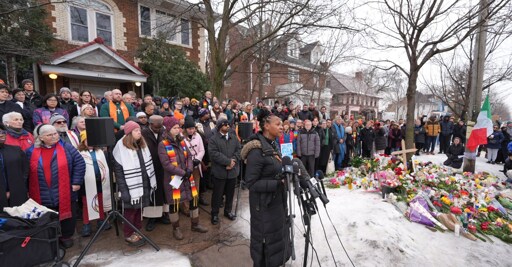

Minister JaNaé Imari addresses the crowd at a press conference held by community faith leaders on January 8, 2026, in Minneapolis. | Jerry Holt/The Minnesota Star Tribune via Getty Images
It’s a recurring feature of anti-ICE protests: the presence of pastors, priests, and reverends on the front lines of demonstrations, and behind-the-scenes, organizing in their communities.
Key takeaways
Religious leaders in Minnesota have been both publicly and quietly tending to their communities in the wake of ICE and DHS surges to the state as part of the Trump administration’s mass deportation agenda.Many view this moment as a time for moral clarity and resistance. But not every congregation or denomination is responding in the same way.There’s every reason to believe this dynamic will intensify so long as ICE continues to operate in the state.
In Chicago last year, religious leaders were pepper sprayed or shot with pepper balls. In Minneapolis this month, they’ve joined protesters in calling for restraint from federal agents and humane treatment of immigrants. And nationally, there is growing realization from some leaders of the need for moral clarity and pushback to the Trump administration.
But religious leaders and their followers aren’t all reacting in the same way to the federal government’s mass deportation surges.
A recent anti-ICE protest in St. Paul, which interrupted a service at a Southern Baptist church with alleged ties to US Immigration and Customs Enforcement, grabbed national attention, sparked outrage from the religious right, and impelled the White House to promise arrests and investigations. And it also triggered responses from some Christian leaders who have been more reticent to criticize the administration.
To break down these divisions and the different ways that religious leaders in and beyond Minnesota are responding, I decided to ask an expert. Jack Jenkins is a national reporter for the Religion News Service, where he covers religion and politics. He spoke to me in between trips to Minneapolis, where multifaith leaders will be meeting this week to organize and discuss ways to tend to their communities and respond to ICE’s presence.
Our conversation has been edited for length and clarity.
I want to start off with a bird’s-eye view. Can you describe how religious communities, both believers and their leaders, are responding to ICE’s presence in Minnesota right now?
I spent most of my time in Minneapolis and it is much easier to find someone who is vehemently opposed to ICE than the opposite. I think for a lot of faith communities there’s an immediate concern for the people they serve.
For instance, pastors that oversee immigrant-heavy congregations. I spoke to a pastor out there; that’s a lot of stress. They are also very much organizing, but for a variety of reasons that organizing isn’t necessarily public. And it’s relatively rare for a lot of those pastors to be even as public or talking to the press because of concerns for their community. And that’s not just Christian pastors, that’s also imams because the Somali American community also has become a target of this administration.
Then there is also this piece of religious communities that are not as at risk, not as vulnerable, who’ve been very involved in pushback to ICE and to DHS agents. That runs the gamut. There’s one church in particular who helps gather food and supplies to feed large numbers of immigrant families that are afraid to leave their homes in the midst of heavy DHS presence in the region. A lot of churches are involved in that kind of effort.
There’s also more direct acts of resistance too, though, aren’t there?
Yes. I rode along with a pastor who was involved in patrolling the neighborhood where she lives, which happens to be the same neighborhood where Renee Good was killed, looking for DHS agents. In the hour and a half that I rode along with her, we spotted likely DHS agents at least twice as they were driving by being tailed by other cars that were honking horns and blowing whistles to alert the community.
Even after Renee Good was killed, there were multiple clergy that ran to the site of the killing, including that same Unitarian minister, Reverend Ashley Horan, who lives a block away, to try to provide some level of immediate response. Both that pastor and another were shot at or hit with pepper spray or pepper powder.
But when I was patrolling that area with that pastor, every other corner had somebody with a whistle around their neck looking out for DHS. Faith groups are very much a part of that.
Does there seem to be any difference in how faith leaders or communities within the state are responding compared to how voices nationally are talking about this?
“We are seeing far more faith leaders get directly involved as cities are targeted.”
Religious pushback to President Trump’s mass deportation agenda began on day one.
There was that sermon that Bishop Mariann Budde, the Episcopal bishop of Washington, gave at the Washington National Cathedral with Trump sitting in the pews in front of her asking the president to have mercy on immigrants. That drew headlines. Religious pushback to his immigration policies hasn’t let up since. We’ve had two popes criticize Trump’s immigration policies. Pope Leo specifically addressed concerns about whether detainees in Chicago were being granted access to faith leaders.
But what’s interesting is what has happened as the administration has launched concentrated efforts in various cities. Early on, I covered a pastor in Southern California where apparent DHS agents showed up on her church property. She ran out and filmed them, demanding they leave. Similarly in California, a pastor got a call that two parishioners were being detained. He ran out and filmed the DHS agents while questioning them.
As these campaigns moved from LA to Portland to DC to Chicago to North Carolina, faith leaders have told me they were in conversation with clergy in cities targeted earlier, training them and sharing information about how to push back against ICE and DHS. When Border Patrol had an influx of agents in Charlotte, within 24 to 48 hours, hundreds of people packed churches hosting ICE watch trainings. Those trainings had actually been planned months earlier.
We are seeing far more faith leaders get directly involved as cities are targeted. Chicago was a good example, where faith leaders were arrested at one protest outside a DHS facility. That likely wouldn’t have happened without these concentrated campaigns.
I want to ask about the outrage after the ICE protest that interrupted a church service in St. Paul. What happened?
The allegation, which I cannot independently confirm, is that one of the pastors of that church is also head of a local ICE or DHS office. Old versions of the church website list him as having been involved in law enforcement. That appears to have been the impetus for that protest.
What followed was interesting. Even religious leaders critical of DHS were uneasy with the nature of that protest and said so publicly. At the same time, many were frustrated by the administration’s reaction and by conservative Christian responses, because dozens of faith groups have opposed DHS actions, have signed onto lawsuits against the administration for claims of violations of religious freedom.
In Chicago last year, viral footage showed DHS agents shooting a Presbyterian minister in the head with pepper balls. I’ve spoken to several pastors who’ve been hit with pepper spray or pepper balls. By my count, between eight and 10 pastors over the last year. That Presbyterian minister, Reverend David Black, was part of a lawsuit that won a temporary restraining order based on religious freedom claims.
Some faith leaders argue there’s a selective concern for religious liberty. One activist involved in that St. Paul protest said, paraphrasing, that houses of worship are either sanctuaries or they’re not. Who gets attention for religious freedom concerns has become a running theme.
What about Catholic leaders? I’ve seen criticism about when they do or don’t speak up, against Trump, specifically some of the most vocal Catholic bishops, like Robert Barron, a conservative leaning Catholic media mogul, and the bishop of the diocese of Winona-Rochester in Minnesota.
It’s very rare to see a bishop involved in a protest. That’s why it stood out when an auxiliary bishop in Chicago participated in a demonstration outside a DHS facility over detainees being denied access to priests. There is also a lawsuit filed by Catholic organizations, priests, and nuns on that issue.
There’s been an awkward dance where the pope has often spoken louder and faster than local bishops. The US Conference of Catholic Bishops has issued a critical statement and video opposing the administration’s immigration policies, and the conference has sued the administration before.
Now Bishop Barron is an interesting figure. He sits on the president’s Religious Liberty Commission and has enormous influence. When concerns were raised about detainee access to priests, Barron joined in voicing concern, but later emphasized that he was not criticizing the administration.
There’s increasing tension inside the bishops’ conference. Groups of bishops are issuing statements independently on immigration. That didn’t use to happen. It reflects deeper division over how to respond to the president’s immigration agenda.
Why does that division exist?
Some bishops occupy different institutional positions. Sitting on a federal religious liberty commission is different than leading a diocese. Holding leadership within the USCCB conference matters. Since Pope Francis and now Pope Leo, the pope has often been more vocal than the conference as a whole, which creates tension. Now that there is an American pope from Chicago, those tensions are sharper.
Let me ask you about a quote from a bishop in New England. You spoke to him because he attracted attention for telling other faith leaders that the time is coming when they may have to to “put [their] bodies on the line.” What did he mean by that?
When I spoke to the Episcopal bishop of New Hampshire, who said clergy should get their “wills in order,” he told me he’s said similar things in the past around gun control advocacy. He was seconded by the Episcopal bishop of Minnesota. In Chicago, more than 200 faith leaders signed a letter referencing putting their bodies on the line.
Many reference Selma, the protests and marches of the civil rights movement, clergy who were killed there, and figures like Bonhoeffer, the Lutheran pastor who was ultimately killed for his part in an attempt to assassinate Adolf Hitler. Many faith leaders I speak to say those in more privileged positions should go first because they are least vulnerable. If faith leaders aren’t doing it, they argue, then who will?
Should we expect more of this?
I’m about to return to Minneapolis for a gathering of clergy from around the country. They are explicitly likening it to a call to Selma. As long as the administration continues targeted campaigns in cities, I would expect more of this.
From Vox via this RSS feed
You must log in or # to comment.