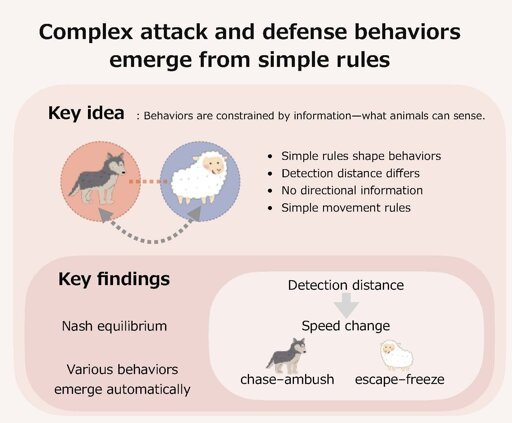
Animal survival depends on effective attack and defense strategies, yet how these behaviors arise remains unclear. Addressing this question, a recent study shows that predator and prey behaviors emerge naturally as stable patterns shaped by simple sensory abilities and motor rules. These patterns correspond to Nash equilibria—states in which neither predator nor prey can improve its outcome by unilaterally changing behavior—providing a theoretical framework for understanding predator–prey interactions.