
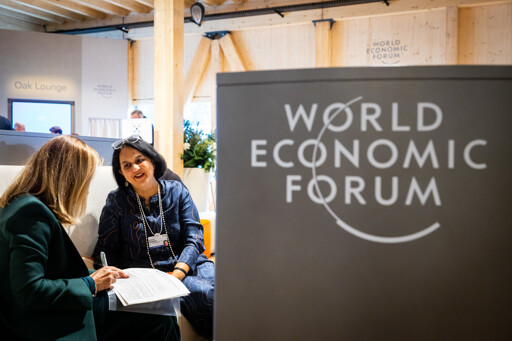
US President Donald Trump grabbed the headlines again at the World Economic Forum, launching his “Board of Peace” for Gaza on the final day of the gathering of political and business leaders. But discussions on climate and energy continued below the media radar.
Climate Home New has been listening in – here are some of the best bits.
Occidental boss: Banks “coming back” to oil and gas
Banks which have previously refused to fund oil and gas projects are “coming back” to the industry, an American oil executive told an event at Davos on Thursday.
Vicki Hollub, CEO of Occidental Petroleum, the world’s 28th most polluting company, said in a conversation with US Energy Secretary Chris Wright that “there was a time” when banks shunned her industry. That, she added, had been a “burden”.
“But some of those banks are now coming back – and in fact I talked to one yesterday that had kind of abandoned us and now are back and wanting to do business in the oil and gas industry,” she said, without revealing the name of the bank.
A report by the London School of Economics last year found that many banks weakened their policies against fossil fuel lending in 2025 and the Net Zero Banking Alliance shut down in October 2025, after many – particularly American – banks left the green initiative.
Azeri oil chief says no spare cash for green tech
European investors appear to have been slower to abandon their climate commitments. Rovshan Najaf, president of SOCAR (the State Oil Company of the Azerbaijan Republic), told a separate Davos panel that his company struggles to get financing from most European commercial banks for its oil and gas operations.
As a result, he said, the firm must use its available cash to fund oil and gas projects – “one of the priority areas” – leaving it with little free capital to invest in lower-carbon fuels like green hydrogen and ammonia, or emissions-reducing technologies such as carbon capture or methane abatement.
Recent COP hosts Brazil and Azerbaijan linked to “super-emitting” methane plumes
Unlike renewables and electrification, there is still no commercial case for funding those potential breakthroughs at scale and making them affordable, he added.
“There should be a big picture approach to all energy mixes and how we can free up the capital [for decarbonisation],” he argued.
Najaf promised last year that the firm would achieve near-zero methane emissions in its oil and gas production by 2035. But, as Climate Home News reported recently, the latest data available from SOCAR shows that its methane emissions more than tripled from 2023 to 2024, when the country hosted COP29.
 Jan 21, 2026 News
Climate at Davos: Clean tech powers on despite policy wobbles
Al Gore says climate policy may be suffering “a recession” in many countries – but the energy transition continues apace, driven by falling costs for renewables and batteriesRead more Jan 20, 2026 Politics
Climate at Davos: Energy security in the geopolitical driving seat
While climate change is a lower priority for leaders at this year’s World Economic Forum, control of energy supplies and minerals is a hot topicRead more Jan 15, 2026 Politics
Ahead of Davos, climate drops down global elite’s list of pressing concerns
In the short term, leading business people, academics and politicians are more worried about geoeconomic confrontation than extreme weatherRead more
US promotes fossil gas to “ally” Europe
One key reason why SOCAR has been investing in more gas production and export capacity is deals with European governments to help replace Russian gas after the invasion of Ukraine in 2022.
At Davos, Wright praised Europe for being close to independence from Russian gas, saying it could achieve that goal in the next year or two.
He called for the EU to weaken its environmental regulations on methane – a particularly potent greenhouse gas – to enable American fossil gas to displace Russian supplies.
Despite President Donald Trump’s recent threats to take over Greenland, which have caused a growing rift with European leaders, Wright insisted Europe is “our main ally in defending the Western world”.
The US supplies about a quarter of the EU’s gas imports, a percentage which has risen since Russia’s invasion of Ukraine.
But overall, the EU’s gas imports are declining and are predicted to keep falling, as the continent moves towards clean energy. On Thursday, data published by think-tank Ember showed that wind and solar generated more EU electricity than fossil fuels in 2025, producing a record 30% of EU power, ahead of fossil fuels at 29%.
“New era of climate extremes” as global warming fuels devastating impacts in 2025
On climate change, Wright played down the threat, saying that deaths from extreme weather have declined over the last 100 years.
While floods, droughts, storms and heatwaves are becoming more frequent and intense as the planet warms, Wright is correct in saying they have caused fewer deaths over this long time period.
This has largely been the result of economic development and, more recently, climate resilience measures of the kind the Trump administration has drastically reduced US funding for.
The post Climate at Davos: Oil execs bemoan “burden” of bank boycotts appeared first on Climate Home News.
From Climate Home News via this RSS feed