

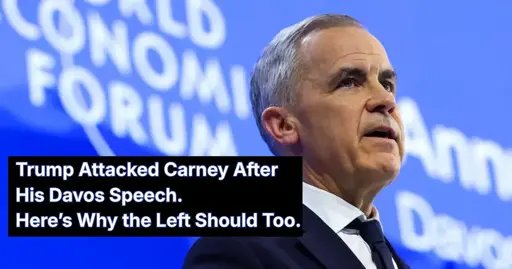

By Hussan, S.K., January 23, 2026
1. The Empire Has Always Lied
Carney’s speech is presented as something new. A rare acknowledgement that the “rules-based international order” has always favoured the powerful and was enforced selectively. This is presented as rupture. A final honest reckoning with reality.
But it’s not news to most of us. Gaza, Sudan, Afghanistan, Cuba, Haiti. The wretched of the earth have always known the rules were fake. We were bombed and sanctioned, not protected.
Carney’s speech is not moral clarity. It’s that this hypocrisy has begun to inconvenience middle-power elites, not just the global poor.
The problems Carney describes are real. Economic coercion by great powers. Weaponized supply chains. The collapse of institutions that once provided some predictability. Trump’s tariffs are not imaginary.
The question is what comes next and who it serves.
Carney’s answer is a controlled confession. The lie is named so that the Canadian ruling elite can reposition themselves inside a harsher world. Not so the harm ends. The violence continues. It is just administered with fewer illusions.
This is risk management for a declining order.
2. The Sign in the Window Is Not About Workers
Carney’s central metaphor comes from Havel’s story about a shopkeeper living under communism who hangs a sign he does not believe in. “Workers of the world unite.” In Carney’s telling, the problem is not exploitation. It is performance. Symbols without conviction.
When he calls for “companies and countries” to take their signs down, he is not speaking to workers or movements. He is speaking to elites.
For those of us who do believe that workers of the world should unite, the message is clear and it is a threat. This future is not for our emancipation. It is for rulers who want to rule without pretending otherwise.
3. Carney Is Proposing the Same Old
Carney talks of “value-based realism.” Speak the language of human rights, sovereignty, and international law but without naïveté. Work with those where you are not value aligned so long as interests align.
This is not a break. It is a continuation. Values remain optional. They are invoked when cheap and set aside when costly. They are mobilized against enemies and not used against friends.
“Variable geometry” means different coalitions for different issues. Defence here. Minerals there. AI somewhere else. When everything is strategic, everything is exempt. Labour rights get traded for market access. Environmental limits get waived for energy security. Migrant justice disappears when borders need hardening.
This is not democratic multilateralism. This is elite deal-making.
4. Doubling Down on Elite Power
Carney talks about “building strength at home.” Which he explains as tax cuts. Capital incentives. Deregulated internal trade. Fast-tracked trillion-dollar investments in energy, AI, minerals, and corridors.
Strength does not mean housing, wages, or democratic control. It means subsidizing capital, accelerating extraction, and concentrating decision-making at the top.
“Fast-tracking” at this scale will not deepen democracy. It will suppress Indigenous consent in the name of urgency. It will destroy the climate and attack workers.
He offers up Canada as a place that has what the world wants. And is ready to sell.
We know what this means. Extraction on Indigenous land. Corridors built through communities. Surveillance infrastructure. All of it justified as resilience or security.
This is not transition. It is extraction rebranded.
And none of it addresses the actual needs of working people. Housing and grocery costs are crushing families. Healthcare is collapsing. Real wages have stagnated for decades.
Carney’s answer is to make Canada more attractive to global capital. Not to meet human needs.
5. This Is a Call to War, Not Peace
Carney celebrates doubling defence spending and building domestic defence industries. He frames it as realism. A country that cannot defend itself has no options, he says.
This massive militarization creates its own logic. Defence industries need contracts. Arms manufacturers need markets. And once you have built the capacity, you find reasons to use it.
Carney is clear. He is not walking away from the empire. He wants Canada to stay at the table. More NATO buildup. Boots on the ground in the Arctic. Submarines and radar and aircraft.
The left answer is not pacifism in the face of aggression. It is collective security rooted in disarmament, not rearmament. It is rejecting the logic that says every threat requires more weapons. It is building power through solidarity, not through military capacity that will be used to discipline movements at home and abroad.
Carney’s militarization will not make us safer. It will make us poorer and more repressive.
6. This Is About the Ruling Elite of the Middle Powers
Carney argues that middle powers have the most to lose in a world of fortresses. He is right.
Superpowers will dominate. The global poor already suffer. What is newly threatened is the leverage and comfort of ruling classes in countries like Canada.
Carney’s response is to protect the interests of that class. By leveraging state resources. By building new alliances. By repositioning Canada in a multipolar world.
This language will have popular appeal precisely because it mobilizes genuine frustrations toward elite solutions. People are anxious. They see economic insecurity. They see American bullying. They want a government that fights back.
Carney offers them economic nationalism. A stronger state. A Canada that stands up for itself.
This is the danger. His framework can mobilize genuine frustrations while directing them toward solutions that entrench elite power.
We need to ask ourselves: What do we do about trade coercion? How do we build economic independence without nationalism? How do we respond to war without militarization?
We need public ownership of key industries. Not subsidies to private capital. Democratic control over investment decisions. Not fast-tracked approvals. International solidarity with workers and movements. Not elite deal-making with authoritarian regimes.
This is not utopian. It is the only realism that does not require the rest of us to pay the price.
7. Carney Is A Banker
Carney is clear about what he will not do. There is no redistribution at scale. No public ownership. No demilitarization. No debt cancellation. No reparations. No limits on capital. No binding climate constraints.
These are not omissions. They are boundaries. His realism has edges and they align neatly with the interests of capital and the security state.
Our survival looks different. Housing. Healthcare. Climate justice. Labour power. Migrant status. Indigenous sovereignty. Peace.
Climate justice means reparations and technology transfer. Indigenous sovereignty means rejecting extraction as a national strategy. Labour power means binding international standards. Migrant justice means stopping displacement elsewhere. Peace means demilitarization and collective security rooted in meeting human needs, not protecting capital flows.
Historically, when states prioritize competitiveness and security, they rely on discipline. Wages restrained. Strikes limited. Borders hardened. Dissent reframed as risk.
Resilience in this framework is something done to people. Not built with them.
This is not living the truth. It is choosing which truths remain off the table.
The ruling classes of the middle powers are repositioning. They see the world clearly. They are naming the collapse of the old order. They are preparing for what comes next.
We need to do the same. But our preparation looks different. It is international solidarity. It is democratic control. It is meeting human needs.
Carney is offering a path. We need to build another one.
The post Trump Attacked Carney After His Davos Speech. Here’s Why the Left Should Too. appeared first on World BEYOND War.
From World BEYOND War via this RSS feed