

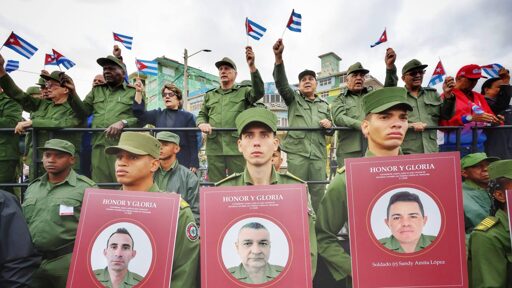
Cuba honored 32 soldiers who fell in combat with the US army on January 3 in Venezuela, carrying out security activities legally agreed upon with the Caracas government. Many of the Cubans killed were part of the personal security detail of Venezuelan President Nicolás Maduro, who was kidnapped after the attack and transferred to the United States. Hundreds of thousands of Cubans attended the ceremonies commemorating the fallen in what the Cuban government described as a new attack against the Revolution.
But not all Cubans who fought against US forces died. Little by little, the testimonies of Cuban soldiers who survived a clearly uneven fight have been revealed.
The testimony of a surviving combatant
Among them is Yohandris Varona Torres, who gave an interview to Adelante, a Cuban media outlet. Varona had been in Venezuela for just over two months as a security guard until the day of the intervention, where, according to Venezuelan authorities, 100 people died and 100 more were injured.
“We fought there against the planes that were firing at us. Even though our weapons were smaller, we didn’t stop fighting; we confronted them. I am trained, and I know how to fight, but they were superior to us. At that moment, my only thought was to fight. We had to shoot, and I started doing so,” said Varona during the commemoration ceremony for the fallen combatants.
Regarding his personal experience during the attack, Varona stated that despite the narrative that the mainstream media tried to impose, the forces on the ground did confront US troops: “That night, I had gone on duty at midnight and was supposed to be there for six hours. The attack took place at approximately 2:00 a.m. It was dawn. Everything was dark. If a helicopter comes at you, the only thing you can do is shoot at it and defend yourself. That’s how it was. We were shooting until the very last moment.”
Varona also spoke about the huge technological gap between Venezuelan and US forces. The same argument had already been made by Cuban President Miguel Díaz-Canel, who explained the difference in weaponry and military infrastructure between the troops defending Venezuelan soil and the US attackers.
In addition, Varona said that after the attack, there was dispersion, and that there was no timely support to collect their dead compatriots: “Our comrades are a glory for all of Cuba. They were my brothers. They were working with me. I saw them all fall, and I carried them all. There was no support from anyone for that, but nobody was left on the field. We preserved them in one of our dormitories. I cannot explain the pain. But at least no one was left in Venezuela. Here they are, in our homeland.”
In the face of threats of possible new aggression against Cuba, during his speech to the crowd honoring the dead, Díaz-Canel said that revolutionaries are willing to fight to the bitter end if a similar or worse attack were to occur against the island. In the same spirit, Yohandris Varona Torres declared: “I will always be at my country’s disposal to fight the enemy wherever necessary. That is what the Commander [Fidel Castro] taught us. And the deaths of my comrades cannot be in vain.”
The post “Even though our weapons were smaller, we didn’t stop fighting”: the testimony of a Cuban combatant after the US attack on Venezuela appeared first on Peoples Dispatch.
From Peoples Dispatch via this RSS feed