

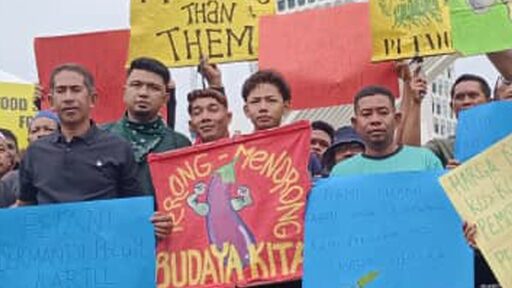
On January 20, scores of farmers, members of Indigenous communities, and activists in Malaysia rallied in Kuala Lumpur to oppose the government’s decision to join the International Union for the Protection of New Varieties of Plant (UPOV), calling the move detrimental to national interests.
Protesters mobilized under the banner of the Socialist Party of Malaysia (PSM), shouting slogans including “seed is not a commodity, it is the life of a farmer,” and opposed the proposed amendments to the Protection of New Varieties of Plants Act 2004.
The Ministry of Agriculture and Food Security has proposed amendments to national seed regulations in order to align the country’s law with the UPOV Convention. The planned changes are a mandatory condition for membership in the Geneva-based organization.
Protesters denounced UPOV, describing it as an organization formed under the pressure of European seed corporations to further their interests at the expense of farmers’ and Indigenous peoples’ rights.
Several leaders, including PSM chairperson Michael Jeyakumar Devaraj, addressed the protesters, underlining the possible implications of Malaysia joining UPOV. The speakers asserted that surrendering to the dictates of the organization is equal to compromising the country’s sovereignty and accepting colonial rule.
Surrendering sovereignty
According to PSM, signing the UPOV Convention would cripple the government’s role. “Any country wishing to join UPOV must first submit its national Plant Variety Protection (PVP) law to the UPOV Secretariat for review. UPOV will then recommend amendments to make that law consistent with the UPOV 1991 Act,” points out a statement issued by PSM and others.
The statement underlined that since “UPOV uses a rigid legal template that must be followed,” this would lead to a complete surrender of the government’s right to intervene when needed to protect the rights of their farmers or local biodiversity.
This “undermines parliamentary sovereignty and restricts Malaysia’s policy space to safeguard national interests — including the rights of local farmers and the public at large.”
Activists claim that since UPOV is neither a part of the UN nor attached to the World Trade Organization (WTO), the Malaysian government’s move to join makes no sense at all.
PSM has also launched a signature campaign in order to increase pressure on the government to stop the legal process of amending the seeds law, and start a wider consultation with farmers and other stakeholders on the matter.
Seed is not a commodity
The UPOV Convention extends monopoly rights to plant breeders for 20-25 years and severely restricts “farmers’ rights — farmers are not free to save, use, exchange, or sell seeds harvested from their own fields,” the PSM statement claims.
Joining UPOV will also “criminalize the traditional and free exchange of seeds among farmers, Indigenous peoples, and communities,” harm local biodiversity and crop diversity, and create corporate monopolies over seeds and increase their prices, ultimately endangering food security in the country, release continues .
“Seeds are the first link in our food chain. When control over seeds is lost, our food sovereignty, culture, and health are put at risk. Communities that have protected and shared seeds for generations must not be criminalized,” the party said.
In a conversation with Peoples Dispatch, Bawani KS, deputy secretary-general of the PSM, said it is natural for people to be worried about the government’s move. Joining UPOV would only “expand agribusiness corporations’ monopoly while denying our farmers their right to use and share protected seeds.”
This would ultimately lead to “increased seed costs and food prices; heighten the risk of bio-piracy; and undermine the rights of Indigenous peoples and farmers” she underlined.
Asserting that attempts to turn food into a commodity must be resisted by all, PSM called for greater unity behind the movement.
The post Malaysian farmers warn of threats to country’s seed and food sovereignty appeared first on Peoples Dispatch.
From Peoples Dispatch via this RSS feed