

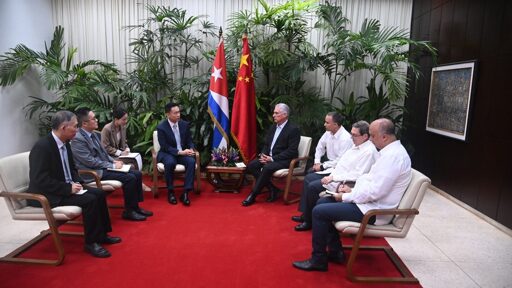
The January 3 attack on Venezuela by the US military profoundly transformed the dynamics in the region, especially in the Caribbean. Following agreements reached between the Venezuelan government led by Delcy Rodríguez and the Trump administration, Cuba was forced to quickly seek solutions to its economic crisis.
For more than 60 years of economic and trade blockade by Washington, Cuba has managed to survive thanks to the support of allied governments, which have provided support for the revolutionary process. During its existence, the USSR supported the island with machinery and goods in exchange for the sale of sugar and other products. After the fall of the USSR, Cuba has navigated a prolonged economic crisis thanks to the support of governments such as China and Vietnam, among others.
However, during the 21st century, Hugo Chávez and Venezuela became a lifeline for the Caribbean island. Despite threats from the United States and the tightening of sanctions against Havana, Venezuela decided to sell oil and other products in exchange for the various services that Cuban professionals could offer in the South American country.
However, the Trump administration seems determined to stifle the Cuban economy at all costs. According to reports, several of the Venezuelan oil tankers seized by US forces in the Caribbean Sea were bound for Cuba, sending a strong and clear message to the government of Cuban President Miguel Díaz-Canel.
“NO MORE OIL OR MONEY FOR CUBA — ZERO! I strongly suggest they come to an agreement BEFORE IT IS TOO LATE,” Trump said on Truth Social.
Now that Washington has forced the Venezuelan government to stop selling oil to Cuba, Havana has had to turn to other allies who have promised their help. Among them is China, which has pledged food and financial aid to the revolutionary government in Havana.
China’s aid
Beijing’s aid includes the delivery of 60,000 tons of rice to Cuba, the first part of which arrived on the Caribbean island on January 20. Cuban Deputy Prime Minister Oscar Pérez-Oliva said: “We deeply appreciate and are grateful for this aid at a difficult time, when levels of aggression are rising, and the United States’ economic, commercial, and financial blockade against the Cuban people is intensifying in an unprecedented manner.”
For his part, Chinese Ambassador to Cuba Hua Xin said the aid “embodies the deep bonds of special friendship between the two nations.” He added: “We deeply understand that true friendship is revealed in times of greatest need… [China] has always been Cuba’s most steadfast partner… every grain of rice delivered today embodies the unwavering commitment of the Chinese people.”
In November last year, China sent six shipments of food by air. In 2025, Beijing sent essential supplies to the island, including solar lamps, roofing materials, and mattresses. In addition to aid, Chinese President Xi Jinping approved financial assistance amounting to USD 80 million.
Russian diplomats visit Cuba
Russia has also maintained friendly ties with Cuba despite the collapse of the USSR. On January 21, Russian Interior Minister Vladimir Alexandrovich Kolokoltsev, accompanied by a delegation of Russian officials and military personnel, held talks with Díaz-Canel in Havana.
The Russian Interior Minister said that the meeting was held to exchange opinions and views on the complex global situation following the US attack on Venezuela.
This visit comes after Putin’s recent statement affirming that Russia “will continue to provide assistance to our Cuban friends, standing in solidarity with their determination to defend their sovereignty and independence by all means.”
As can be seen, Havana has made its moves to find a way to overcome the new obstacles that the Trump administration has placed in its path. Once again, the resilience and resistance of the Cuban people will be put to the test in the face of US power, which, since the beginning of the Cuban revolution, has done everything possible to destroy it.
The post China and Russia reaffirm commitment to Cuba appeared first on Peoples Dispatch.
From Peoples Dispatch via this RSS feed
You must log in or # to comment.
That means so so much. Just ask Venezuela, or Iran.