

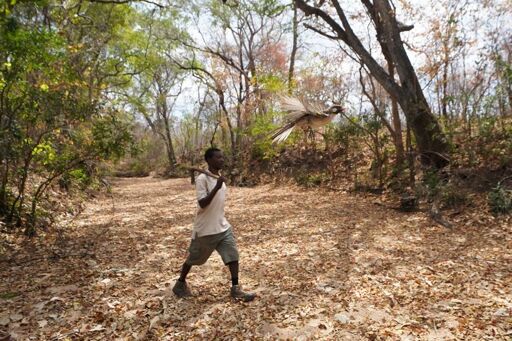
In northern Mozambique, local honey-hunters use vocal signals to communicate with wild honeyguide birds to locate and harvest honey. New research finds that human calls used across the region vary, but the birds learn these subtle differences and continue to cooperate with their human partners, guiding them to wild bees’ nests. The study focused on Mozambique’s 42,000-square-kilometer (16,000-square-mile) Niassa Special Reserve, where honey-hunters work with greater honeyguides (Indicator indicator), small brown birds that eat larvae and wax. With a bird’s-eye view, honeyguides locate bees’ nests and lead honey-hunters to them. People then use tools to open the nest for honey and leave behind the exposed wax and larvae for the birds. This ancient partnership can be found in a handful of areas across Africa. Niassa honey-hunters use three distinct calls to attract their bird partners. Two function as “recruitment calls,” attracting the birds’ attention, while a third “coordination call” keeps them engaged once the hunt is underway. Researchers examined recordings of 131 honey-hunters from 13 villages. The three principle calls involved combinations of shrill whoops, low trills and grunts, and the presence or absence of whistles. The calls varied between villages and those differences increased with distance between communities, much like human dialects. If honey-hunters move to live in other villages, they adopt the local calls, behavioral ecologist Jessica van der Wal, the study’s lead author, told Mongabay. “If a certain village is using a different call,” said van der Wal, “it probably means that’s the call to get the…This article was originally published on Mongabay
From Conservation news via this RSS feed