

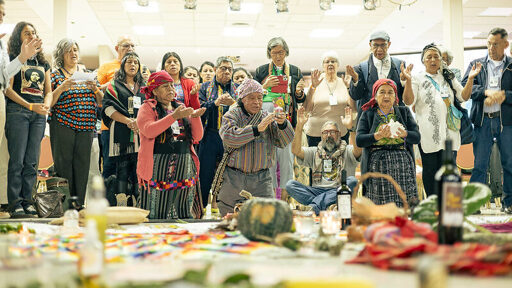
Right to health networks are preparing for the upcoming meeting of the World Health Organization’s (WHO) Executive Board with a series of in-depth discussions on key agenda items, organized under the umbrella of the Geneva Global Health Hub (G2H2). On January 19, the People’s Health Movement (PHM) launched this discussion cycle with a conversation on WHO’s Global Plan of Action (GPA) for the Health of Indigenous Peoples – an early draft of which Executive Board members will review between February 2 and 7.
In recent years, the health of Indigenous peoples and ancestral medicine have received greater attention in global health forums, following decades of grassroots organizing and advocacy. The document to be reviewed next month builds on discussions from 2023, reflecting growing recognition of Indigenous peoples’ right to the highest attainable standard of health. At the same time, the speakers at the event – as well as the documents under discussion – acknowledged that Indigenous communities continue to face more vulnerability than others, underscoring the need for concerted efforts to realize this right. The draft GPA is thus being developed through consultations, a participatory approach long advocated by civil society within the WHO. As signaled by PHM’s Lauren Paremoer, this has generated cautious optimism among activists.
Read more: World Health Assembly resolution on the health of Indigenous peoples is a landmark moment
Ultimately, however, responsibility for the plan’s expected adoption in 2027 lies with WHO Member States, emphasized Alia El-Yassir, Director of WHO’s Department of Gender, Rights, Equity and Sexual Misconduct Prevention. As she walked participants through the current draft and next steps, El-Yassir stressed that many proposed measures – such as ethical data collection and support for Indigenous community members pursuing jobs in health care – require further development and commitment by national governments.
While referring to persistent health inequities faced by Indigenous populations, including higher maternal and infant mortality, higher prevalence of chronic and infectious diseases, and lower life expectancy, El-Yassir also situated these outcomes within broader systems still shaped by colonization and structural racism.
Bolivian Indigenous leader and PHM member Dr. Vivian Camacho echoed these concerns, reflecting on the ongoing marginalization of ancestral knowledge and medicine in spaces dominated by perspectives from the Global North. While traditional medicine has been particularly disparaged, Camacho argued that market-driven approaches to health undermine all forms of health work. “If it’s Western modern medicine or traditional ancestral medicine, it should be a human right, not merchandise, not business,” she said, reiterating a longstanding PHM position. “Without social justice, none of us will have health.”
Read more: 5th People’s Health Assembly calls for the transformation of health systems
Indigenous knowledge, participants noted, has not only been sidelined but also exploited for commercial gain, with catastrophic results. This point was raised by Putira Sacuena of Brazil’s Secretariat of Indigenous Health, who cited the example of açaí – a fruit with health-promoting properties that has been recently so aggressively commercialized that it has contributed to environmental degradation in its native ecosystems. The extractivist dynamics that have accompanied the appropriation of ancestral knowledge in the West, speakers agreed, represent serious dangers for both climate justice and planetary survival.
As a result, discussions at the WHO have implications beyond Indigenous communities alone. Over time, they may contribute to a reinvention of health systems and care with the wellbeing of people in mind. However, this outcome should not be taken for granted, Tido von Schoen-Angerer from the Complementary and Integrative Healthcare Coalition cautioned, noting that some WHO Member States, particularly European states, had previously shown limited understanding of alternative systems.
Read more: Silenced voices: intercultural perspectives in the prevention, preparation and response to pandemics
PHM’s discussion concluded with a renewed call to continue campaigning for Indigenous participation in all health-related decision-making processes and to strengthen collaboration between progressive organizations in global health. “It is not interculturality to continue foreign programs imposed on our people, but to have a respectful dialogue between both modern Western medicine and traditional ancestral medicine,” Camacho said. Invoking the legacies of left physicians such as Ernesto Che Guevara and Salvador Allende, she emphasized the need for continued struggle. “From the Global South, we must keep speaking out, because we are places that have been colonized, and we are resisting with our own ways and views.”
People’s Health Dispatch is a fortnightly bulletin published by the People’s Health Movement and Peoples Dispatch*. For more articles and subscriptions to People’s Health Dispatch, click* here.
The post What’s in the WHO’s draft plan for Indigenous peoples’ health? appeared first on Peoples Dispatch.
From Peoples Dispatch via this RSS feed
You must log in or # to comment.