

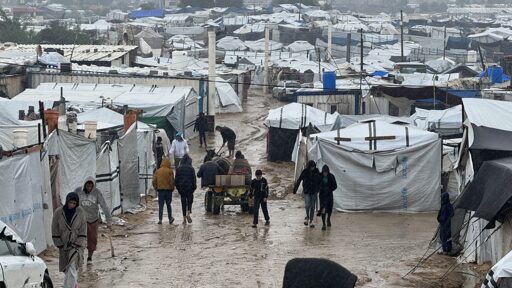
Health conditions in Gaza remain critical as the Israeli occupation, despite the ongoing so-called ceasefire, continues to undermine the provision of health services and access to care. Over recent weeks, health workers have recorded a rising number of infectious disease cases, with children, older people, and those with pre-existing health conditions at particular risk of further complications.
Dr. Ahmed Muhanna from Al-Awda Hospital told The New Arab that “a widespread increase in infections has been observed, particularly among children.” Dr. Mohammed Abu Salmiya of Al-Shifa Hospital added: “The danger lies in the weakened immunity of people in Gaza due to famine, malnutrition, and the lack of necessary vaccinations, which has created a serious threat to patients’ lives.”
“Food, shelter, a protective family, healthcare, and education. Those are the five essential things every child needs,” pediatrician Dr. Tanya Haj-Hassan insisted in an interview with the Institute for Palestine Studies (IPS). “And in Gaza, every single one of these has been targeted.”
Read more: This is not a ceasefire: the Israeli genocide continues
Some public health experts have described the genocide-created living conditions in Gaza that fuel disease as “wet tent syndrome,” a term referring to the interrelated effects of immune deficiency, infections, and the inability to recover due to the destruction of housing and infrastructure. According to UN sources, at least ten children have frozen to death this winter in tents where most of the Strip’s population has been forced to live during the genocide. Organizations including Physicians for Human Rights (PHR) have repeatedly emphasized the disproportionate impact of Israeli destruction on children and pregnant women – amounting to a premeditated assault on Palestinians’ basic reproductive capacity, according to a new report.
“The destruction of Gaza’s health infrastructure, combined with restrictions on food and medical supplies including baby formula, has created an environment in which the fundamental biological processes of reproduction and survival have been systematically destroyed, resulting in known and foreseeable harm, pain, suffering and death,” the PHR report states.
Read more: Intergenerational hunger: the effects of Israel’s starvation of Gaza
Gynecologists who worked in Gaza during the genocide told the organization that all women they treated – “pregnant or not” – were malnourished. Others described their experiences upon returning to health institutions that had been besieged and raided by Israeli occupation forces, confirming the conviction that Palestinian healthcare itself is a target. “Kamal Adwan had one of the only functioning neonatal ICUs in the North at the time,” a health worker who witnessed the destruction in early 2025 recalled. “There were incubators that had been smashed and strewn about. The whole facility was destroyed.”
Researchers and activists continue to stress the deliberate nature of Israel’s destruction of Palestinian healthcare. In this context, Layth Malhis of the IPS has advanced the concept of “de-healthification” to analyze and counter this strategy. According to Malhis, de-healthification is “a systematized regime that transforms health from a protected public good into a field of coercion,” a process that has reached a new phase during the genocide in Gaza but has existed throughout the occupation. “Under settler-colonial rule,” Malhis writes, “these mechanisms unfold through both slow administrative violence and punctuated military destruction, ensuring that the capacity to heal is continually withdrawn.”
Read more: Dr. Ghassan Abu Sitta: “Israel was able to weaponize life itself”
Since October 2023, Israel’s systematic assault on Gaza’s healthcare sector has contributed directly to the deaths of tens of thousands of people. In less than three years, the genocide has reduced Gaza’s population by at least 254,000 people – around 10% of the total population.
There is no reason to believe that attacks on healthcare provision will stop in the near future, as US President Donald Trump and Israeli authorities persist in rolling out new aspects of the “ceasefire.” Approximately 18,500 patients, including 4,000 children, are still waiting for medical evacuation, while critical supplies remain extremely limited.
Instead, the occupation is adopting new tactics, including the coercion of international medical organizations operating in Palestine. On January 24, Doctors Without Borders (MSF) announced that it would share information about Palestinian staff with Israeli authorities in order to be allowed to continue operating in the occupied territories. The decision has drawn sharp criticism, with anonymized testimonies from MSF staff in Palestine warning of its consequences.
“Sharing names means not only targeting employees but also filtering who can continue working and who cannot,” one testimony, shared by surgeon Ghassan Abu Sitta on social media, warned. “Employees become targets not only of their livelihoods but also of their lives.”
“Knowing that the occupying authorities won’t stop there, the matter will escalate to targeting patients and their families, as well as the families of employees,” the testimony continued. “The occupation’s classifications of those it considers collaborators or not are based on no logic or right and wrong. This is all part of a genocidal plan that, although seemingly halted, has been ongoing for over 70 years and will continue.”
People’s Health Dispatch is a fortnightly bulletin published by the People’s Health Movement and Peoples Dispatch*. For more articles and subscription to People’s Health Dispatch, click* here.
The post Researchers warn of “de-healthification” in Palestine as infections spread in Gaza appeared first on Peoples Dispatch.
From Peoples Dispatch via this RSS feed
Weird way to spell “famine & plague”