

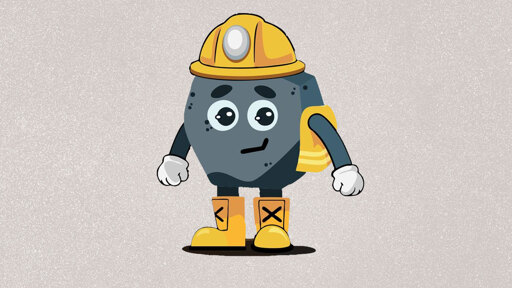
Can a lump of coal ever be … cute?
It’s a question no one was thinking about until last Thursday, when Interior Secretary Doug Burgum posted a cartoon of himself on X kneeling next to “Coalie” — a combustible lump with giant eyes, an open-mouthed grin, and yellow boots, almost like a carbon-heavy Japanese video game character.

Department of the Interior
It might seem like a strange mascot to promote what Burgum calls the “American Energy Dominance Agenda.”
“Especially for this administration, I would have expected a little bit more macho twist to it,” said Joshua Paul Dale, a professor of literature and culture at Chuo University in Tokyo, and the author of Irresistible: How Cuteness Wired Our Brains and Conquered the World.
In Japan, Dale said, seemingly everything gets a cute character attached to it — not just in TV shows and games, but also as part of government public relations efforts. This ultra-adorable aesthetic, associated with rounded shapes and huge eyes, is so common it has a name: kawaii. Even the Tokyo police department has an orange, mouselike mascot, with a disarming cuddliness that serves to make law enforcement feel softer and less threatening.
Coalie appears to do something similar, countering Burgum’s “mine, baby, mine” message with a kawaii-style innocence. “You know, it makes us feel more familiar,” Dale said. “It makes us want to get closer.” Those warm, fuzzy feelings come from how our brains are wired to respond to babylike characteristics. Give a character a round body, big eyes, and chubby arms and legs, and you can even make a lump of coal look huggable.
Coalie is just the latest in a long line of characters used by controversial industries, from tobacco to nuclear energy, that seem designed to make their risks feel less threatening — though they typically looked less cute, at least in the United States. David Ropeik, a risk expert, sees Coalie as part of a tradition of advertising strategies that widely disliked companies use to push back against criticism.
“It’s a common response from cultures that feel themselves under attack, looking for ways to make their case in a less than adversarial way to sell their point of view,” Ropeik said. President Donald Trump has been working on rehabilitating coal’s image as the administration tries to stall the fuel’s decline. Trump has even said he has a standing order in the White House for staff to use the phrase “clean, beautiful coal.” He explained why in November, saying, “It’s ‘clean and beautiful’ because it needs public relations help.”
Even cuteness can backfire, though, if people notice that an extra-adorable character is trying to coax them into liking something dangerous. Consider Pluto-kun, a cherubic mascot from the 1990s who promoted the Japanese nuclear company Tepco — at one point by cheerfully drinking a glass of plutonium as if it were harmless. The character attracted little attention until the nuclear accident at Tepco’s Fukushima plant in 2011, when people began resurfacing Pluto-kun online to point out the irony of its upbeat reassurances as the threat of nuclear disaster felt real and immediate.
Some felt a similar dissonance when Interior Secretary Burgum posted the image of Coalie. Chelsea Barnes, director of government affairs and strategy at Appalachian Voices, an environmental nonprofit, said the character was mocked by some of her friends and colleagues who work to support coal communities because of the serious damage they see firsthand from coal. “There’s nothing funny about climate change,” she said. “There’s nothing funny about black lung disease. There’s nothing funny about the water pollution that many people in Appalachia experience because of coal mining.”
Part of the problem was that the timing was bad, Barnes said. The day after Coalie showed up on Burgum’s social media feed, Trump signed a law that redirects $500 million in funding originally set aside for cleaning up abandoned coal mines to the Forest Service and federal wildfire management programs. On top of that, the administration has been trying to roll back safety programs for miners. To people who care about the health of people working in mines and living near mines, Barnes said, Coalie “comes across as a middle finger, in a way.”
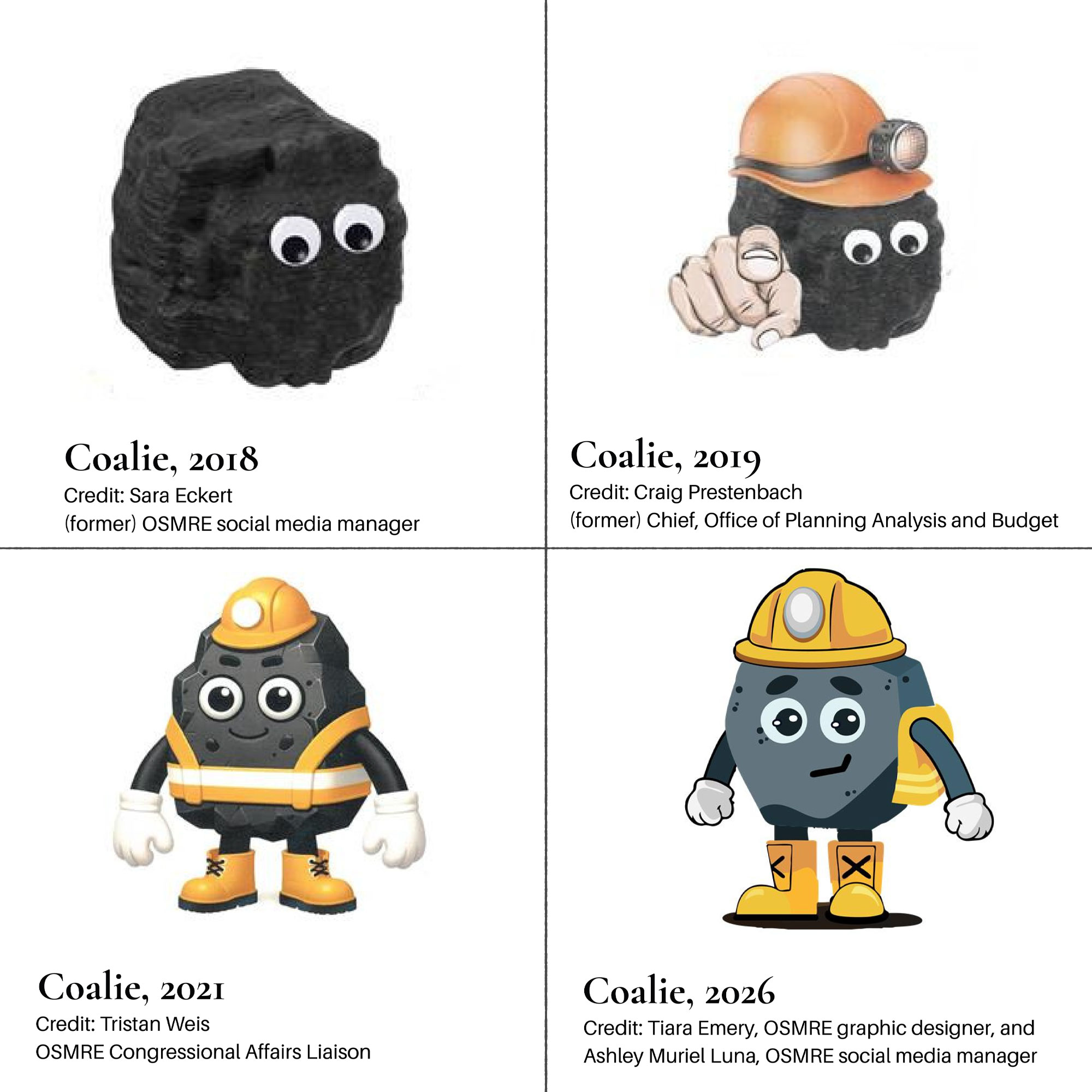
For Coalie’s creators, the backlash was a bit surprising, according to Simone Randolph, the communications director at the Interior Department’s Office of Surface Mining Reclamation and Enforcement, or OSMRE. The thing is, Coalie wasn’t initially intended as a mascot for “American Energy Dominance.” Its story actually started way back in 2018, when a social media manager at OSMRE put googly eyes on a picture of coal.
“Coalie” became a running joke in the office and an icon on their Teams channel, evolving into different versions over the years, Randolph said. “If you walk down our hallway in the D.C. office, people have pictures of Coalie on their doors.”
Grist / OSMRE
Despite the uproar over Coalie, Randolph hopes the mascot can help people learn about her obscure federal office. OSMRE oversees the permitting and regulation of the country’s coal mines and is responsible for cleaning up old, polluted mining land. The agency has transferred and authorized billions of dollars to restore mining lands for better uses — like what’s now the Pittsburgh Botanical Garden.
“So often, communication boils down to something that’s kind of bland,” Randolph said. “It doesn’t really catch the public’s attention. And so we were hoping to do something that would be a little bit more attention-grabbing.” Last week, OSMRE posted an explainer of its work using Coalie as a guide to walk readers through the agency’s responsibilities.
But the office’s character has notable differences to the version of Coalie that Burgum posted on X, which has tiny pink circles next to its eyes. Its features show a clear link to kawaii, an unusual move for an American institution, Dale said. It’s possible that it’s the result of somebody in Burgum’s department using AI to generate the image. In his own experimentation, Dale has found that AI will often add kawaii features to cute characters. Randolph said that OSMRE’s team uses AI tools, encouraged by Burgum, and that the version of Coalie he posted was designed to align with the secretary’s existing “Cartoon Doug” character.
Randolph said that it was an intentional decision to have the interior secretary introduce Coalie online, to bring more attention to OSMRE’s work. “The response has been extreme on both sides,” she said. “And my hope is that we can capitalize upon this moment to at least show the good work that is happening.”
This story was originally published by Grist with the headline Why the government is trying to make coal cute on Jan 29, 2026.
From Grist via this RSS feed