


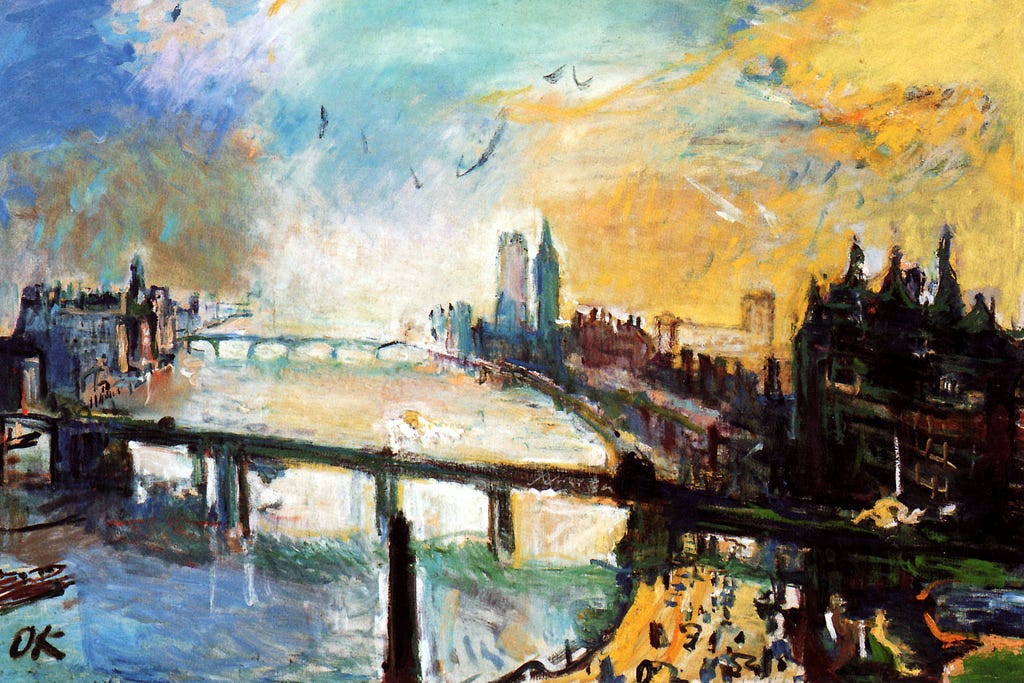
Thames Landscape by Oskar Kokoschka
Hello,
Welcome to Cultural Capital!
In The Times this week I wrote about one of my favourite defences of democracy (and one that feels especially pertinent at the moment) David Runciman’s book The Confidence Trap.
Runciman’s thesis, roughly, is that any given week in a democracy looks like a clown show of dithering, delay, u-turns, squabbling and complacency. But from the longer perspective the chaos is effective — a symptom of democracy’s capacity to criticise itself, to change tack, to spread its bets widely, keep its options open and correct its failures.
Democracies can just keep hitting “reset” in a way autocracies generally can’t. It looks like chaos (e.g. the last ten years of UK politics) in the short term. In the long term it’s often a kind of genius:
In 1917, the penultimate year of the First World War, France got through four prime ministers. This looked unforgivably amateurish — especially when compared with the authority of Germany’s “silent master” General Ludendorff. But after a series of duds France eventually landed on Georges Clémenceau, “Le Tigre” and the saviour of his country. Germany had no alternative to Ludendorff who would soon bring his nation to its knees.
Liz Truss was bad. But just imagine if she was our dictator for life.
Thanks for reading Cultural Capital! Subscribe for free to receive new posts and support my work.
Was Homer Simpson MAGA?This is very good fun (and also really interesting about how culture shapes politics). James Breckwoldt tracks how Simpsons characters would have voted over the last half century based on their demographic characteristics. Once upon a time, a middle aged, white union member like Homer Simpson would have been a nailed-on Democrat. Not any more. Bad news for liberal Simpsons fans:
Homer’s profile looks tailor-made for modern Republican politics: White, male, lower-middle-class, union-connected but not precarious, doing OK but not especially comfortable, living outside big metropolitan centres, and deeply sceptical of elites. This is the Trump voter.
Perhaps even more distressingly Mr Burns is now a democrat (at least based on his broad demographic characteristics):
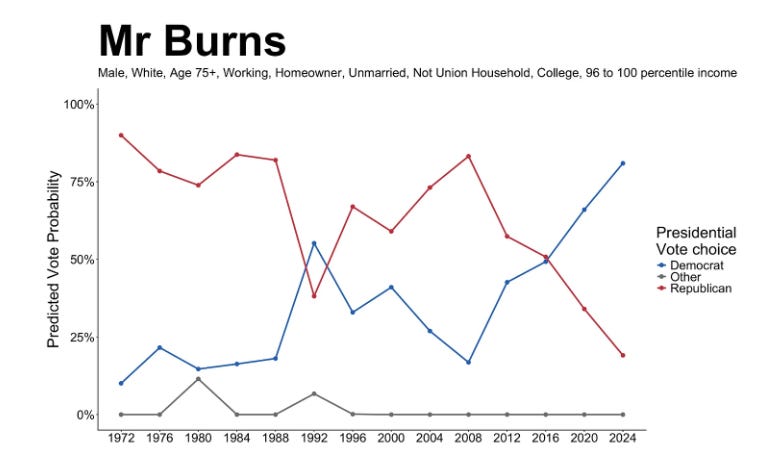
Breckwoldt says that’s symptomatic of the way wealthy “elite” voters have dramatically shifted over to the Democrats in recent years. The Republicans used to be the party of elite behaviour. Now that the party projects an uncouth, authentic, anti-elite image it tends to repel wealthy older voters like Mr Burns on cultural if not economic grounds. As Breckwoldt writes:
When Mr Burns meets Larry (his [estranged] biological son) he is deeply embarrassed, because Larry does not behave like the elite. He is uncouth, loud, unpolished, indiscreet and incapable of operating within the social codes Burns takes for granted. Burns ultimately rejects him not because Larry threatens his wealth, but because he threatens his sense of status.
Trump plays a similar role in American politics. He may promise tax cuts and deregulation, but his manner, language and disregard for institutional etiquette make him feel like Larry Burns in the Oval Office. For voters like Mr Burns, that is intolerable.
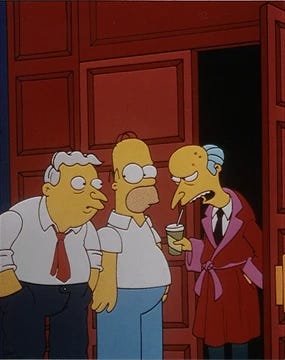
Mr Burns and his uncouth son Larry talk to Homer Simpson
Useless hunter gatherersI loved this nugget from Geoffrey Miller’s book The Mating Mind. Miller argues counterintuitively that big game hunting in hunter gatherer communities is motivated more by status competition among males rather than the actual need to provide food.
Female band members generally provide enough calories by gathering plants and catching small game. The men are just showing off and proving their sexual fitness to potential mates:
In the early 1980s, female anthropologists contributed to a corrective volume entitled Woman the Gatherer. They showed that in most hunter-gatherer societies women provide most of the sustenance, efficiently collecting plant foods and small game. The men often fail to bring any meat back from the hunt and often rely on their female partners for day-to-day sustenance. Trying to chase down large mammals that have evolved to run away from predators much faster than you is just not an efficient, reliable way to support yourself, much less your family.
Anthropologist Kristen Hawkes found that in the tribe she was studying, men have only a 3 percent chance per day of successfully killing a large animal. That’s 97 percent failure: not the stereotypical image of the cave-man bringing home the bacon. Data from other tribes shows slightly higher success rates, but they rarely exceed 10 percent each day.
I’m obviously not qualified to judge whether this is true though it’s a fun idea. And a useful illustration of Miller’s argument that evolution by sexual selection shapes humans in profound and unexpected ways.
The Mating Mind is superb by the way. One of the best evolutionary psychology books I’ve read. It’s about how evolution by sexual selection (as opposed to natural selection) shaped human intelligence and especially human creativity. Miller suggests that the amazing complexity of the human mind — with its capacity for art, humour, paradox, riddling and story telling — is analogous to a peacock’s tail and evolved as an extravagant sexual fitness indicator.
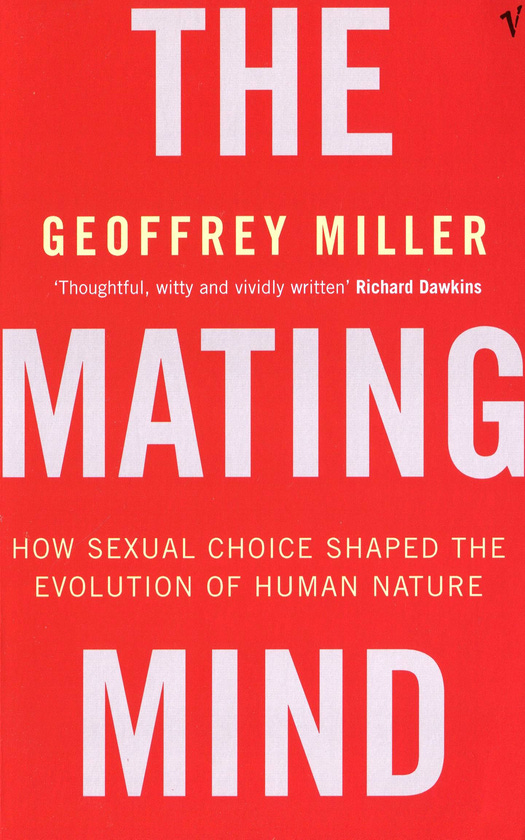
Strongly recommended
The self-immolation of the Washington PostThe self-destruction of the Washington Post, once a close rival of the all-conquering New York Times has been quite something to behold. Nate Silver lays it out starkly in this piece. Back in 2016 Washington Post leaned heavily into a liberal anti-Trump position, adopting the tagline “democracy dies in darkness”. But after the Trump vibeshift, Jeff Bezos pushed his paper dramatically in the other direction which has caused it to haemorrhage subscribers:
in October, 2024, Bezos quashed the paper’s planned endorsement of Kamala Harris…the timing was poor, and it understandably played into concerns about the increasing assertiveness of billionaires seeking to curry favor with the Trump administration and protect their financial interest. Around 250,000 people cancelled, about 10 percent of the Post’s digital subscriber base. Since then, the Post has also fired or let go many of its liberal columnists [and] replaced its leadership team with a goal of championing “personal liberties and free markets,”
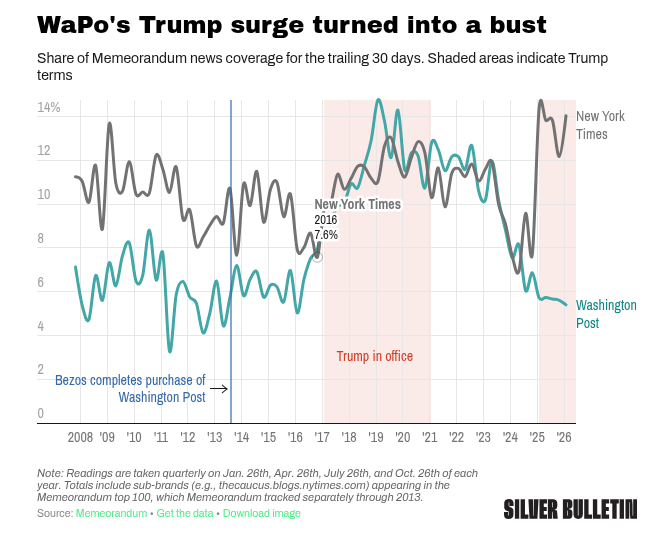
Perhaps also relevant to the Post’s decline is a point recently made to me by a conservative Substack writer who thinks that there is probably a relatively limited audience for conservative political writing. He reckons that nowadays it is easiest to make a living as a writer if you’re a liberal centrist.
In the twenty-first century, the argument goes, conservatism correlates with lower income, lower education and lower political engagement (see above). Brute demographics suggests the pool of conservatives (especially MAGA style conservatives) willing to pay for written political analysis is probably relatively limited. Progressives meanwhile are overwhelmingly young and therefore more likely to be watching clips of Hasan Piker on TikTok or YouTube.
Middle aged, wealthy, university educated types — the demographic by far the most likely to pay for writing — are overwhelmingly liberal centrists. It’s certainly notable that many of the most popular political writers on Substack (Andrew Sullivan, Matt Yglesias, Sam Freedman, Derek Thompson etc) are somewhere in the liberal centre.
It is time for me to monetise my own wishy-washy centrist politics to greater financial effect.
How to be less awkwardI enjoyed this piece about how to be less awkward. Superfluous for suave Cultural Capital readers of course:
When you miss a cue or make a faux pas, you just have to own it. Apologize if necessary, make amends, explain yourself, but do not attempt to undo your blunder with another round of blundering. If you knock over a stack of porcelain plates, don’t try to quickly sweep up the shards before anyone notices; you will merely knock over a shelf of water pitchers.
This turns out to be a surprisingly high-status move, because when you readily admit your mistakes, you imply that you don’t expect to be seriously harmed by them, and this makes you seem intimidating and cool. You know how when a toddler topples over, they’ll immediately look at you to gauge how upset they should be? Adults do that too. Whenever someone does something unexpected, we check their reaction—if they look embarrassed, then whatever they did must be embarrassing. When that person panics, they look like a putz. When they shrug and go, “Classic me!”, they come off as a lovable doof, or even, somehow, a chill, confident person.
Is Trump dying?You may have already read this but the long New York Magazine interview with Donald Trump is unmissable. It’s a highly entertaining piece and full of amusing details:
Fred Trump died in 1999 at age 93. He had, Trump said, a “heart that couldn’t be stopped” with almost no health conditions to speak of throughout his long life. “He had one problem,” Trump said. “At a certain age, about 86, 87, he started getting, what do they call it?” He pointed to his forehead and looked to his press secretary for the word that escaped him.
“Alzheimer’s,” Leavitt said.
“Like an Alzheimer’s thing,” Trump said. “Well, I don’t have it.”
“Is it something you think about at all?” I asked.
“No, I don’t think about it at all. You know why?” he said. “Because whatever it is, my attitude is whatever.”
Unfortunately I think a lot of the speculation about Trump’s health is wishful thinking. He always looks astonishingly lively to me.
**Finally…**For those seeking another book recommendation I’ve just finished Ursula le Guin’s novel The Word for World is Forest — a sci-fi allegory of the Vietnam War (I know that sounds unpromising). I’m always interested to know what you’re all reading. Let me know in the comments if you feel so moved.
Until next week!
James
From Cultural Capital via this RSS feed