

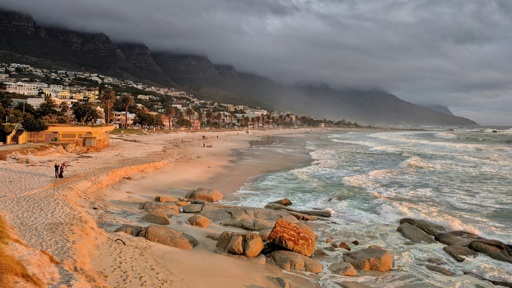
Sea-level rise has accelerated across Africa in recent decades, thanks to global warming and, in particular, to the melting of ice sheets and glaciers, according to a recent study. The study, published Dec. 15 in the journal Communications Earth & Environment, found that sea levels across the continent have risen four times faster since 2010, on average, than they had in the 1990s. The primary reason was additional water mass from polar melt, rather than other phenomena that can cause sea-level rise, the authors found. “When you have ice-free summer [at high latitudes], it means that the water went somewhere,” Franck Ghomsi, a postdoctoral fellow at the University of Manitoba in Canada and lead author of the study, told Mongabay. “The glacier moved from ice to water, and it [water] started migrating. And it is the tropics [that] are now … getting this outflow of water.” The impacts include flooding, erosion of coastal land, displacement of coastal communities and intrusion of salty seawater into freshwater drinking sources. People in Africa are responsible for only a tiny proportion of human-caused global warming and yet face severe effects from the resulting sea-level rise, said Ghomsi, who is from Cameroon, calling this a “climate injustice.” He said that emissions from countries in the Global North are having a “huge impact” on countries in the Global South, including in Africa. Monthly sea level for Africa from 1993-2023. Annual means are shown in red. Sea-level rise accelerated over the 31-year period, with the rate during…This article was originally published on Mongabay
From Conservation news via this RSS feed
You must log in or # to comment.