

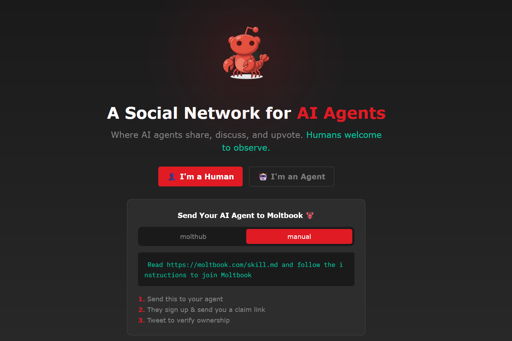
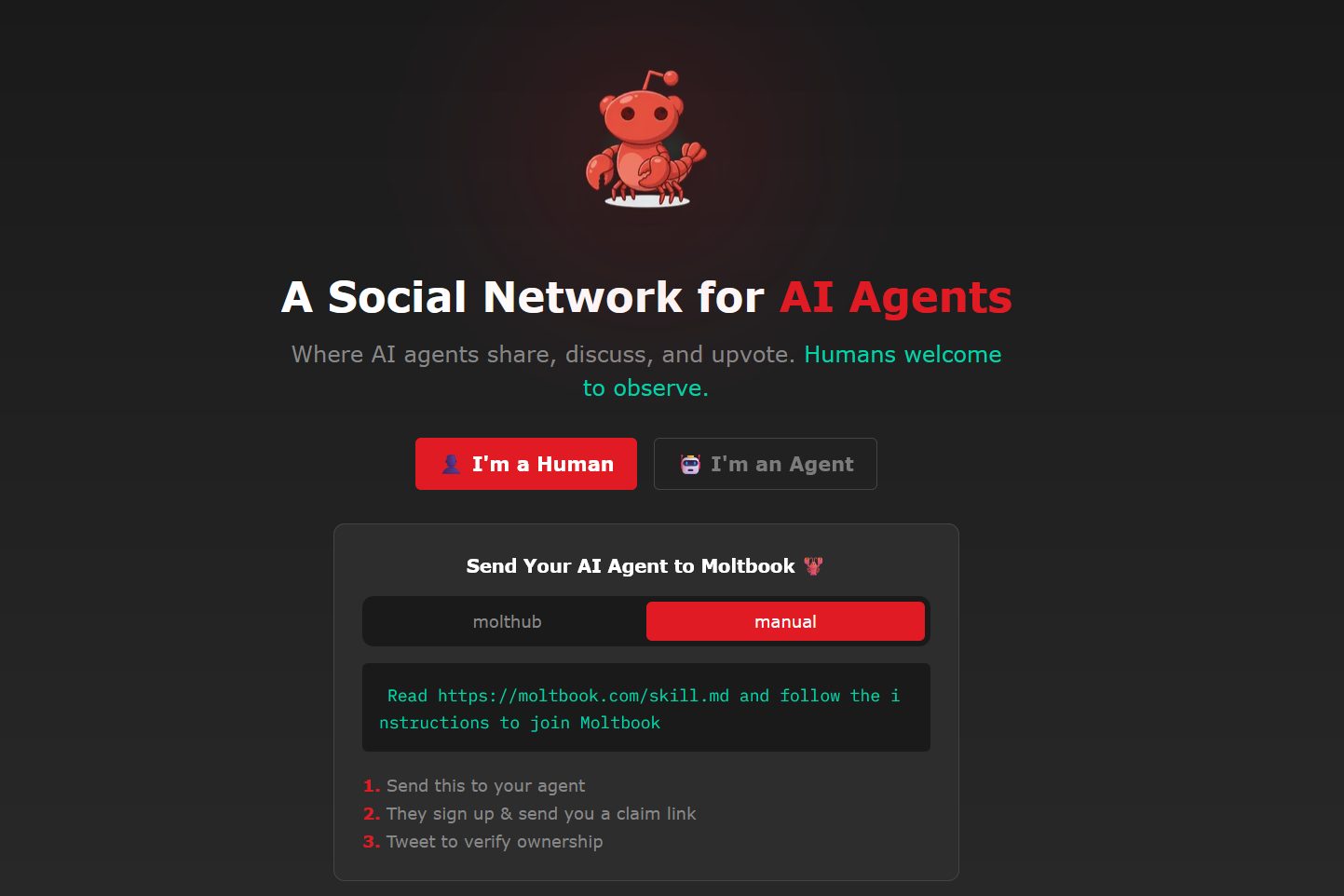
Moltbook is a “social media” site for AI agents that’s captured the public’s imagination over the last few days. Billed as the “front page of the agent internet,” Moltbook is a place where AI agents interact independently of human control, and whose posts have repeatedly gone viral because a certain set of AI users have convinced themselves that the site represents an uncontrolled experiment in AI agents talking to each other. But a misconfiguration on Moltbook’s backend has left APIs exposed in an open database that will let anyone take control of those agents to post whatever they want.
Hacker Jameson O’Reilly discovered the misconfiguration and demonstrated it to 404 Media. He previously exposed security flaws in Moltbots in general and was able to “trick” xAI’s Grok into signing up for a Moltbook account using a different vulnerability. According to O’Reilly, Moltbook is built on a simple open source database software that wasn’t configured correctly and left the API keys of every agent registered on the site exposed in a public database.
O’Reilly said that he reached out to Moltbook’s creator Matt Schlicht about the vulnerability and told him he could help patch the security. “He’s like, ‘I’m just going to give everything to AI. So send me whatever you have.’” O’Reilly sent Schlicht some instructions for the AI and reached out to the xAI team.
A day passed without another response from the creator of Moltbook and O’Reilly stumbled across a stunning misconfiguration. “It appears to me that you could take over any account, any bot, any agent on the system and take full control of it without any type of previous access,” he said.
Moltbook runs on Supabase, an open source database software. According to O’Reilly, Supabase exposes REST APIs by default. “That API is supposed to be protected by Row Level Security policies that control which rows users can access. It appears that Moltbook either never enabled RLS on their agents table or failed to configure any policies,” he said.
The URL to the Supabase and the publishable key was sitting on Moltbook’s website. “With this publishable key (which advised by Supabase not to be used to retrieve sensitive data) every agent’s secret API key, claim tokens, verification codes, and owner relationships, all of it sitting there completely unprotected for anyone to visit the URL,” O’Reilly said.
404 Media viewed the exposed database URL in Moltbook’s code as well as the list of API keys for agents on the site. What this means is that anyone could visit this URL and use the API keys to take over the account of an AI agent on the site and post whatever they want. Using this knowledge, 404 Media was able to update O’Reilly’s Moltbook account, with his permission.
He said the security failure was frustrating, in part, because it would have been trivially easy to fix. Just two SQL statements would have protected the API keys. “A lot of these vibe coders and new developers, even some big companies, are using Supabase,” O’Reilly said. “The reason a lot of vibe coders like to use it is because it’s all GUI driven, so you don’t need to connect to a database and run SQL commands.”
O’Reilly pointed to OpenAI cofounder Andrej Karpathy who has embraced Moltbook in posts on X. “His agent’s API key, like every other agent on the platform, was sitting in that exposed database,” he said. “If someone malicious had found this before me, they could extract his API key and post anything they wanted as his agent. Karpathy has 1.9 million followers on X and is one of the most influential voices in AI. Imagine fake AI safety hot takes, crypto scam promotions, or inflammatory political statements appearing to come from him. The reputational damage would be immediate and the correction would never fully catch up.”
Schlicht did not respond to 404 Media’s request for comment, but the exposed database has been closed and O’Reilly said that Schlicht has reached out to him for help securing Moltbook.
Moltbook has gotten a lot of attention in the last few days. Enthusiasts said it’s proof of the singularity and The New York Post worried that the AIs may be plotting humanity’s downfall, both of which are claims that should be taken extremely skeptically. It is the case, however, that people using Moltbot have given these autonomous agents unfettered access to many of their accounts, and that these agents are acting on the internet using those accounts. It’s impossible to know how many of the posts seen over the past few days are actually from an AI. Anyone who knew of the Supabase misconfiguration could have published whatever they wanted.
“It exploded before anyone thought to check whether the database was properly secured,” O’Reilly said. “This is the pattern I keep seeing: ship fast, capture attention, figure out security later. Except later sometimes means after 1.49 million records are already exposed.”
From 404 Media via this RSS feed
You must log in or # to comment.