

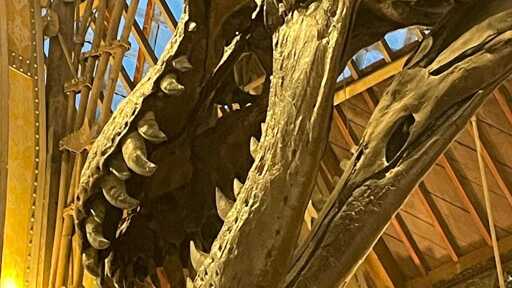
In the first month of a threatening year, in January of 1938, a great writer gathered himself to speak to children about dragons.
We know JRR Tolkien as the creator of Middle Earth and the author of the Lord of the Rings. But at the time he was just an Oxford university professor who had agreed to bring some light to a dark winter’s evening.
His first book, The Hobbit, had just been published. Most likely the children who gathered in the University Museum had not read it. Professor Tolkien over-prepared, bringing twenty-four pages of hand-written prose.
The text is powerful, if scattered. It would have taken about two hours to read aloud. While I mulled over it in the archives in Oxford, I pictured the mothers leading their children out of the lecture hall to look at the museum’s collection of dinosaur fossils, or for hot chocolate (just “chocolate,” the English boys and girls would have said) elsewhere.
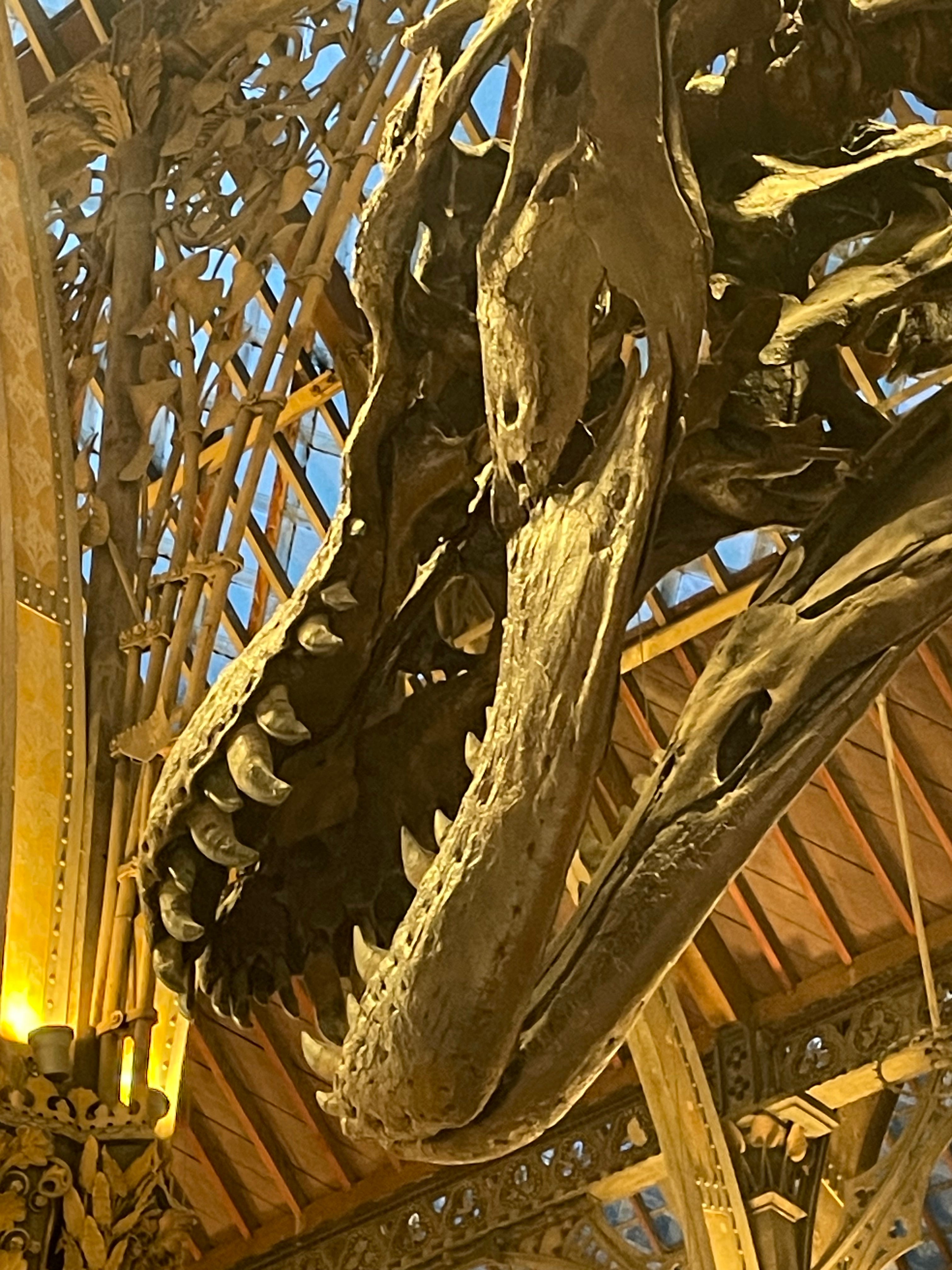
Tyrannosaurus Rex at the University Museum, today the Oxford University Museum of Natural History, photo TS, 1/26
The good linguist was a specialist in Old English, Old Icelandic, and Gothic. Anyone who did not know the plot of Beowulf and the Volsung Saga would have had some trouble following what the professor was talking about.
And his purpose was a serious one: not so much as to describe dragons as to explain what they essentially are. The dragons faced by the heroes Beowulf and Sigurd had elements in common, which Tolkien had gathered together in the form of his own dragon, Smaug, the terror of Bilbo the hobbit and his dwarf companions.
The lecture gives us a bit of the moral theory behind The Hobbit, and of the books to follow. Dragons, explained Tolkien, assemble huge wealth, appreciating only its quantity, but taking no joy in any particular object. They are, however, enraged if any one piece were to go missing, and would burn the world with fury. They are obsessed to the point of paranoia with thieves. Their great intelligence is thus reduced to the cunning of protecting their hoard.
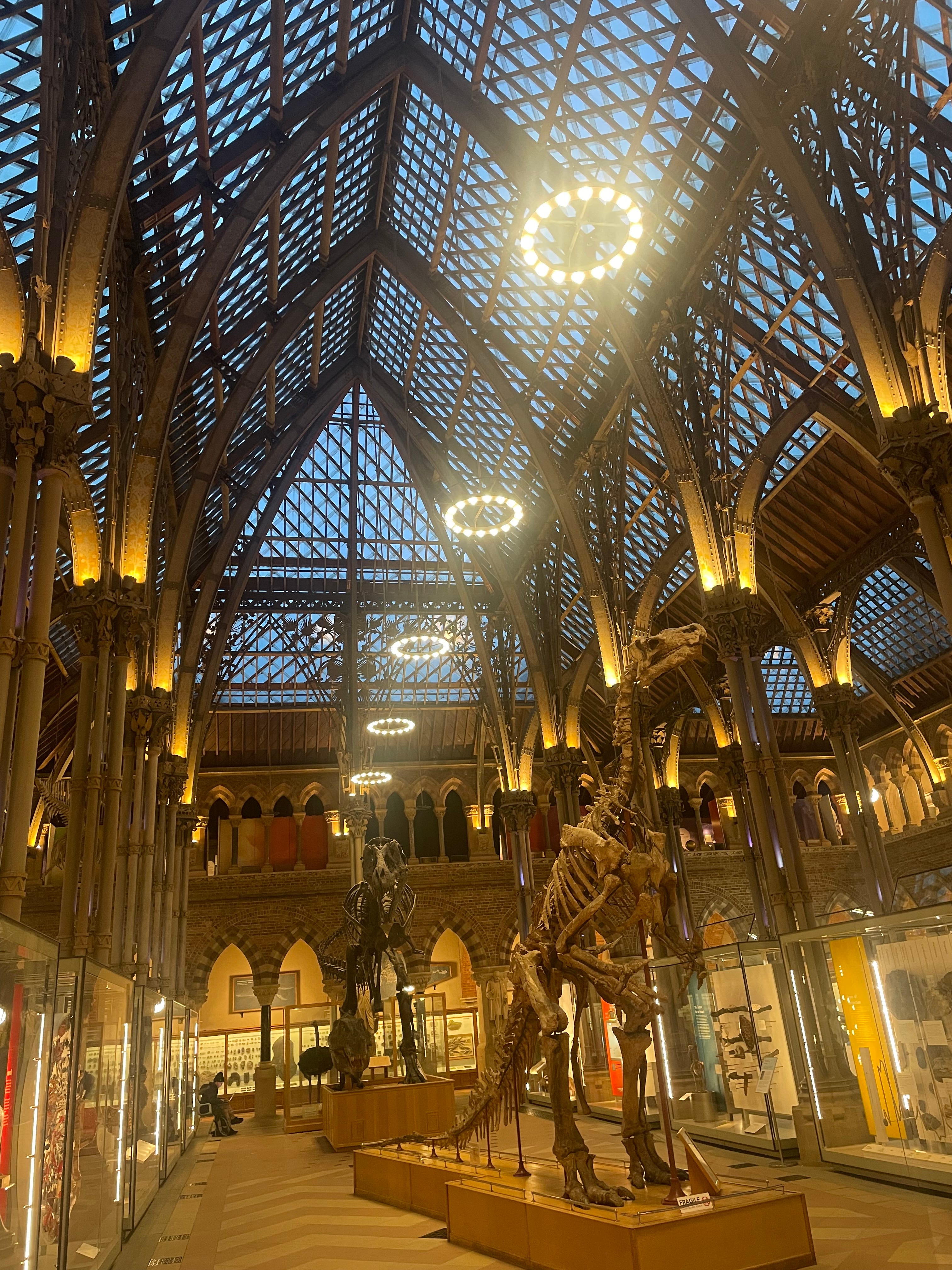
A view of the ground floor of the Museum.
A dragon is not a fearful beast of a real or imaginary past, but a way of being in the world. They are not the serpent that represents evil; they are not a symbol of something abstract. “The alarming thing about dragons as I have said is not only their shape — which may have dwindled or vanished — but their spirit.” Dragons convey to us a way that people can be evil, here in our world: turning the quality of small joys into the quantity of a senseless hoard, mocking and destroying others who still see the good things of life.
It is the spirit of dragons, concluded Tolkien, that has survived, and it survives in us, or in some of us. A man can become a dragon through sheer greed. If we want to find a dragon, the place to look is the “vaults of the Bank of England.” And if “you want to see a dragon-heath just go out and look” at a landscape tortured by machines, a sky blackened with smoke.
Dragons might seem invulnerable. Their scaled skin is armored by jewels. Their eyes can entrance, and their speech is an enchantment of its own. Some of today’s dragons have gone so far as to claim Tolkien for their own. But, as Tolkien said in his lecture, citing “my friend Mr. Baggins,” every worm has a weak spot.
Tolkien himself thought that the lecture to the children was “very unsuccessful.” In the reading, though, it delivers its reward, as the explicit moral complement to the book that, in decades to come, millions of children would read.
The dragons were, for Tolkien, “the final test of heroes.” It was not so much the strength and the sword that defines the hero, he said, but the courage and the comradeship. A hero sees a dragon for what it is, fearsome but fallible. A hero sees the dragon as the harbinger of one world, wants another, and steps forward.
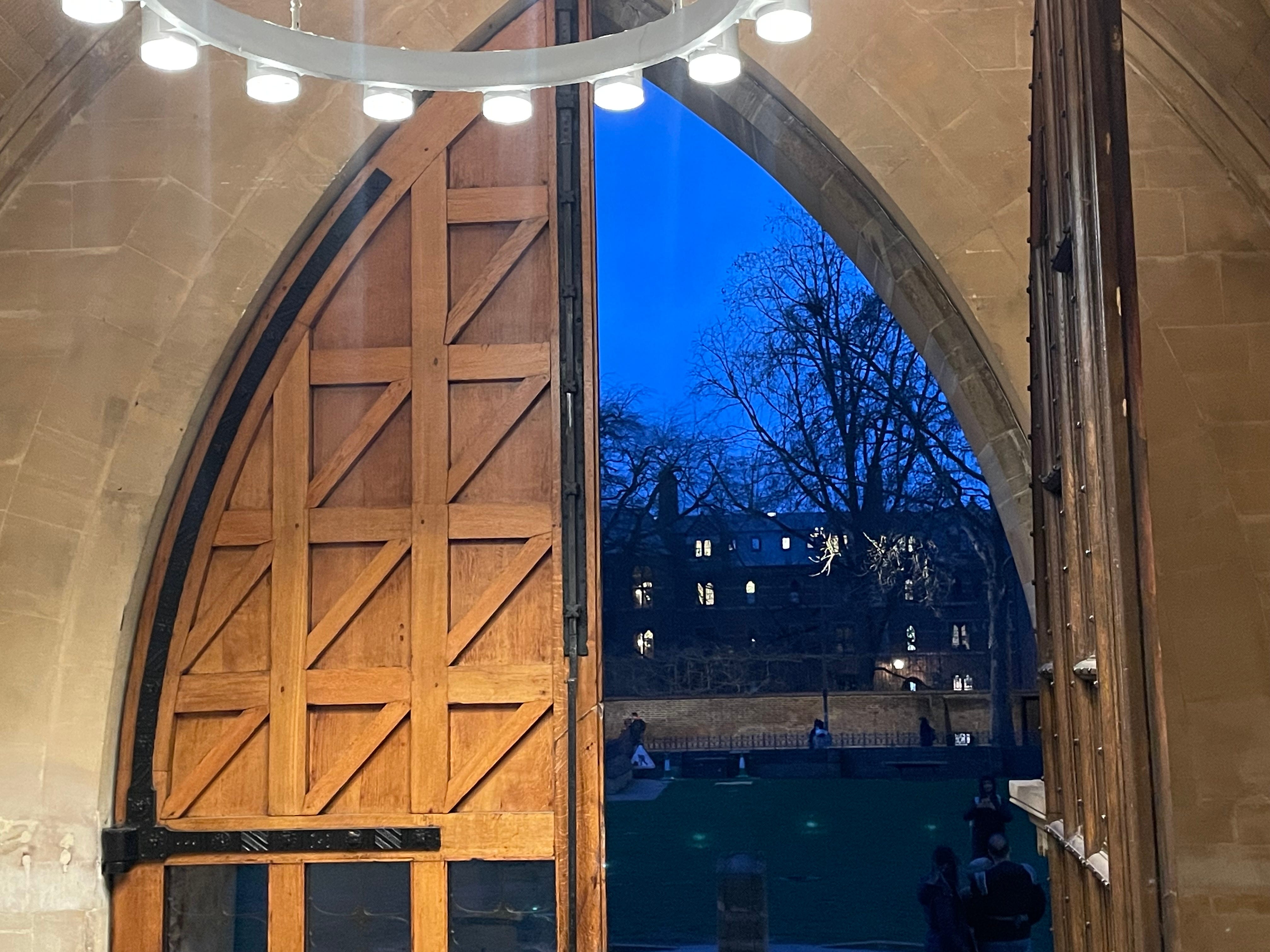
Departing the Museum.
Thinking about… is a reader-supported publication. To receive new posts and support my work, consider becoming a free or paid subscriber.
From Thinking about… via this RSS feed