

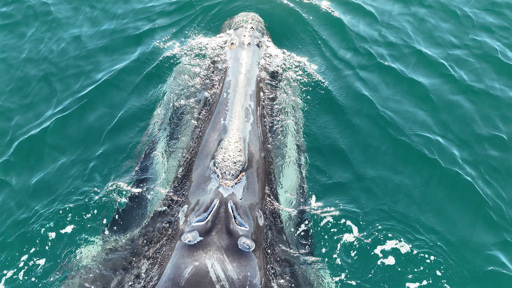
Division was four years old when he died, a young age even by the shortened standards now applied to North Atlantic right whales. His body was found in late January, adrift off the coast of North Carolina, partial and unrecoverable. The weather was too dangerous for anything more than confirmation. By then, the cause was already understood. Division with his mother in January 2022. Photo credit: CMARI Division with his mother in January 2022. Photo credit: CMARI He was first seen entangled in early December, fishing line wrapped tightly around his head and mouth. It cut into his blowhole and lodged in his upper jaw. Some of the gear was removed. Enough remained to slow him, to feed infection, to drain energy from a body still meant to grow. Scientists who tracked him afterward saw what they had learned to recognize: weight loss, altered swimming, the steady signs of decline. They followed his movements as best they could. Distance and storms intervened. He was last sighted alive on January 21st, off Cape Hatteras. Six days later, he was dead. Division’s catalog number was 5217. His name came from the pale markings on his head, callosities arranged in a pattern that resembled a mathematical symbol. To those who knew him only through photographs and survey logs, he was one of many. Sixty-eight recorded sightings. Twenty-three photographs. A few notes about tooth decay in the bonnet. One image shows him leaping, much of his body briefly clear of the water. He…This article was originally published on Mongabay
From Conservation news via this RSS feed