

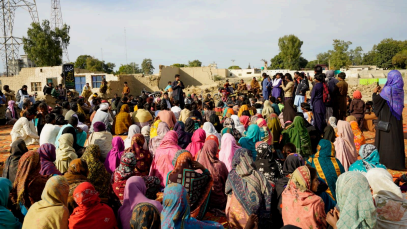
Hundreds of people belonging to Indigenous communities in Dera Ghazi Khan, in Pakistan’s Punjab province, gathered on the banks of Taunsa Barrage on the Indus River to condemn the demolition of their homes by the local authorities and assert their rights of inhabitation.
The gathering was called a Lok Sath (People’s Tribunal), organized by the Sindhu Bachao Tarla (Save Indus Demand) and other organizations.
Scores of affected people from Basti Sheikhan gave testimonies of their suffering at the hands of the Punjab Encroachment Regulatory Authority (PERA), the police, and the local government, and sought proper accountability from those responsible for their plight.
The Peoples Tribunal, in its final judgement, demanded the cessation of all displacements and adequate compensation for the displaced. It also demanded a public apology for causing harm to the people and the local environment, holding the government and the World Bank equally responsible.
The judgement also questioned the existing legal regimes which declare people who have been living on the land and using its natural resources for generations “illegal encroachers”. It asked for its revision and recognition of people’s inherent rights over the land, the river, and its resources.
Forced displacement
Nearly 70 houses belonging to various Indigenous communities who have lived on the land for generations (according to some sources, even prior to the formation of the modern Pakistan state) were demolished with bulldozers last week by PERA and other authorities.
Hundreds of women, children, and elderly were forced to spend nights in the open in severe winter conditions. The people’s access to the river was also blocked and their boats were seized, depriving them of a major source of livelihood and sustenance.
Most of the people whose houses were demolished belong to extremely poor Indigenous communities in Pakistan, recognized as Kehal, Morr, and Mohana. These are mostly fisherfolk who also work as basket weavers.
Activists claimed the demolition of houses in the region was carried out in complete violation of the existing laws, as most people had all necessary government documents to prove their residence.
The demolition was also a violation of established safety protocols and earlier promises made by the government to the people.
According to claims made by the activists, the government wants to build a circuit house on the land thus vacated.
Government and the World Bank must be held accountable
Several speakers in the People’s Tribunal recalled how this was not the first time they were displaced from their homes by the state in the name of development. It claimed similar displacements took place in the 1950s as well, when the present Taunsa Barrage was constructed.
The tribunal claimed the World Bank, which was the sponsor of the project, failed to implement its own resettlement plan, approved after popular protests, leading to their fresh displacement in 2007.
The repeated displacements, the present one being the third, has made it difficult for the people to establish sustained livelihoods, forcing them to live temporary lives affecting their future generations. They are unable to provide proper education for their children because of lack of certainty, for example.
“To truly understand and address this loss, it must be viewed in the broader context of how the control of rivers has stripped Indigenous fisherfolk of their freedom and reduced them to bonded laborers merely for profit,” claimed Mushtaq Gaadi, professor at Quaid-i-Azam University and one of the organizers of the SBT, in a statement accessed by Peoples Dispatch.
“The result is the social and environmental destruction we see before us today,” he underlined.
During the People’s Tribunal, people also spoke about their harmonious existence with the river. Their dependence on it for their livelihood makes its survival their primary responsibility, they claimed.
Several left organizations, such as the MKP, have extended their support to the calls of the Peoples Tribunal and the SBT.
Talking to Peoples Dispatch, Ramis Sohail, a lawyer and a leader of the left-wing Mazdoor Kisan Party (MKP) claimed that we should not see the People’s Tribunal as merely “symbolic”.
“When courts are closed to the poor, people begin to construct their own institutions. The Lok Sath represents the earliest form of collective political power, a refusal to accept that legality and justice are the same thing.”
The post People’s Tribunal in Pakistan holds government and the World Bank equally responsible for displacement and environmental damage appeared first on Peoples Dispatch.
From Peoples Dispatch via this RSS feed