

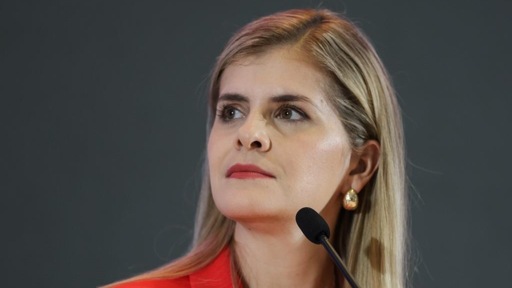
There were a few surprises on February 1 in the Costa Rican elections. The electorate decided to give its support to right-wing Laura Fernández of the Sovereign People’s Party (PPS), the political heir to fellow right-winger Rodrigo Chaves, who has governed the Central American country for the past four years.
According to the Supreme Electoral Tribunal (TSE), with 88% of the votes counted, the ruling party’s candidate won the support of 48.5% of Costa Ricans in the first round. In second place was Álvaro Ramos, from the center-right National Liberation Party (PLN), with 33.3%, which came as a surprise to some due to his high vote count, though it was not enough to prevent Fernández’s victory.
According to the Central American country’s electoral law, the large difference between the two candidate, in addition to more than 40% support, allows Fernández to be declared the president of Costa Rica in the first round.
Fernández: continuity for Costa Rica’s right wing
In addition, the PPS won 30 of the 57 seats in parliament, giving them a simple majority. Therefore, if she wants to carry out the promised reforms, Fernández will have to reach agreements with other political forces to achieve a qualified majority. The centrist PLN won 18 seats, while the leftist Broad Front party won seven parliamentary seats. The remaining two were divided between the Citizen Agenda Coalition and the Social Christian Unity Party.
In her victory speech, the ruling party candidate repeated the arguments put forward during the election campaign: economic prosperity and a tough stance on crime. Perhaps this is why some have called her “the Costa Rican Bukele,” although it is still too early to know her governing style and strategy on crime.
“This is a historic and glorious moment for our beloved Costa Rica. The people have spoken. Democracy has decided. Costa Rica has voted and has opted for continuity of change,” said the jubilant president-elect.
Fernández is well acquainted with public administration. A loyal supporter of current President Chaves, the 39-year-old political scientist served as minister of planning and minister of the presidency. The key difference between Chaves and Fernández, explains academic Ronald Alfaro-Redondo, is not so much one of content as of style.
“Chaves maintains a direct and even confrontational tone, which makes him appear to be a firm politician. Fernández’s style is different from that of the president, which poses a challenge for the candidate … The president has made efforts to transfer his high popularity, based on his personalistic style,” says Alfaro-Redondo.
Fernández has thus promised to continue in some cases and deepen in others the work of Chaves, who, according to some polls, has support greater than 58%, something unusual for an outgoing president.
Fernández thus attempted to portray herself as a faithful successor to the current president: “Continuity means deepening, without hesitation, the frontal assault on drug trafficking and organized crime, with the firmness and heavy hand that only we have dared to exercise.”
The rise in violence and the shadow of Bukele
However, security indicators seem to show a different reality. Costa Rica ended 2025 with a homicide rate of 16.7 per 100,000 inhabitants, making it the third most violent year in its history, according to the country’s Judicial Investigation Agency. Based on the same institution’s data, about 70% of the murders are linked to the illegal drug trade.
Fernández has promised to declare states of emergency in areas with the highest crime rates: “As future president of Costa Rica, I am prepared, in strictly necessary cases and if we see an escalation in contract killings and crimes related to organized crime, to request that the Legislative Assembly lift or suspend individual guarantees.”
Part of the opposition fears that Fernández’s conservative political, security, and economic reforms will result in a reduction in political freedoms and violate human rights. This was expressed by Ariel Robles, a former left-wing presidential candidate who said during his campaign: “Laura, why are you promoting the suspension of individual guarantees instead of finding solutions to the security crisis?”
However, Chaves and Fernández have hinted that their security project is closer to Bukele’s El Salvador than to any other project … or at least that is how they have made it appear during the election campaign, which tacitly included the presence of Nayib Bukele, who, during an official visit to Costa Rica, heard how the Costa Rican executive plans to build a prison with a capacity to hold 5,000 people, very similar to the controversial Salvadoran detention center CECOT. It seems no coincidence that the first president to congratulate Fernández was Bukele.
New and not-so-new reforms
In addition, the ruling party has promised that the Fernández administration will continue with the judicial reform undertaken by Chaves, which has been seen by some opponents as controversial for allegedly causing the executive branch to interfere in other functions of the state. “In Costa Rica, there is the principle of non-belligerence. Without a doubt, the president has pushed the limits,” says academic Alfaro-Redondo.
However, a large part of the population has clearly placed its trust in the continuity of a process that claims to have steadily increased GDP in recent years and, according to the executive branch, reduced poverty. Nevertheless, several opponents claim that the macroeconomic data hides the constant reduction in state investment in social issues. “A primary surplus cannot be achieved at the expense of a child without a scholarship and with gaps in their education,” Robles said during the campaign, indirectly referring to the Chaves government.
Nevertheless, in her victory speech, right-wing Fernández stated that the PPS project will not be stopped, despite criticism from the opposition: “The obstructionist and sabotaging opposition that only wants to bring about the failure of the government wears us all down and hinders the struggle for the prosperity and well-being of our country.”
But the PPS project goes beyond judicial reform and a heavy hand. Fernández, in line with neoliberal doctrine, has promised to sell state assets, such as the Bank of Costa Rica, to private interests, as well as to increase private investment in the Central American country.
Whether Fernández will be able to maintain Chaves’ high popularity ratings remains to be seen. Costa Rica demands a change in the unusual increase in violence it has experienced in recent months, as well as an improvement in the economic conditions of the majority of the population. In this regard, Fernández will have to fulfill his promise of an impeccable, effective, and strong administration if he wants the PPS to become a historic force. Otherwise, the Costa Rican right will once again fall into the vortex of empty and unfulfilled promises, as well as the historical weariness and indifference that its governments have caused among the common people.
The post Right-wing triumphs in Costa Rica’s presidential race appeared first on Peoples Dispatch.
From Peoples Dispatch via this RSS feed
You must log in or # to comment.