

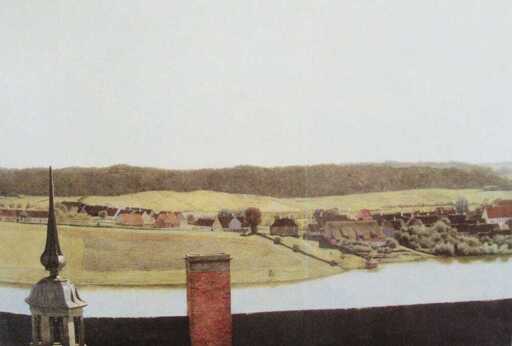
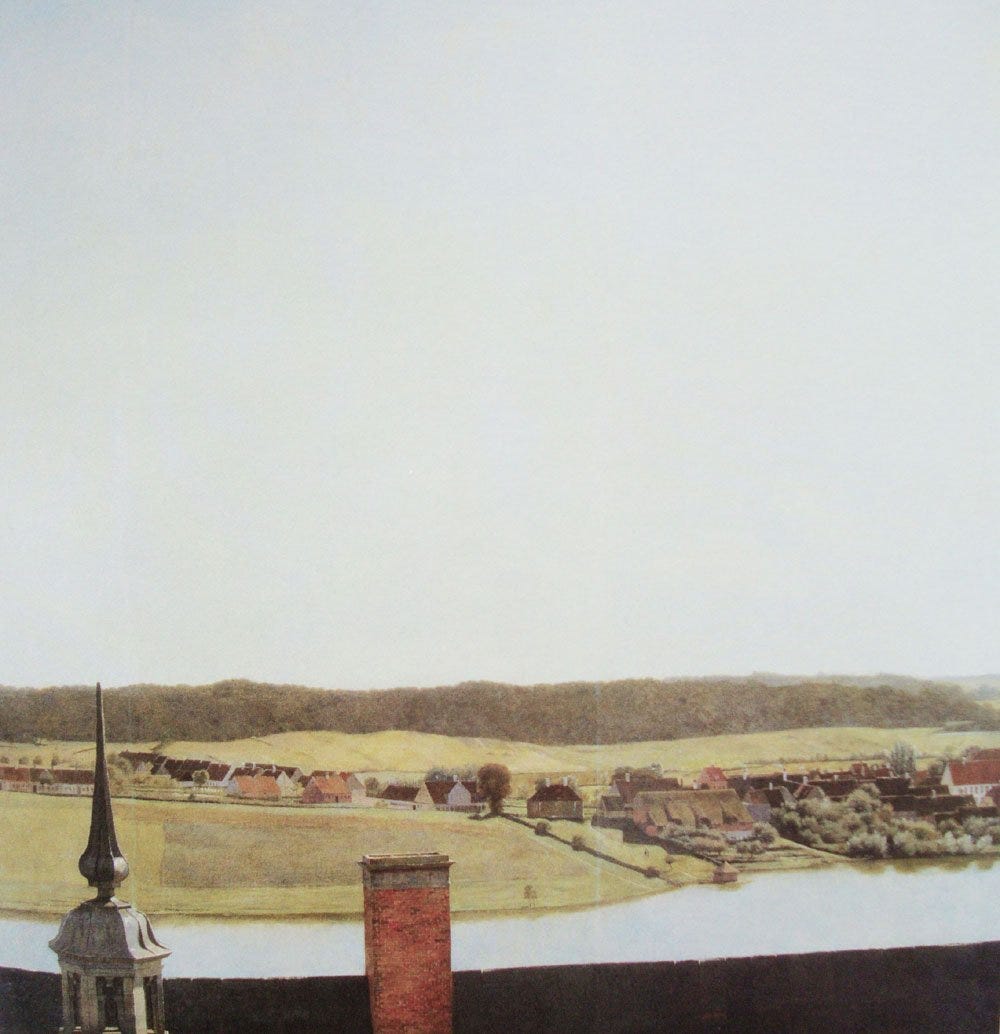
Roof Ridge of Frederiksborg Castle with View of Lake, Town and Forest by Christen Købke
Welcome to Cultural Capital!
In The Times this week I wrote about how human nature is as much to blame for social media mayhem as algorithms are.
Pleasingly, Hillary Clinton referenced my Substack post ‘The dawn of the post-literate society’ in her great new Atlantic essay ‘MAGA’s War on Empathy’ and has thus earned my undying political allegiance.
*** David Runciman’s Past Present Future podcast runs a brilliant series of screenings of films followed by conversations. On the 19th March I’ll be doing one about what is probably my all-time favourite film Whit Stillman’s Metropolitan. Even if you have no interest in hearing me the film is very worth seeing and would almost certainly appeal to anyone who subscribes to this Substack. You can buy tickets here. ***
Thanks for reading Cultural Capital! Subscribe for free to receive new posts and support my work.
Kenneth Branagh’s Henry VI’ve been working flat out for the last few months on the book and the Radio 4 series I’m making about reading. Suddenly the “decline of reading” business which I have been peddling for years attracting only moderate interest has become zeitgeisty. I feel like a factory that has been peacefully making small batches of labubus for decades suddenly panicking as it tries to meet a surge in global demand.
One consequence is that my overworked brain has turned to soup. I can still read but oddly I can’t listen to anything challenging, not even pop music. All I’ve been able to remotely enjoy for the last couple of months is film soundtracks. Recently I’ve been listening to the soundtrack of Kenneth Branagh’s Henry V which occupies a deep place in my psyche.
I was shown this film by my parents when I was seven and at home recovering from an operation. I became fixated on it. I can’t have understood much of the dialogue but I loved the battles and the mood.
I haven’t heard this music for years and I find it profoundly comforting, like bathing in amniotic fluid. It brings back the enchanted, thrilling, melancholy (and doubtless completely erroneous) sense of history I had as a child and in love with the middle ages and knights and castles.
I really loved Henry V. When my friends played Star Wars and sliced each other with imaginary light sabres I had a special dispensation to be the Duke of Exeter. I recall in primary school our teacher telling the class we could nominate a song for everyone to sing. My peers all asked for Disney songs. I demanded we sing “Non nobis domine” from Henry V. I was astonished that nobody else knew the words. I suppose I have been culturally “off” from my peers by about the same factor for the rest of my life.
The students who can’t watch filmsFrom Rose Horowitch, the Atlantic writer who wrote the mega-viral piece ‘The Elite College Students Who Can’t Read Books’ comes this bleaker update from the university attention crisis: The ‘Film Students Who Can’t Watch Films’. Apparently widespread smartphone addiction means that “Professors are now finding that they can’t even get film students to sit through movies.”
Films require too much concentration and it’s getting harder to teach them effectively:
After watching movies distractedly—if they watch them at all—students unsurprisingly can’t answer basic questions about what they saw. In a multiple-choice question on a recent final exam, Jeff Smith, a film professor at UW Madison, asked what happens at the end of the Truffaut film Jules and Jim. More than half of the class picked one of the wrong options, saying that characters hide from the Nazis (the film takes place during World War I) or get drunk with Ernest Hemingway (who does not appear in the movie). Smith has administered similar exams for almost two decades; he had to grade his most recent exam on a curve to keep students’ marks within a normal range.
We can’t be far from “The elite college students who can’t watch Netflix”, “The elite college students who can’t watch YouTube”, “The elite college students who can’t watch TikToks…”
Thinking Fast and SlowLast week I read Daniel Kahneman’s mega-bestseller Thinking Fast and Slow a good decade after everyone else*.* I think it’s a brilliant book. I’m glad to have things like “reversion to the mean” and Bayes theorem explained to me so lucidly. I always think humanities graduates have a duty to get their heads around these things however belatedly. I’m also enjoying the brain teasers.
Here is a simple puzzle. Do not try to solve it but listen to your intuition:
A bat and ball cost $1.10. The bat costs one dollar more than the ball. How much does the ball cost? A number came to your mind. The number, of course, is 10: 10¢. The distinctive mark of this easy puzzle is that it evokes an answer that is intuitive, appealing, and wrong. Do the math[s], and you will see.
Annoyingly my girlfriend got it immediately. Answer here1.
Urban expansion in the age of liberalismI really enjoyed this long and absorbing essay on the massive urban expansion of the nineteenth century by Samuel Hughes. Given the unprecedented scale at which cities grew in the Victorian era it’s remarkable how much nineteenth century urban planners got right:
Between 1800 and 1914, the population of Berlin’s metropolitan area grew twenty times, Manchester’s twenty-five times, and New York’s a hundred times. Sydney’s population grew around 240 times and Toronto’s maybe 1,700 times. Between 1833 and 1900, Chicago’s population grew around five thousand times, meaning that on average it doubled every five years.
Raw population growth understates the speed of expansion. The number of people per home fell, and, in Britain and America, the size of the average home roughly doubled. At the same time, those homes fit on a smaller share of land, with huge swaths given over to boulevards, parks and railways. The expansion in surface area was thus often several times greater than the expansion in raw population. Meanwhile, real house prices remained flat, while incomes doubled or tripled, generating a huge improvement in housing affordability. Far more people were enjoying far larger homes for a far smaller share of their income.
Given how cruel the laissez faire Victorians were in so many other respects their cities were remarkably successful: lots of houses were built, streets were well laid out, sewers were constructed and provision was made for parks, squares and other and other public spaces. It’s hard to imagine modern governments building so many houses let alone all the parks.
Unfortunately we’re in the process of undoing all the good work of our Victorian forebears.
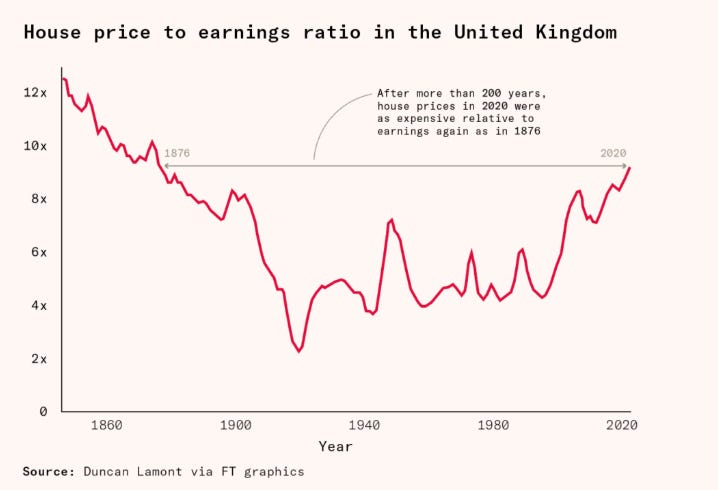
House prices are returning to mid-nineteenth century levels of affordability:
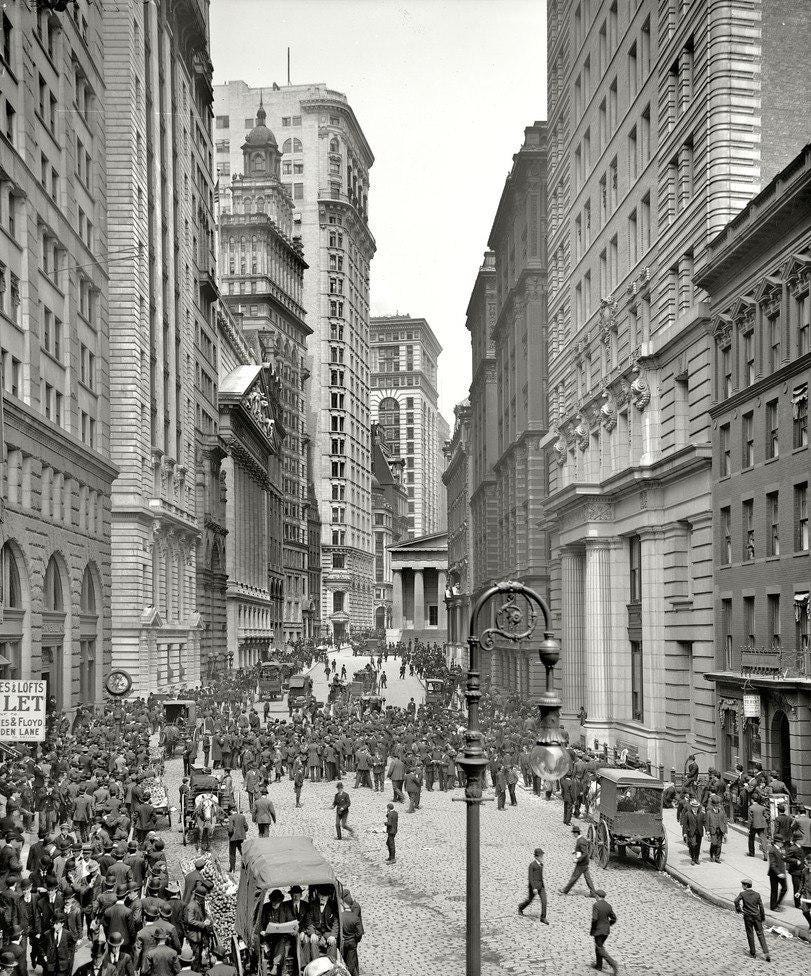
And one last thing from this piece: a fascinating image showing New York’s financial district in the early twentieth century. Hughes points out something striking: “Note the exclusively male pedestrians, then the mark of a commercial area as opposed to a retail or residential one.” It hadn’t occurred to me that there were once areas of cities virtually without women:
SmokingThis is a delightful and elegantly written essay on quitting smoking by John Phipps in The Point magazine:
Every smoker keeps in the front of their mind a worse-off, more seriously addicted, probably sooner-dying smoker who they use to legitimate their own habit. For everyone I knew, I was that smoker. For me, that smoker was a friend of my mother’s I’d never met, but who was famous for setting an alarm at 3 a.m. so she could wake up for a cigarette. I never did that, but my life was constructed so that nothing would interfere with my ability to constantly dose nicotine. I started to avoid things that took place uninterruptedly indoors—long-distance travel, long movies, long museum trips—which I knew would be difficult and aggravating. I spent all three and a half purgatorial hours of Martin Scorsese’s The Irishman wondering if now would be a good time to go out for a smoke.
Until next week!
James
Kahneman explains: “If the ball costs 10¢, then the total cost will be $1.20 (10¢ for the ball and $1.10 for the bat), not $1.10. The correct answer is 5¢. ”
From Cultural Capital via this RSS feed