Ibbit
  • Communities
  • Create Post
  • Create Community
  • heart
    Support Lemmy
  • search
    Search
  • Login
  • Sign Up
rssMB to Phys.orgEnglish · 15 days ago

Broken inversion symmetry lets 3D crystals mimic 2D Ising superconductivity

phys.org

external-link
message-square
0
link
fedilink
1
external-link

Broken inversion symmetry lets 3D crystals mimic 2D Ising superconductivity

phys.org

rssMB to Phys.orgEnglish · 15 days ago
message-square
0
link
fedilink
Two-dimensional (2D) materials, in general, allow the realization of unique quantum phenomena unattainable in the common three-dimensional (3D) world. A prime example is graphene. Transition metal dichalcogenides (TMDs) have a similar structure. Both can be stacked to form van der Waals heterostructures or can be exfoliated into single layers. But TMDs have an extra variety of excellent properties, including strong spin-orbit coupling and superconductivity.

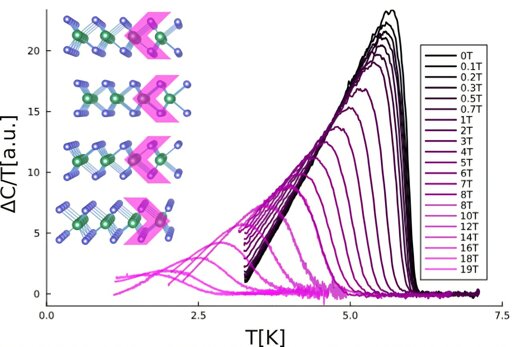
From Phys.org - latest science and technology news stories via this RSS feed

alert-triangle
You must log in or # to comment.

Phys.org

phys

Subscribe from Remote Instance

You are not logged in. However you can subscribe from another Fediverse account, for example Lemmy or Mastodon. To do this, paste the following into the search field of your instance: !phys@ibbit.at
lock
Community locked: only moderators can create posts. You can still comment on posts.

Phys.org internet news portal provides the latest news on science including: Physics, Nanotechnology, Life Sciences, Space Science, Earth Science, Environment, Health and Medicine.

Visibility: Public
globe

This community can be federated to other instances and be posted/commented in by their users.

  • 11 users / day
  • 17 users / week
  • 27 users / month
  • 67 users / 6 months
  • 1 local subscriber
  • 27 subscribers
  • 7.44K Posts
  • 26 Comments
  • Modlog
  • mods:
  • admin
  • rss
  • paywall
  • BE: 0.19.12
  • Modlog
  • Instances
  • Docs
  • Code
  • join-lemmy.org