

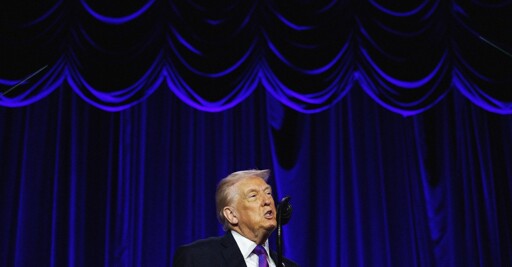
The National Prayer Breakfast was founded in 1953, when President Dwight Eisenhower accepted an invitation to join members of Congress to break bread together. Every president since has participated, regardless of party or religious persuasion. It offers an opportunity, according to its organizers, for political leaders to gather and pray collectively for our nation “in the spirit of love and reconciliation as Jesus of Nazareth taught 2,000 years ago.”
Donald Trump never got that memo—or, if he did, he’s found ways to ignore it.
In a rambling, 75-minute speech at the Prayer Breakfast yesterday, we saw the quintessential Trump. His comments were grievance-filled, narcissistic, conspiratorial, factually false, divisive, and insulting. He referred to his critics as “lunatics.” He engaged in projection, comparing them to “dictators” and “the gestapo.” He labeled Republican Representative Thomas Massie a “moron” because he won’t cast legislative votes the way Trump wants. Joe Biden is “Crooked Joe,” while Jacob Frey is “the horrible fake mayor” of Minneapolis. Trump praised El Salvador’s authoritarian President Nayib Bukele—Bukele has referred to himself as “the world’s coolest dictator”—for his “very strong prisons.” (The prison that Trump celebrates, Centro de Confinamiento del Terrorismo, known as CECOT, is notorious for its cruel and inhumane conditions.) Trump emphasized that Bukele—who also spoke at the National Prayer Breakfast—is “one of my favorite people.”
Trump took credit for churches “coming back stronger than ever” and for religion being “hotter than ever.” He claimed he has “done more for religion than any other president”—apparently, before the age of Trump, Christians couldn’t say “Merry Christmas” in public—and argued that his predecessors in the White House “bailed out” on religion. “I don’t know how a person of faith can vote for a Democrat. I really don’t,” he said, adding, “They cheat.”
The spirit of love and reconciliation that Jesus of Nazareth taught 2,000 years ago was not particularly evident in the words of the president. Of course, it never has been. No matter. The audience of some 3,500—the great majority of whom undoubtedly claim to be followers of Jesus—responded to Trump’s remarks with a standing ovation.
It is testimony to the marketing genius of Donald Trump that he never sold himself to Christians as one of them—pious, devoted, merciful, forgiving, irenic, biblically literate, a faithful husband and father, a man of high moral standards. Instead, he sold himself as their protector. He didn’t hide his cruelty or his belief that the ends justify the means; doing so would have been impossible for him because they are central features of his personality. So he did the opposite: He presented himself to Christians as a fierce, even ruthless, warrior on their behalf. It worked. He built a huge, loyal, fanatical following.
At the National Prayer Breakfast, Trump recounted comments made about him by Robert Jeffress, the senior pastor of the First Baptist Church in Dallas and a stalwart Trump ally for a decade.
[Peter Wehner: MAGA Jesus is not the real Jesus]
According to Trump, the case Jeffress made on his behalf in 2016 went like this: “He may not have ever read the Bible, but he will be a much stronger messenger for us.” It was Jeffress who said at the time, “I want the meanest, toughest SOB I can find to protect this nation.”
Jerry Falwell Jr., then the president of Liberty University, put it this way in a 2018 tweet: “Conservatives & Christians need to stop electing ‘nice guys’. They might make great Christian leaders but the US needs street fighters like @realDonaldTrump at every level of government b/c the liberal fascists Dems are playing for keeps & many Repub leaders are a bunch of wimps!”
Tony Perkins, an ordained Southern Baptist minister and the president of the Family Research Council, a prominent evangelical activist group, admitted in 2018 that he and other evangelicals gave Trump a “mulligan” on his multiple affairs and hush-money payments to a porn star for a simple reason: Evangelicals “were tired of being kicked around by Barack Obama and his leftists. And I think they are finally glad that there’s somebody on the playground that is willing to punch the bully.” When asked what happened to turning the other cheek, Perkins replied, “You know, you only have two cheeks. Look, Christianity is not all about being a welcome mat which people can just stomp their feet on.”
They thrill to watch Trump savage his critics, and their devotion grows with every dehumanizing word, with every merciless act.
If Henry VIII earned the title “Defender of the Faith,” why not Donald Trump?
It is odd to see the very same evangelicals who claim the Bible is inerrant and who criticize fellow Christians about matters such as ordaining women—on the grounds that they are being unfaithful to what Paul wrote in one of his Epistles, an interpretation that many biblical scholars dispute—dismiss Jesus’s most famous sermon. For these Christians, the teachings of the son of God take a back seat to the pronouncements of the king of Mar-a-Lago.
Much of today’s evangelical world sees Trump’s viciousness not as a vice but as a virtue, so long as it is employed against those they perceive as their enemies, against those whom they resent and for whom they have a seething hatred. Unless you’ve spent time in the evangelical world, fully appreciating the level of antipathy that exists toward Democrats and progressives is difficult. The only thing that exceeds it is the loathing reserved for the Christians and conservatives who broke with Trump because their commitment to their faith, and to cherished moral truths, required them to speak out against him.
What i am describing isn’t true of all Christians, thankfully. Some have found the cumulative effect of Trump’s assault on Christian ethics too much. The Catholic Church and its American pope, Leo XIV, are speaking out prudentially but forcefully against the actions of the Trump administration. Mainline denominations, including the United Methodists, are stepping up. My friend Mark Labberton, a former president of Fuller Theological Seminary and a Presbyterian (PCUSA) pastor, traveled to Minneapolis to express solidarity with the people of that city after an ICE agent killed Renee Good. He joined many others in peaceful protests in subzero temperatures. Other pastors and theologians I respect, several of whom were formative in my journey of faith, signed a statement titled “Christ Alone: A Call to Faithful Resistance.” It nowhere mentions the president or his party, but it does take a prophetic stance “in a time of fear and capitulation in both the Church and in our civic life.”
[From the January/February 2024 Issue: My father, my faith, and Donald Trump]
“In this moment we specifically call on the Church and peoples across the political spectrum to recognize the clear and present danger of rising authoritarian rule to all of us, especially the most vulnerable,” the statement says. “We commit ourselves to resisting cruel or oppressive means of control and to standing in solidarity with the oppressed, the marginalized, and the silenced.”
Even among evangelicals, support for Trump is hardly universal, and many pastors I know are quite disturbed by the damage he and his administration are doing. Yet they know full well that many within their congregations voted for Trump and still align themselves with the Republican Party. These ministers are therefore hesitant to speak out not only from the pulpit but in any capacity. They want to keep their head down.
That’s understandable. The best pastors I know are instinctively wary about speaking out politically; that’s not why they got into ministry in the first place. They don’t feel that it’s their job to offer political commentary, nor do many of them feel especially equipped to do so. They also realize that many people go to church seeking a safe haven from politics. They believe, too, and with some justification, that to take a stand, even with great care, might well split a congregation.
Evangelical denominations and pastors, though, even those who are not deeply immersed in politics, are generally willing to speak out on culture-war issues that have political and sometimes legislative implications. I’ve seen this happen many times over the years.
So the reluctance to take a prophetic stance in the realm of politics and culture is less a principled unwillingness than a selective one. Ministers, like most of the rest of us, are likely to wade into controversial waters only when it’s safe—in their case, when there is overwhelming agreement within a congregation on a set of issues. They speak out when the response from those in the pews is a resounding “Amen!” rather than even a handful of voices saying, “Oh no you don’t!”
I don’t pretend these are easy matters for pastors to face. A minister of a conservative congregation might tell himself that the downside to speaking out against the sins of the authoritarian right, even judiciously and without partisan rancor, is too costly. They may fear that their ministry will be damaged, that offended parishioners will tune them out, and that they will gain nothing concrete.
But aren’t prophets esteemed precisely for their willingness to tell difficult truths to the people of God? For being steadfast in the face of fierce criticism; for denouncing social injustice and idolatry, including political idolatry, when it’s unfashionable to do so; for issuing warnings when others fall silent; and for calling people to repentance during times of moral blindness?
Non-maga evangelical pastors are going to face a set of difficult questions during the next three years: Under what conditions, if any, are you willing to speak out when a president and his administration repeatedly violate Christian ethics? Will you stay silent even when acts of cruelty, lawlessness, and injustice aren’t the exception but the norm? How much more indecency do you need to see before you act?
My colleague Jonathan Rauch, an eminently fair-minded, reasonable, and wise writer, recently explained why, after heretofore avoiding the term, he has come around to the belief that Donald Trump’s governing style qualifies as fascist.
[Jonathan Rauch: Yes, it’s fascism]
Even if you disagree with Rauch’s conclusion, it’s still worth wrestling with his catalog of the president’s misdeeds, broken into 18 categories. And the case Rauch makes—that although America is not a fascist country, it has a fascist president—will almost certainly become stronger over time.
At some point, then, it may become nearly impossible for pastors who are not fully on board with MAGA to look away, to stall for more time, to let others do the heavy lifting, or to tell themselves that things aren’t so bad, that silence is golden. A healthy church culture, like a healthy family culture, brings things into the open. It doesn’t avoid or close off conversations.
Labberton, the Presbyterian pastor, once told me that the more highly contentious an issue is, the more likely he is to want to discuss it with his congregation in a way that is honest, open, and biblically informed. Of course, there will be a diversity of opinions. That’s not something to run from; it’s something to learn from.
“Our reality is sufficiently complex that we need to invite one another along for the journey,” Labberton said. We need to invite one another into respectful conversations. “Together we need to instigate a long journey into God’s mercy and justice.” Pastors, and the congregations they lead, have to hope that we can summon the courage to go where God’s mercy and justice lead us.
“Seldom, if ever, do I pause to answer criticism of my work and ideas,” Martin Luther King Jr. wrote. But when a group of white Alabama clergymen declared him an outside agitator whose efforts were “unwise and untimely,” he decided to respond. The result was “Letter From Birmingham Jail,” one of the most important documents in U.S. history.
This letter, like all of King’s greatest works, cannot be understood apart from his Christian faith. Faith shaped his views on ethics and human dignity. It also gave him the courage to create tension in the cause of justice. “I am grateful to God that, through the influence of the Negro church, the way of nonviolence became an integral part of our struggle,” he wrote.
The white pastors in Birmingham had a case to make. They didn’t want what they called “days of new hope” in Birmingham to be undone by “extreme measures” that would cause divisions. King, one of America’s great prophets, saw things differently. He wept over the laxity of the Church and reminded it of its high calling—not to be the master or the servant of the state, but rather its conscience.
[From the King issue: Martin Luther King Jr.’s ‘Letter From Birmingham Jail’]
I imagine that all of the white pastors I know think that if they had been a minister at that time—especially if they were a minister of churches that were made up of white segregationists—they would have found a way to speak up rather than be silent, would have stood with King instead of those who urged caution in the name of unity.
The question now comes again in our time: What does it mean for the Church to be the conscience of the state?
From The Atlantic via this RSS feed
You must log in or # to comment.