

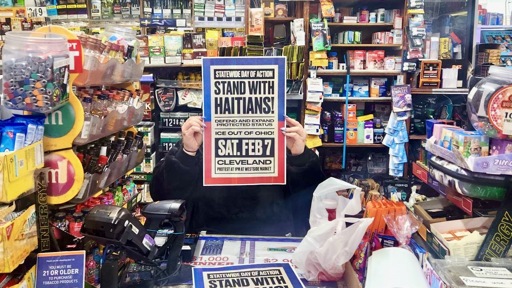
A federal judge blocked the Trump administration’s attempt to revoke Temporary Protected Status (TPS) for 300,000 Haitian immigrants in the US, following intense pressure from over 300 labor unions, faith groups, and rights advocates. The victory however, has done nothing to quell the outrage at the government’s efforts to terminate the protections. Community groups say tens of thousands of Haitian immigrants are especially vulnerable as ICE forces are set to deploy to Haitian hubs in the state of Ohio, Springfield and Columbus, according to a leaked White House memo.
That is why people across Ohio are gearing up for coordinated statewide actions on Saturday, February 7, to demand:
ICE out of Ohioan end to the racist campaign against Haitian immigrantsthe expansion of the TPS program
“People recognize holistically that the fight is far from over,” said Haitian-American organizer Rachel Domond, speaking to Peoples Dispatch.
“We have to keep fighting because right now Haitians are living in a legal limbo and could have their immigration status changed at any point.”
Defend and expand TPS
The judge’s ruling on February 2 was only a “temporary injunction” rather than an extension of the TPS program. Now that the Ohio community has been targeted, leaders say people won’t settle for defending TPS as it is. They are calling for the expansion of the entire TPS program.
“No one else can apply to be protected and there isn’t extra time on this status,” said Yola Lamarre, a community advocate with the Haitian Community Network.
“This leaves thousands of other Haitians at risk and at a legal limbo.”
She was speaking at a press conference at Columbus City Hall on February 3, hosted by faith leaders, community activists, and city officials, including Columbus Mayor Andrew J. Ginther. They all declared their solidarity with the Haitian community and called on people across Ohio to mobilize in the face of Trump’s attacks.
“People from all backgrounds, including local politicians in Columbus, faith leaders in Dayton and Springfield, are standing up and ready to defend Haitian people even in the face of this victory,” says Domond.
Despite the escalation of militarized violence by federal forces across the United States, organizers on the ground describe a deep commitment to resistance.
Minnesota led the way, now Ohio rises
“What happened in Minneapolis over the last couple of weeks has fundamentally changed the mood of the entire country and the willingness of people to stand up and fight back and unify across differences,” says Domond.
The historic general strike in Minnesota on January 23 grew into a nationwide shutdown the following Friday, January 30, in response to the murder of Alex Pretti by Customs and Border Patrol agents.
Now, a majority of people in the US support abolishing ICE (57%), according to a YouGov poll. In cities across the country, actions are happening daily to resist ICE. Businesses are coming together to commit to future strikes, community organizations are forming anti-ICE coalitions, and high school students are building a nationwide walkout movement against ICE operations.
Ohio in particular was rocked by massive walkouts on February 5 and 6. Hundreds of students at Walnut Hills High, Lorain High, Cincinnati High, Cleveland High, Lowell High, and many more, left school to call for an end to immigration enforcement operations.
The fight for Haitian migrants is deeply rooted across communities in Ohio, where Haitians form a core part of the economy and cultural life. But understanding why organizers say the expansion of rights and protections is long overdue requires looking at the deepening political and humanitarian crisis on the island itself.
The roots of displacement in Haiti
At the City Hall press conference in Columbus, speakers explained that although TPS is a temporary program, it is based on the qualifying conditions of the country of origin. The federal judge’s ruling was based on the lack of evidence that conditions on the Caribbean island warranted the termination of protections for its migrants.
“The US embassy in Haiti is shut down and the United Nations has expressed tremendous concern for the country’s condition,” said Yola Lamarre.
The situation in Haiti is serious. Heavily armed gangs control large areas of the capital Port-au-Prince and the Artibonite Department. Unprecedented violence claimed more than 5,000 lives in 2025 and internally displaced over 1.3 million Haitians.
Guillermo R. Barreto, a retired professor at Simón Bolívar University (Venezuela), argues that the violence and destabilization in Haiti is intentional, perpetrated by the United States government. In Peoples Dispatch, he wrote:
“It is important to note that these gangs have destroyed vital infrastructure, including 38 hospitals, six universities, and libraries, and have forced more than 1,000 schools to close. All of this, and the resulting demobilization of the population that this violence entails, calls into question the idea that these are simply conflicts between criminal gangs. These gangs regularly receive weapons and ammunition from the United States, and this action indicates a project that seeks to make the functioning of a nation unviable.”
Haiti was the world’s first Black republic and the first independent nation to abolish slavery, following a successful 13-year revolution (1791-1804) by enslaved African peoples. However, after the Haitian Revolution, France imposed a massive, long-term debt on the new nation for its independence. In the 20th century, the US took over the collection and control of Haiti’s finances, which continues to this day.
This week, the US deployed three warships to the Caribbean island, days before the mandate of the transitional government in the country is set to end.
“There is a reason people have fled the conditions in Haiti that have been created by the US fundamentally and they should be considered refugees in this country,” Domond told Peoples Dispatch.
“We can’t deny that Haiti is a war zone right now. We need to demand full and equal rights. Full legalization for Haitians at this point.”
Solidarity with migrant communities
Community leaders in Columbus also expressed solidarity with the hundreds of thousands of Venezuelans in the US who are in a similar position after TPS status was revoked for them, effective November 7, 2025. “Operation Buckey”, a DHS operation in Ohio in December 2025, heavily targeted Latin residents and was described as a “war on our community” by Columbus organizers.
With statewide actions set to unfold on February 7, organizers say Ohio is becoming a key front in the national fight against the deportation machine and the future of TPS. For Haitian migrants and all migrant communities, the message driving people into the streets is clear: protections must not only be defended, but expanded, and the conditions forcing people to flee must be confronted at their root.
The post Haitians in the US mobilize against ICE and deportation threats appeared first on Peoples Dispatch.
From Peoples Dispatch via this RSS feed
You must log in or # to comment.