

Drop Site is a reader-funded, independent news outlet. Without your support, we can’t operate. Please becoming a paid subscriber or making a 501©(3) tax-deductible donation today.
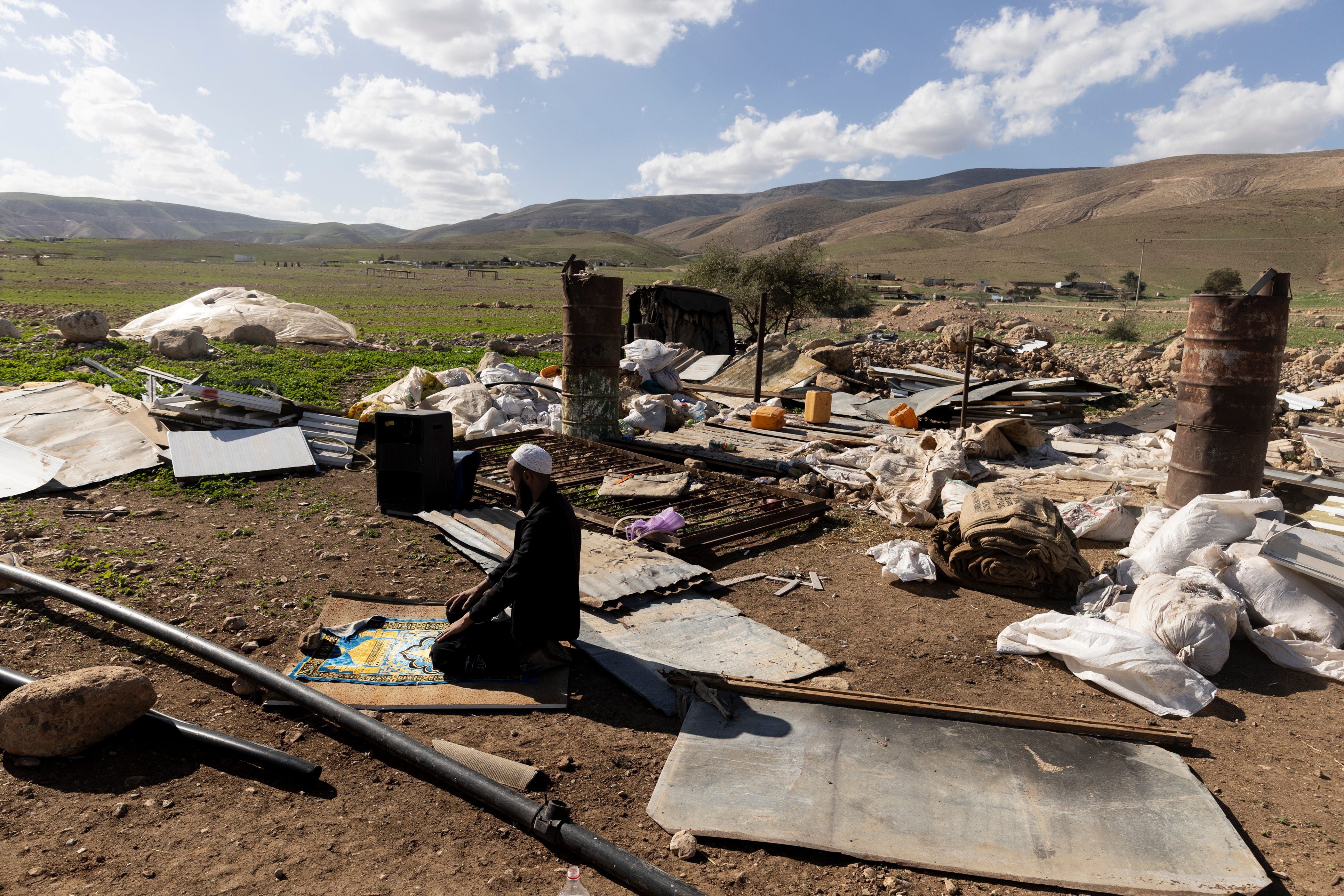
RAS EIN EL-AUJA, WEST BANK - JANUARY 12: A Palestinian Bedouin man prays at the remaining of a dismantled house, after a community is forced to evacuate their homes due to settlers harassment from a nearby outpost on January 12, 2026 in Ras Ein el-Auja, in the Jordan Vally West Bank. (Photo by Amir Levy/Getty Images)
AL-MAGHAYYER, Occupied West Bank—Over the span of four years, 50-year-old Fidda Mohammad Naasan and her family have been violently uprooted from their homes and lands in the occupied West Bank, not once but twice. Now, after relocating for a second time they continue to face relentless, daily attacks and abuse from Israeli settlers and soldiers determined to force them off their lands yet again.
The most recent large-scale attack on Naasan’s family took place on December 7. Israelis raided Naasan’s current home in the al-Khalayel area on the edges of al-Mghayyer village in the central West Bank.
“I was sleeping in my room with my 13-year-old grandson next to me. At 1:30 a.m., a group of five settlers raided my room, all masked, carrying pipes. They beat me on my forehead until I lost consciousness,” Naasan told Drop Site News.
Naasan was hospitalized for two days and was forced to undergo cardiac catheterization surgery following heart complications and a severe rise in her blood pressure. Her nephew also suffered cuts to his head and required six stitches.
“While he was beating me, the settler kept shouting: ‘Don’t you want to leave? If you don’t leave we will kill you,’” she recalled. “I lied and told him I would leave just so he would stop beating me.”
Naasan and her family once lived on their ancestral lands in the Wadi Daliyeh area south of Fasayil village in the central Jordan Valley. With a water spring and vast grazing lands, the area is ideal for Palestinian Bedouins who depend on livestock for income. From there, they were driven off their land by settlers to an area near the village of Turmusayya in the central West Bank where they spent the next two years.
Just before the onset of Israel’s genocide in Gaza in October 2023, a settler killed 15 of their sheep by driving over them with his ATV, pushing the family to leave once again. They bought a plot of land on the edges of al-Mghayyer village, east of Ramallah, where they are currently living.
Naasan says she refuses to be displaced a third time despite the routine terror from settlers and military occupation forces.
At the end of January, Naasan’s 34-year-old daughter-in-law, Fatima, moved from al-Khalayel to a home inside the village of Mghayyer after she gave birth, out of fear for her newborn. In May 2025, Fatima was assaulted by settlers as she tried to protect her father, in an incident captured on video and widely shared on social media. She was then arrested by the military before being released the next day without charge.
“Both the soldiers and settlers keep ordering us to leave. A soldier recently threatened me when I told him we won’t be going anywhere. He said, ‘You’ll be seeing another side of me.’ I responded: ‘We saw that side a long time ago. No one is leaving,” she said…“They raid our area at least three times every day, including at night. It’s terrifying.”
“Maximum land, minimum population”
The story of the Naasan family is emblematic of an Israeli state-backed campaign of forcible transfer unfolding across the West Bank at an unprecedented rate. What was once creeping encroachment by settlers has escalated over the past three years into a violent campaign of mass expulsion.
Since the onset of the Gaza genocide, a staggering 10,000 Palestinians have been internally displaced across the West Bank, with entire villages emptied, dismantled, and erased. This is in addition to the more than 30,000 Palestinians displaced from the Jenin, Tulkarem, and Nur Shams refugee camps in a large-scale Israeli military operation launched in January 2025, which marked the largest displacement of Palestinians in the West Bank in one operation since the 1967 war. Over that same period, more than 1,000 Palestinians—nearly a quarter of them children—have been killed.
The scale and speed of displacement as a result of Israeli settler and military violence, home demolitions and access restrictions are only accelerating. Since the beginning of 2026, nearly 700 Palestinians have been displaced, affecting nine villages and herding communities, according to the UN Office for the Coordination of Humanitarian Affairs (UNOCHA).
Palestinian experts say what is unfolding across the occupied West Bank and Jerusalem is not spontaneous, incidental, or the work of fringe extremists, but rather a deliberate, state-funded project of demographic engineering—geographically planned, openly articulated, and systematically executed.
Over the past several years, the Israeli government and other quasi-governmental organizations like the World Zionist Organization (WZO) and the Jewish National Fund (JNF) have funded the building of illegal outposts and provided them with basic services to the tune of over $26 million.
The foundation for the current settlement project was laid by the Oslo Accords signed in 1993 and 1995, which fragmented the occupied West Bank into Areas A, B, and C. The Palestinian Authority nominally controls civil and security affairs in Area A, and just civil affairs in Area B. These are also the two areas where most of the three million Palestinians in the West Bank live, crowded into cities, towns and villages.
Israel retained full control over Area C—the largest section of the West Bank comprising more than 60 percent of the territory and containing nearly all farmland, grazing areas, water resources, and borders to the outside world. Area C also contains the vast majority of the more than 200 illegal Israeli settlements, as well as military bases and all other occupation-related infrastructure. This structure enabled illegal settlement expansion, strangled Palestinian development, and accelerated the forced transfer of rural and Bedouin villages living in Area C.
Though Oslo was meant to be a stepping stone to Palestinian statehood, Israel has since tripled its settler population in the West Bank over the past three decades. Currently, some 750,000 Israelis are living illegally in settlements in and around Palestinian cities and villages, which have become increasingly divided from one another in isolated cantons.
In recent months, senior Israeli officials have openly advocated for the unilateral annexation of the West Bank and introduced bills in parliament to make it official. People like Israeli Finance Minister Bezalel Smotrich have explicitly articulated a policy aimed at consolidating territorial control while minimizing Palestinian presence as: “maximum land, minimum population.”
Jamal Jumaa, the coordinator of the grassroots Stop the Wall Campaign and a secretariat member of the Boycott Divestment and Sanctions National Committee (BDS), said the West Bank is being “ethnically cleansed, fragmented and annexed in every sense of the word.”
“Right now, Israel is trying to annex the largest possible area of the occupied West Bank,” Jumaa told Drop Site. “They are doing this by forcing Palestinians into population centers. They are pushing people from Area C into Areas B and A.”
“Since the war on Gaza, this strategy has severely intensified, and what we’re seeing is that settlers and army are not only attacking area C, but also area B, and even area A at times,” Jumaa said.
In a statement last week, Ajith Sunghay, the head of OHCHR OPT reiterated the “forcible transfer of Palestinians within the occupied West Bank is a war crime and may amount to a crime against humanity.”
Erasure of Palestinian Bedouin Villages
This is precisely what happened to Fidda Naasan’s son and daughter-in-law, Fatima, who were forcibly transferred from Area C into Area B, and what settlers are continuing to try and force her to do.
The central Jordan Valley—the area between Ramallah and Jericho—once housed one of the largest concentrations of Palestinian Bedouins across the entire West Bank. More than 60 Palestinian Bedouin villages have been entirely expelled and erased since 2022, with most of these forced removals occurring since the start of the Gaza genocide in October 2023.
Fidda Naasan’s Bedouin community of al-Daliyeh, east of Ramallah, in the central Jordan Valley, was one of the first to be displaced in 2022. Between January 11-28, the last remaining Palestinian Bedouin village between Ramallah and Jericho–Ras Ain al-Auja—was fully transferred out of the area and wiped off the map.
“You’re talking about an area over 1,000 square kilometres. That’s three times the size of the Gaza Strip, taken over by force in a matter of years,” explained Jumaa.
On January 26, following repeated attacks by Israeli settlers, the remaining 100 residents of Ras Ain al-Auja’s Bedouin community dismantled their homes and packed their belongings onto trucks, many to an unknown fate. In total, 600 Palestinians were displaced from Ras Ain al-Auja, “marking the highest single-community displacement due to settler attacks and access restrictions over the past three years,” UNOCHA said in a statement.
As residents were being expelled, dozens of Israeli settlers moved in, immediately taking over the land with hundreds of sheep across the village’s fields—a stark example of forced displacement followed almost instantaneously by settler takeover.
Haytham Zayed, a 25-year-old lawyer from Ras Ain al-Auja, was uprooted along with his family and relocated temporarily to an area roughly five kilometers away where they live without access to electricity or running water.
“After this, I have given up on life entirely,” Zayed told Drop Site. “This humiliation—we will never forget it,” he said, adding “Our children aren’t attending school. We don’t sleep. We can’t even provide food for our families. We can’t meet our children’s most basic needs…I swear to you, when we lay our heads down at night, we pray that morning never comes.”
He described the conditions of displacement as degrading and unbearable. “We don’t even have bathrooms. Imagine—my sisters don’t have bathrooms. It’s a disaster,” he said. “These were the hardest ten days of my life.”
Mustafa Barghouti, a prominent Palestinian political leader, told Drop Site the only way to stop Palestinian dispossession was to impose international sanctions on Israel.
“There is a very serious process of annexation and Judaization of the occupied West Bank,” Barghouti said. “Israel has completely destroyed the Oslo agreement and now is intentionally trying to kill any potential for a Palestinian state, and they’re not hiding it. That’s what [Israeli Prime Minister] Netanyahu himself says,” he continued. “The Palestinian Authority must give up all their false dreams about the possibility of a solution with the Zionist movement.”
“They must give up all these illusions about the Oslo Accords and move in the direction of the unity of all Palestinians in what has now become an existential threat to all Palestinians, and the need to struggle for our survival.”
From Drop Site News via this RSS feed