

Noam Chomsky’s life and work cannot be understood without understanding that there were always two Noam Chomskys: one working for the US military, in his research job at the Massachusetts Institute of Technology (MIT); the other working tirelessly against that same military.
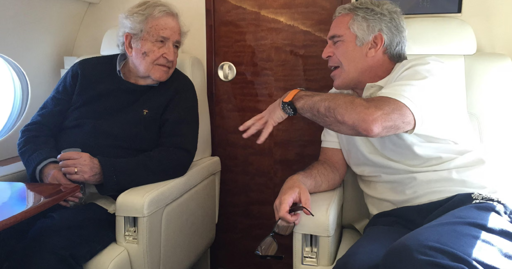
In May 2023, when it was first revealed that Chomsky had met with Epstein “a number of times”, the exact nature of their relationship wasn’t clear. Consequently, admirers of Chomsky’s anti-militarism, like myself, could still feel inspired by his powerful denunciations of US foreign policy.
Emails released last month by the US Department of Justice, however, now make it difficult to respect Chomsky’s views on anything at all.
One email from the famed academic and his second wife Valeria describes their friendship with Epstein as “deep and sincere and everlasting”. Other messages – signed only by Chomsky – are equally generous to the already convicted sex offender, saying, for example, “we’re with you all the way” and “you’re constantly with us in spirit and in our thoughts.”
The emails even reveal that shortly before Epstein’s arrest and death, in July and August 2019, Chomsky was still intending to be interviewed for a documentary that Epstein was making. It seems Chomsky remained loyal to his cherished “friend” right until the end. On Monday, Valeria Chomsky issued an apology on both her own and her husband’s behalf, saying they made “a grave mistake” and a “lapse in judgement”.
An odd pair.
To understand this shocking reality, we first need to understand that in the years following his 2008 prison sentence, Epstein worked hard to collect what he called “the world’s smartest people”. He even talked about arranging a dinner party with “Noam Chomsky, the movie director Woody Allen, former president Bill Clinton, and the living God, the Dalai Lama.” This wasn’t just casual schmoozing. As a way to clean up his public image, Epstein was deadly serious about getting as close as he could to such celebrities.
So it’s clear why Epstein wanted to befriend Chomsky. But how could Chomsky end up befriending Epstein?
The most straightforward explanation is that Epstein was a skilled manipulator who worked hard to charm and befriend Chomsky and his wife by offering them financial services and, at one point, [a place to live](https://www.justice.gov/epstein/files/DataSet 9/EFTA01054046.pdf). Meanwhile, Chomsky was particularly vulnerable to such offers because he’d found himself in a highly distressing family dispute over money, which the 89-year-old described to Epstein as the [“worst thing that’s ever happened to me”](https://www.justice.gov/epstein/files/DataSet 9/EFTA01048717.pdf).
This is a striking statement considering that Chomsky had earlier spent two traumatic years caring for his first wife while she suffered from terminal brain cancer. By late 2018, these tragic events had led to a shocking and surreal situation in which, in [various](https://www.justice.gov/epstein/files/DataSet 9/EFTA01010003.pdf) [email chains](https://www.justice.gov/epstein/files/DataSet 9/EFTA01032525.pdf), Epstein was advising Chomsky on his painful dispute with his family, while Chomsky was advising Epstein on how best to respond to press coverage of his appalling history of sexual abuse.
Some years later, in May 2023, when confronted by journalists about his involvement with Epstein, Chomsky offered no apologies. He told them instead that the disgraced financier had “served his sentence, which wiped the slate clean” and that he’d met all sorts of people in his life, including “major war criminals” and didn’t regret meeting any of them.
What he didn’t say to journalists, but to a friend, was that he was completely unaware of the more serious accusations against Epstein. This is a claim repeated in Valéria Chomsky’s recent statement that they originally met Epstein at a “professional event” in 2015 and were both unaware of the “full extent” of his crimes until after his arrest.
Many commentators have found it difficult to believe that the world’s leading critic of the US establishment could have been quite so unaware of who Epstein really was. Some have understandably blamed Chomsky’s behaviour on a blindness both to gender issues and to problems of sexual violence and abuse.
I remain unclear about what he did or did not know. What is clear to me, however, is that Chomsky was accustomed to finding positives in people whom he would have shunned as criminals had he not encountered them via his professional life at MIT.
‘If somebody’s got to be running the CIA, I’m glad it’s him.’
A telling example is John Deutch, an MIT scientist who played a leading role in the Pentagon’s nuclear and chemical weapons strategy before becoming deputy defense secretary and then director of the CIA. As a passionate anti-militarist, Chomsky surely judged Deutch harshly. Yet in various interviews, he describes Deutch as a friend who “has more honesty and integrity than anyone I’ve ever met in academic life, or any other life. … If somebody’s got to be running the CIA, I’m glad it’s him.”
Deutch wasn’t the only Pentagon figure with whom Chomsky got along. “I’m at MIT,” he explained in 1989, “so I’m always talking to the scientists who work on missiles for the Pentagon.” He did this even though, in 1969, he’d condemned such scientists for having the same attitude as “Nazi scientists” in view of their indifference to the millions who would die if the nuclear missiles they were designing were ever used.
At this point, it’s worth recalling why Chomsky was recruited to MIT in the first place: it was to conduct research for Jerome Wiesner, a Pentagon scientist who later became a top adviser to President Kennedy.
Wiesner played a key role in setting up the US’s entire nuclear missile programme, including its command and control systems. He evidently kept funding Chomsky’s unusual kind of linguistics in the expectation that it might eventually enhance this terrifying technology.
Despite Chomsky’s denials, the evidence for this is overwhelming. For example, in the early 1960s, Lieutenant Jay Keyser – who would later become the head of MIT’s linguistics department – was quite explicit that Chomsky’s theories might one day be useful in the computerised control of missiles and aircraft, including B-58 nuclear-armed bombers.
An MIToffshoot called the Mitre Corporation was particularly interested in Chomsky’s ideas and actually employed him as a “consultant” for a research project that was always meant to support the “development of US Air Force-supplied command and control systems” – systems clearly intended to enable the control of nuclear weaponry.
Fortunately, this research was years away from being developed into actual weapons systems. This, however, wasn’t enough to reassure Chomsky’s anti-militarist conscience, and in 1967, he seriously considered resigning from MIT.
Understandably, the advantages of a career at MIT seemed too attractive to renounce. So Chomsky decided to keep his job, while salving his conscience by campaigning against the very military establishment that employed him.
Anyone familiar with Chomsky’s political writings will know the authenticity of his rage at the US military. That’s one side of the complex figure. But the celebrated linguist’s attempts to whitewash MIT’s military collaboration – especially his excuses for Deutch and Wiesner – reveal a wholly different side to him. There have always been two Chomskys: the MIT professor loyal to the US military-industrial establishment, and the anti-militarist dissident bitterly opposed to that establishment.
The two Chomskys.
In my view, it was the first Chomsky, the loyal MIT professor, who was open to befriending Epstein. After all, he’d befriended many dubious establishment figures in the past. It was the second Chomsky, the tireless campaigner, whom his former assistant, Bev Stohl, had in mind when she said in response to his growing chorus of critics: “I observed his total dedication to humankind. He barely slept [and] had to be reminded to eat.”
Personally, I never had much time for the theoretical approaches of either of the two Chomskys – although I certainly appreciated his writings on global conflicts, especially with respect to Israel and Palestine. Chomsky, on the other hand, always found my critiques of his work completely intolerable, at one point accusing me of peddling “defamation and deceit”.
My long-term project to decode Chomsky came from a realisation that his deeply reactionary linguistic theories lay behind nearly everything that was wrong with the paths taken by anthropology, linguistics and the human sciences since the 1970s. I am referring here to the so-called “cognitive revolution” in these various branches of science.
The essence of this “revolution” can be summed up as philosophical idealism, a decisive reversal of the insights of Karl Marx. This idealism leads to a prioritising of mind over matter, internal computation over public action. Whenever thinkers do this, they follow in the patriarchal tradition of assuming that men represent the necessary superiority of mind and culture over women as mere nature.
In perhaps his most shocking email to Epstein, Chomsky refers to the burgeoning #MeToo movement as “the hysteria that has developed about abuse of women, which has reached the point that even questioning a charge is a crime worse than murder.” Although in 2018, Chomsky suggested that #MeToo was “a very healthy development”, it’s quite clear that he never took the insights of feminism to heart (in her statement, Valeria Chomsky rejects this notion: “Noam’s criticism was never directed at the women’s movement; on the contrary, he has always supported gender equity and women’s rights,” she said. “What happened was that Epstein took advantage of Noam’s public criticism towards what came to be known as ‘cancelling culture’ to present himself as a victim of it.”).
Chomsky was at no point the perfectly principled radical intellectual admired by so many of his followers. If he had been, he would have resigned from MIT long ago. Yet, had he done so, he would never have come to know the US military establishment from the inside in a way that enabled him to become that establishment’s most knowledgeable and assured critic.
It would be foolish to stop learning from his writings. It would be equally foolish to gloss over his mistakes. Instead of deciding whether to cancel or exalt him as an individual, I suggest we prioritise developing what he advocates, however hypocritically: a revolutionary politics for our times.
From Novara Media via this RSS feed
I’m going to be honest, I didn’t know shit about him until this Epstein stuff.