

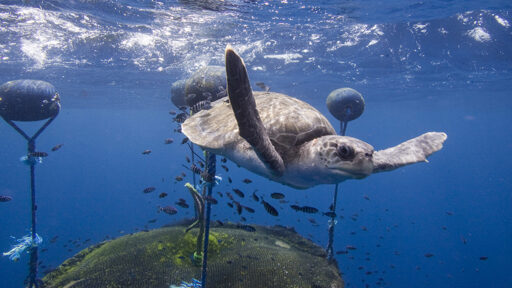
SANTA CRUZ, GALÁPAGOS ISLANDS, Ecuador — “Good morning,” Walter Borbor, a social media-famous fisher, says to his followers in a 2022 Instagram video. “What we have here is a plantado.” He points to a large black floating device with a trailing rope that’s wrapped around the tail of a decomposing whale — right in the middle of the Galápagos Marine Reserve. Plantado is the local name for a fish aggregating device (FAD), a tool industrial tuna fleets commonly deploy to attract numerous tuna they can scoop up all at once. Modern drifting FADs have been used since the 1980s to improve fishing efficiency. Over the past 25 years, they’ve become the primary tuna fishing method, according to a May study in the journal Science. Meanwhile, Ecuador’s tuna fleet grew by roughly half over the same period. Both factors have contributed to more and more abandoned FADs drifting into the Galapagos Marine Reserve from international fleets, sources told Mongabay. Abandoned FADs pose numerous problems. They shed plastic as they break down, damage coral reefs and collide with artisanal fishing boats. Inti Keith, a researcher with the Charles Darwin Foundation, a Galápagos-based science and conservation group, said scientists routinely find sharks, turtles, sea lions, seabirds and other wildlife entangled in the netting — or worse, dead. Now, Galápagos agencies and organizations are banding together to better track and collect these devices. But the root of the issue — their deployment outside the marine reserve — remains a challenge. Yellowtail surgeonfish (Prionurus punctatus)…This article was originally published on Mongabay
From Conservation news via this RSS feed
You must log in or # to comment.