

This is an edition of The Atlantic Daily, a newsletter that guides you through the biggest stories of the day, helps you discover new ideas, and recommends the best in culture. Sign up for it here.
Last night, during Super Bowl halftime, I watched a mustachioed entertainer put on a show that celebrated working-class values, the pleasures of a good party, and the virtues of marriage, with a side serving of grievance against elites. This wasn’t Bad Bunny’s performance—it was the alternative performance put on by Turning Point USA, led by Kid Rock. Despite the best efforts of the organizers to stoke controversy, I couldn’t help but notice how much overlap there was between its message and the one the Puerto Rican superstar delivered in Santa Clara.
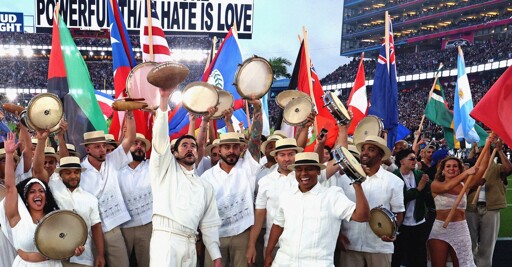
As my colleague Spencer Kornhaber writes, Bad Bunny’s show was unifying rather than divisive, but it did have a political message: that working hard, playing hard, and loving America aren’t values that belong to any political group or linguistic heritage. Although Turning Point’s show was intended to offer a radical contrast, the many thematic convergences only strengthened that argument.
Above all, the Turning Point show was boring and dour. It kicked off with a distorted-electric-guitar rendition of “The Star-Spangled Banner,” a Jimi Hendrix pastiche shorn of all the irony and pathos of the famous version at Woodstock. Brantley Gilbert played “Real American,” a bland piece of nu-metal/country patriotic kitsch, and “Dirt Road Anthem,” a paean to drunk driving. Gabby Barrett, a former American Idol third-place winner, sang a kiss-off to a cheater and then a love song to “one of the good ones.”
More overtly political, at least in theory, was Lee Brice’s “Drinking Class.” “I’m a member of a blue-collar crowd / They can never, no, they can’t keep us down,” he sang. “Monday through Friday, man, we bust our backs.” This is a common sentiment in contemporary country music, but it is not, despite what Brice might believe, unique to white conservatives. The New York Times wrote that Bad Bunny “was summoning a Latin heritage across generations, one that recognized hard work—cane-cutting, electric-grid repairs—alongside the good times workers sweated to earn.”
These kinds of echoes were all over the two shows. Kid Rock extolled marriage, singing, “You can always put a diamond on her hand / ’til you can’t,” and Charlie Kirk, the assassinated founder of Turning Point, was heard encouraging marriage in an old audio clip; Bad Bunny hosted an actual wedding during his performance. Both shows used “real” instruments as signifiers of authenticity—workmanlike performances on guitars and drum kits for the Turning Point set (except from Kid Rock, who appeared to be lip-synching his 1999 hit “Bawitdaba”); a brass salsa band and the characteristic Puerto Rican cuatro during Bad Bunny’s.
“We fly that red, white, blue, high, waving all across the land,” Gilbert sang. Bad Bunny flew that red, white, and blue too, along with flags from Puerto Rico and other countries in North and South America, declaring, “God bless America.” The fact that the patriotism he displayed was more complicated and nuanced that Gilbert’s does not make it any less genuine. Bad Bunny even danced on top of a pickup truck, a visual that would have worked perfectly for any of the Turning Point performers if they hadn’t been playing on a darkened, austere soundstage.
Each show also had its complaints about mistreatment by elites, but not all grievances are equally legitimate. During “El Apagón,” Bad Bunny performed atop imitation power poles topped with sparking transformers—a symbol of Puerto Rico’s fragile power grid, and of the political corruption and imperial neglect that let it get that way. But whereas the Jumbotron behind Bad Bunny at Levi’s Stadium declared The only thing more powerful than hate is love, Brice delivered swipes at liberals and trans people in a new song called “Country Nowadays,” which nevertheless complained that “because I have my morals and my small-town point of view / You assume that you don’t like me means that I don’t like you too.” Could that be because of your lyrics?
This unearned sense of grievance is what animated the backlash to Bad Bunny’s performance and inspired Turning Point’s alternative show. Right-wing pundits charged that Bad Bunny’s message would be divisive (it wasn’t) or that he was an immigrant (he’s not). President Trump ranted about the show on Truth Social, writing that it was “absolutely terrible, one of the worst, EVER! It makes no sense, is an affront to the Greatness of America,” adding that “Nobody understands a word this guy is saying, and the dancing is disgusting.” Laura Loomer was more straightforward in her condemnation: “This isn’t White enough for me,” she posted on X.
If the people participating in the Bad Bunny backlash slowed down and looked a little closer, they might find that they actually have a great many values in common with him. (Well, maybe not Loomer. Some Bad Bunny critics are just bigoted.) This might provide the grounds for just the sort of understanding and reconciliation that Brice claims to want. Other Americans will notice, however, how familiar and relatable Bad Bunny’s ethos was, even if they couldn’t understand his Spanish-language lyrics.
Almost as important as the message of Bad Bunny’s show was the exuberance with which he conveyed it: Living these American values could be joyful, he suggested. It was, as Spencer wrote, a performance “rooted in the good old-fashioned pleasure principle.” Meanwhile, the Turning Point musicians sang about having a good time, but they didn’t appear to be having a good time. If right-wing leaders wonder why MAGA has struggled to overtake the country’s cultural establishment, they might start with the very different ways the two shows framed shared values.
Related:
Trump’s golden age of culture seems pretty sad so far.How Bad Bunny did it
From The Atlantic via this RSS feed
You must log in or # to comment.