

Drop Site is a 100% reader-funded, independent news outlet. Without your support, we can’t operate. Please consider making a 501©(3) tax-deductible donation today.
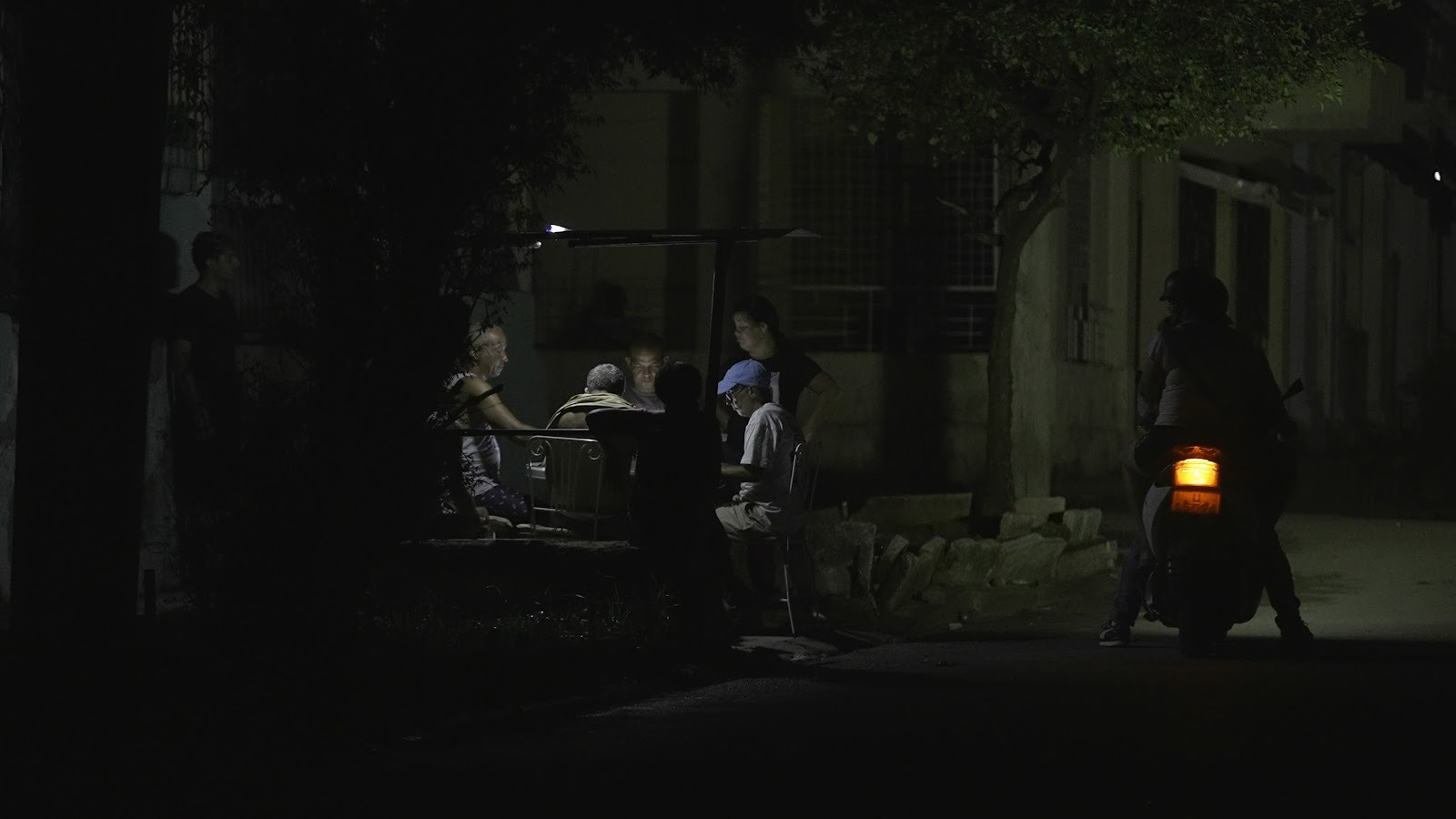
A blackout in the 10 de Santo Suarez neighborhood of Havana in September. Power outages have gone from 4-6 hours a day in Havana several months ago to upwards of 12 hours a day in recent weeks. Photo: Belly of the Beast.
Today’s story is written in collaboration with the news outlet Belly of the Beast, an independent media organization that covers Cuba and U.S.-Cuba relations.
MEXICO CITY, MEXICO—U.S. President Donald Trump followed through on his threat to impose an oil blockade on Cuba, declaring the government led by Miguel Díaz-Canel an “unusual and extraordinary threat” to U.S. national security and announcing, on January 29, punishing tariffs on any country that provides oil to Cuba.
Washington’s effort to forcibly compel other countries to join its internationally condemned blockade threatens to further squeeze a population that is already experiencing enormous strain due to U.S. sanctions.
The Cuba-based media outlet Belly of the Beast recently spoke to Cubans in the capital—normally insulated from some of the worst impacts of the blockade but is now also experiencing blackouts—who described an increasingly difficult situation.
“The future is extremely uncertain but something has to happen, somehow, because we’re the ones suffering the most. Something has to happen because electricity is impossible to get, food is getting more and more expensive,” 36-year-old Raydén Decoro told Belly of the Beast. “Right now, fuel is only available in dollars, and inflation keeps rising.”
Keep up with Drop Site:
Cuban officials announced Friday a nationwide and far-reaching energy-saving plan that prioritizes fuel and electricity for essential and life-saving services. The measures also expand solar power deployment, sharply reduces transport services, and cut down operating hours for schools, universities, and workplaces. The aim is to protect health care, food and water supply, and social services amid an acute energy shortage caused by the U.S. blockade.
The country has already notified airlines that they will be unable to refuel international flights for at least a month, further complicating tourism to the island, a vital source of income for Cuba.
“Things have gotten worse this month. More hours of blackouts. My daughter in Baracoa [located in eastern Cuba] experiences 16 hours of power outages, and she has three children,” said 61-year-old Carlos Villaurrutia. “It’s a complete injustice. There won’t be anything for anyone.”
Trump’s executive order directly pressures Mexico and Mexican President Claudia Sheinbaum has so far buckled to that pressure. Mexico’s state-owned oil company PEMEX became Cub’a’s major supplier of oil given that shipments from Venezuela to Cuba were suspended following the U.S. blockade of Venezuela and the kidnapping of President Nicolás Maduro last month. PEMEX, which suspended a shipment of oil to Cuba in January, maintains that its deliveries are part of a 2023 contract with Cuba and the company is willing to continue to provide crude to the country. Víctor Rodríguez Padilla, director general of the state oil company, says a diplomatic solution must come first in order to avoid reprisals from Washington.
Two vessels from the Mexican Navy carrying humanitarian aid departed Sunday for Cuba. Sheinbaum said her country is directly exploring a diplomatic solution with Washington in order to resume deliveries of oil.
“What the U.S. is doing is not fair, it is a country that is using force, its power, and the pressure of an underlying threat of military invasion to pressure Cuba and other countries,” said Yosvani Pérez, a 30-year-old community manager from Havana.
Cuba’s energy infrastructure relies on foreign imports for energy generation and reportedly is only weeks away from running out of oil. Cubans describe a deteriorating situation on the island, especially with the recent suspension of oil shipments from both Venezuela and Mexico.
“I think everything is going to get even worse. There will be more power outages, less freedom of movement for people, many businesses will close, leading to greater food shortages, higher prices, and so on, a chain of problems with no end in sight,” Eduardo Riviera, a 28-year-old waiter in Havana told Belly of the Beast.
Meanwhile, the Russian Ambassador to Havana, Viktor Koronelli, told Sputnik in an interview that his country intends to continue supplying its oil to Cuba. Russia, already subject to sanctions, is less exposed to threats of further U.S. measures than Mexico, which has thus far avoided new tariffs on its exported goods despite repeated threats from Trump since his return to the White House.
Nonetheless, with an emboldened Trump administration and the revision of the United States–Mexico–Canada Agreement already in progress, the Sheinbaum government is reluctant to enter into direct conflict with Washington.
Grassroots organizations in Mexico are mobilizing to back Sheinbaum’s efforts to alleviate the humanitarian situation in Cuba. On February 1, several hundred demonstrators gathered in front of the former site of the U.S. Embassy in Mexico to deliver a message to the Trump administration but also to the Sheinbaum government.
“Yes we know there’s a lot of pressure on Mexico, on the Mexican government…but that doesn’t change our history: We’ve never abandoned Cuba, and now is not the time to do so,” Tamara Barra of the Mexican Movement in Solidarity with Cuba told Drop Site News in Mexico CIty.
Barra says they will continue to work to give room for the Sheinbaum government to operate on this question while building a broad front of social movements, grassroots organizations, and trade unions to push the Sheinbaum government to break the blockade of Cuba.
In the meantime organizations inside Mexico are working to deliver humanitarian aid directly. The Association of Recent Cubans in Mexico “José Martí” launched a campaign last August on the occasion of the 100-year anniversary of the birth of Fidel Castro to procure and deliver a shipment of oil to Cuba.
“The idea takes up a precedent from the ‘90s, precisely here in Mexico, during the Special Period, when two oil tankers were sent to Cuba, in other words, there is a historical precedent, and it is a tribute to Comandante [Fidel Castro], but at the same time, it reactivates solidarity with Cuba and helps to alleviate the difficult economic situation our people are experiencing,” Olivia Garza Joa told Drop Site.
Garza describes an already complex situation for her own family members living in Cuba but says an oil blockade would be devastating.
“The human cost would be incalculable; it would be a Gaza in the Caribbean where nothing gets in and all because of a desire to starve and subdue the Cuban people,” said Garza.
She says without fuel, the country would grind to a halt: “In other words, there’s no transportation to get around, to go to school, or to work; there wouldn’t be electricity for hospitals, intensive care patients could die, dialysis patients wouldn’t be able to receive their treatment, and that goes for the entire healthcare system.”
In nationally televised remarks Thursday, President Díaz-Canel rejected allegations that his country represents a threat but warned that the country was preparing to move into a “state of war” if necessary.
“Our country’s defense doctrine, or military doctrine, is based on the concept of the People’s War, which is a concept of defending the country’s sovereignty and independence,” said Díaz-Canel. “It in no way contemplates, at any point, in any section, or under any concept, aggression against another country. We are not a threat to the United States.”
Despite the rhetoric from U.S. officials and the de facto oil blockade, Díaz-Canel said his government is open to dialogue with the United States. Cuban Deputy Foreign Minister Carlos Fernandez de Cossio told Reuters that the two governments are in communication but that there are no formal high-level talks yet.
The U.S. announced Thursday $6 million in aid to be delivered by the Catholic Church and the Catholic charity group Caritas in order to circumvent the government. Senior State Department official Jeremy Lewin said U.S. officials would be “making sure that the regime does not take the assistance, divert it, try to politicize it.”
Washington pins the blame for the economic situation on the island on the Cuban government, claiming they are hoarding the country’s resources.
Pérez, the community manager, said the U.S. blockade is largely responsible but he also says the government has been too dependent on oil deliveries from foreign states and should have explored energy generation alternatives much sooner.
“There are several culprits, but the only victim is the people of Cuba,” Pérez told Drop Site and Belly of the Beast.
Despite the challenging circumstances, many also express a clear defiance of Washington’s efforts to dominate countries in the region.
“The revolution isn’t going to fall. We’ve been through worse. I lived through the Special Period and I survived,” said Villaurrutia referring to the economic crisis in the ‘90s following the collapse of the Soviet Union and the end of its support for Cuba.
“No one here is going to surrender,” 61-year-old retiree Caridad Ramírez told Belly of the Beast. “That’s why we Cubans are warriors, we are warriors because if Trump comes here to fight, I’ll be the first to pick up a rifle and defend my land because this is my land where I was born.”
From Drop Site News via this RSS feed