

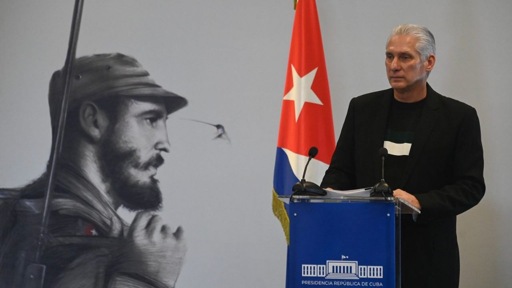
Cuban President Miguel Díaz-Canel spoke to the press on Thursday, February 5, about the situation facing the island in the wake of the latest measures imposed by Washington.
Following the seizure of Venezuelan tankers bound for Cuba by the United States Military, the Trump administration increased pressure on the island, which has been under an economic and commercial blockade for more than 60 years, by threatening to increase tariffs on any country that sells fuel to Cuba.
The US military campaign against Venezuela, including a naval blockade on oil and the kidnapping of the president and the first lady, cut off one of Cuba’s only alternatives for obtaining oil.
In his address, the president reported that no fuel has entered Cuba since December.
The loss of fuel supply severely complicates the electricity supply on which schools, transportation, and vital health infrastructure depend. In view of this, several analysts have called Trump’s latest measure against the Cuban people “genocidal”.
“Cuba is not a threat to the United States”
Díaz-Canel said he is aware of the difficulties and painful hardships that the Cuban people are going through following a decision that Washington justifies based on an alleged threat that Cuba poses to its national security, something that has been widely questioned by various analysts and politicians around the world.
On this subject, a deeply moved Díaz-Canel said during his appearance: “Cuba is not a terrorist country, nor is it a threat to the security of the United States. Cuba has never carried out, nor proposed, nor organized any aggressive action that puts at risk the territorial integrity, the security, or the stability of the government of the United States.”
He added: “We do not protect terrorists, and there are no military forces in Cuba from other nations or from other groups. In Cuba, there is indeed a military base – an illegal military base – and it is an illegal United States military base on Cuban soil, in the province of Guantánamo, against the will of the Cuban people.”
Cuba proposes dialogue “between equals”
In response, he affirmed that Cuba has always been and remains willing to engage in dialogue with Washington, although he clarified that “dialogue under pressure is not dialogue.” In this regard, he said that Cuba advocates civilized relations between neighbors, but rejects blackmail, threats, and impositions by some countries on others as a method of negotiation. He thus demanded respect for Cuban sovereignty.
Díaz-Canel said that his government is willing to meet with officials from the Trump administration to discuss the situation between the two countries: “Cuba is open to dialogue on any issue that needs to be debated or discussed, as long as there is no pressure or preconditions, in a situation of equality and respect for our sovereignty, independence, and self-determination.”
The theory of collapse
According to Cuban Foreign Minister Bruno Rodríguez, between March 2024 and February 2025 alone, the damage caused by the economic blockade of Cuba amounts to 7.556 billion USD, which represents a 49% increase compared to the previous period, showing that the blockade causes greater damage over time.
For his part, the Cuban president recalled that the US strategy of applying pressure until the country collapses is not new, and that despite all the difficulties Cuba has had to endure, it is not a failed state, as claimed by the White House: “The theory of collapse and the insistence on it is related to a whole set of constructs that the US government has tried to use to characterize the Cuban situation. This theory of collapse is associated with one of the currents in which the US government is determined to overthrow the Cuban revolution.”
Currently, he said, Cuba is enduring not only a series of mechanisms that seek to suffocate the Caribbean country, combined with the constant threat of military aggression, but also a media campaign that combines slander, hatred, and psychological warfare to justify various US attacks.
Read more: For the Cuban people, surrender is not an option
However, the Cuban president also pointed out that, despite the new conditions following the attack on Venezuela on January 3, there are several signs of international solidarity with his government: “Cuba is not alone, and we know that there are countries and companies willing to continue working with the largest of the Antilles.”
The revolutionary government’s decisions: savings and defense
Faced with this difficult situation, Díaz-Canel outlined the decisions his government has taken to tackle this new onslaught: “We have had to make a series of assessments in the Political Bureau, the Executive Committee of the Council of Ministers, and the National Defense Council, and we have just had a meeting in the Council of Ministers to update the plan to be implemented based on government directives to address an acute fuel shortage.”
Cuba has implemented fuel rationing to ensure the functioning of essential and basic activities for the Cuban population, although he acknowledged that the difficulty has been enormous, considering that no oil shipments have arrived in Cuba throughout 2026. This will mean a reduction in public transportation and an increase in blackouts on the island, which have already broken records.
In response, the Cuban president raised the possibility of increasing other types of energy sources, such as renewable energies, although this process will take time. Therefore, he said, the government must now demonstrate enormous creativity to overcome this new barrier that the United States, the most powerful country on earth, is unilaterally imposing on a country of just 10 million inhabitants.
In addition, Díaz-Canel stated that following the attack on Venezuela, in which more than 30 Cuban combatants on security missions in the South American country were killed, Cuba has prepared itself to face possible US military aggression: “One of the priorities we established was to deploy a defense preparedness plan.”
According to Díaz-Canel, in the event of military aggression, Fidel Castro’s old military principle of “war by the entire people” will be used against external aggressors. This, however, does not mean that the country is entering a “state of war”, but rather that it is preparing for the moment when that step must be taken, the president said.
In this regard, Foreign Minister Rodríguez said on Telegram: “The US seeks to impose its will on the rights of sovereign states and has been using force and aggression against Cuba for 67 years. On its side is enormous military power and the size of its economy, plus vast experience in aggression and crimes. On our side is reason, international law, and the patriotic spirit of a people.”
He added: “We Cubans are not willing to sell our country or give in to threats and blackmail, nor are we willing to renounce the inalienable prerogative with which we build our own destiny, in peace with the rest of the world. We will defend Cuba. Those who know us know that this is a firm, categorical, and proven commitment.”
The post Cuban government responds to US-manufactured fuel shortage: “We will defend Cuba” appeared first on Peoples Dispatch.
From Peoples Dispatch via this RSS feed