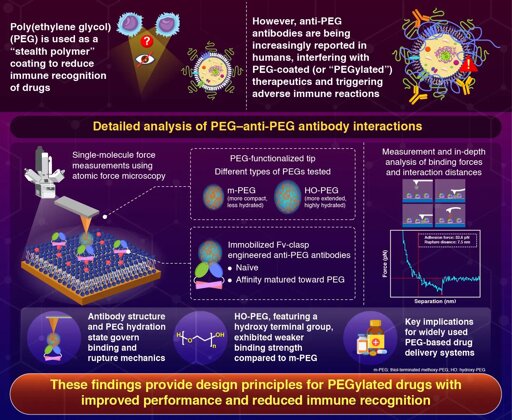
A recent study by researchers from Institute of Science Tokyo unveils the molecular mechanisms explaining why some "stealth" drug coatings fail to evade the immune system. Using single-molecule atomic force microscopy, the team measured how individual antibodies bind to poly (ethylene) glycol, showing that hydration and terminal chemistry strongly influence immune recognition. Their findings pave the way for novel drug coatings that stay effective longer by avoiding unwanted immune responses.