

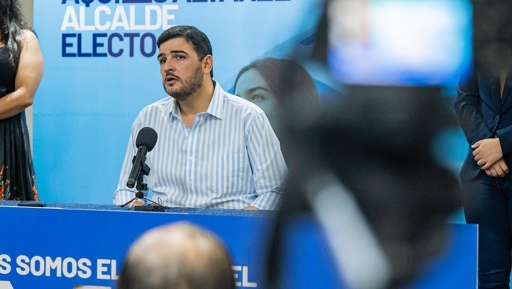
In the early hours of February 10, Ecuadorian police entered the home of Guayaquil Mayor Aquiles Álvarez. Ecuador quickly saw images of the mayor in his pajamas being handcuffed and taken to Quito. According to the prosecutor’s office, Álvarez is under investigation for alleged organized crime involving money laundering and tax fraud. His two brothers and eight other people allegedly linked to the crime were also arrested.
Álvarez was already under investigation and required to wear an electronic ankle bracelet, but he was not wearing it at the time of his arrest. The prosecutor’s office is investigating his involvement in an alleged crime of illegal fuel distribution, although the mayor of Guayaquil has stated on several occasions that this is retaliation by the right-wing government of Daniel Noboa to prevent his political profile from continuing to grow. Many analysts believe that Álvarez could run for president and have a good chance of winning.
Álvarez: Noboa’s harsh critic
Álvarez became mayor of Guayaquil thanks to an alliance between his RETO party and former President Rafael Correa’s Citizen Revolution (RC) party, after defeating the right-wing Social Christian Party, which had been in power for several decades in Ecuador’s main port city. Álvarez thus began an administration that has enjoyed considerable public approval and gradually emerged as a possible opposition candidate by publicly criticizing the Noboa government.
In fact, a few weeks ago, Álvarez made a video in which he claimed that the Ecuadorian state was completely co-opted by “narco-politics” and harshly criticized President Noboa for not taking direct action to confront drug trafficking groups, whose disputes with each other have caused the deepest security crisis in Ecuador’s history, with 2025 being the year with the most violent deaths in the country’s history. Ecuador is currently the second most dangerous country in Latin America, behind Haiti.
In addition, Álvarez said he would provide direct evidence to embassies and international organizations showing how Ecuadorian ports are being used to ship not only cocaine (Ecuador is the world’s leading exporter of that drug), but also fentanyl precursors, which pose an enormous risk to the country. He also said, without specifying who he was referring to, that hundreds of pounds of cocaine were found on the estate of a very powerful family in Ecuador, which, to the surprise of many, later disappeared, and all those arrested were released.
For now, several members of the Guayaquil city council have shown their support for the mayor. Deputy Mayor Tatiana Coronel said that the arrest was because Álvarez had become an inconvenient figure for the government: “As deputy mayor of Guayaquil, I express my full support and loyalty to the legitimate mayor of Guayaquil, Aquiles Álvarez … The message is very clear: anyone who causes inconvenience will suffer the consequences. And that should concern us beyond the names and political affiliations.”
“We live in a dictatorship,” says Correísmo
From within the ranks of the RC, it is claimed that this type of criticism of Noboa and Álvarez’s possible presidential candidacy (which could defeat the current president in a future election) is what may be behind the government’s quick action to neutralize Álvarez politically and judicially.
From the National Assembly, the RC stated that Álvarez is just another victim of the executive branch’s political persecution. A few weeks ago, the home of former RC presidential candidate Luisa González was raided, and an investigation was opened by the prosecutor’s office.
“We are living in a dictatorship,” said the leader of the Correa-aligned bloc in the Assembly, legislator Juan Andrés González, who also asserted that all opponents of the government are being persecuted in one way or another. “We stand in solidarity, not only [those of us in] the [RC] bloc, but also with more than 80% of the country, which is outraged by what is happening, with our colleague Aquiles Álvarez, who is a victim of political persecution.”
For her part, the president of the RC, former assembly member Gabriela Rivadeneira, said that Álvarez’s arrest is part of a smokescreen to divert attention away from Mario Godoy, president of the Judicial Council, the institution responsible for administering and sanctioning Ecuadorian judges, who has currently requested a leave of absence while he is being investigated for alleged irregularities and faces impeachment proceedings in the National Assembly.
“The kidnapping – because this is a kidnapping – of Aquiles Alvarez is happening right in the middle of the conflict and scandal over Mario Godoy’s links to drug trafficking. What are they trying to hide? … This is just another smokescreen, and we, the assembly members and activists, are here demanding transparency because the country cannot continue like this,” said Rivadeneira, while demonstrating outside the courthouse where Álvarez is being tried.
Rivadeneira also harshly criticized the government: “The rule of law has definitely been broken. We are living under a government with limitations on justice, proscription, and persecution.”
Controversy in the judicial system
The arrest of the mayor of Guayaquil came just hours after the presidency of the Judicial Council was entrusted to a trusted ally of Noboa, Damián Larco, who had previously headed the Internal Revenue Service and whose administration had reduced the million-dollar debts of several powerful families, including those of the Noboa family group, to which the president of the republic belongs.
Several lawyers and politicians have criticized Larco’s appointment not only because of his close ties to the presidency, but also because he does not yet have a professional law degree. He is still a law student.
In addition, several critics of the Noboa administration have suggested that this is a political move to protect Godoy from possible political censure by the assembly while he defends himself and takes over the presidency of the Judicial Council.
The post Progressive mayor of Guayaquil arrested, opposition denounces “political persecution” appeared first on Peoples Dispatch.
From Peoples Dispatch via this RSS feed