

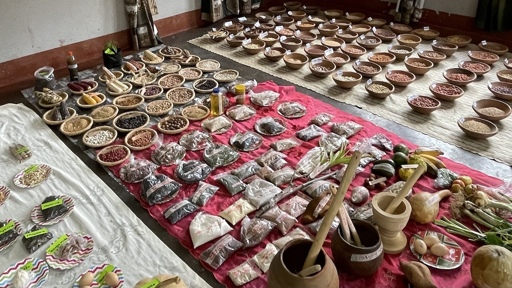
On February 16 and 17, representatives from the Zimbabwe Smallholder Organic Farmers’ Forum (ZIMSOFF) and other members of the Zimbabwe Seed Sovereignty Program (ZSSP) will participate in a public dialogue with Zimbabwe’s Parliamentary Portfolio Committee on Lands, Agriculture, Water, Fisheries and Rural Development. The consultation, organized by ZSSP members who are PELUM Zimbabwe (Participatory Ecological Land Use Management) partners, will address proposed changes to the country’s seed legislation.
At the heart of this dialogue is the extent to which Zimbabwe should align its domestic law (specifically the Plant Breeders’ Rights Act and the Seed Act) with the 1991 UPOV Convention. UPOV is the international framework that governs national seed laws. While this dialogue may appear routine, much is at stake. The outcome will affect not only Zimbabwe’s farmers but also the broader question of sovereignty across Africa.
Peasant movements and food sovereignty activists have long criticized the UPOV 1991 Convention, which prioritizes the interests of multinational corporations over farmers’ rights. It dramatically expanded intellectual property protections for commercial seed breeders while curtailing farmers’ age-old rights to save, exchange, and sell their own seeds. Under the earlier 1978 Act, farmers were generally free to save and reuse seeds from their harvest. Under UPOV 1991, this right becomes an optional exception at best. Even where granted, farmers may save seeds only for their own land and must often pay royalties to corporations. The exchange of saved seeds with neighbors (a practice through which over 80% of all seeds in Africa are still produced) is strictly forbidden.
Zimbabwe faces pressure to align with UPOV 1991 through the ARIPO Arusha Protocol, which came into force in November 2024. This reflects a broader pattern in which developing nations are compelled to adopt legal frameworks favoring multinational seed companies, often through trade agreements and regional protocols that serve imperialist interests and control over the economies of the Global South.
ZIMSOFF (a member of La Via Campesina and the Alliance for Food Sovereignty in Africa) argues that adopting UPOV 1991 would criminalize traditional seed exchange. Under such a framework, a farmer who saves a “protected” seed and shares it with a neighbor could face prosecution. ZIMSOFF and its ZSSP partners are demanding that Farmer-Managed Seed Systems be exempt from these restrictions. They also demand that indigenous and farmer-saved seeds receive legal recognition.
The stakes in this debate are deeply connected to Zimbabwe’s historic land reform, which transcended flag independence in 1980. Starting in 1999, a grassroots popular uprising reclaimed land expropriated by colonialism, leading to the Fast Track Land Reform Program. It transferred approximately 10 million hectares to over a million smallholder family farms, dismantling the white racial monopoly over land that had defined the settler-colonial economy. This land reform has provided livelihoods for millions of farming families and has been the anchor of Zimbabwean sovereignty. It was immediately met by sanctions (first from the European Union, then from the United States) which remain in place today and have hamstrung the country’s development for nearly three decades.
Against this backdrop, the push to align Zimbabwe’s seed laws with UPOV 1991 must be seen as the latest manifestation of imperialist pressure on countries that pursue an independent path. UPOV 1991 incentivizes genetically uniform commercial seeds and extends corporate monopolies for 20 to 25 years. It deepens dependence on multinational suppliers and on expensive chemical inputs (the very dependence that movements like ZIMSOFF have spent decades resisting).
ZIMSOFF’s position is grounded in the lived experience of Zimbabwe’s smallholder farmers and in international law. The United Nations Declaration on the Rights of Peasants (UNDROP), adopted in 2018 with Zimbabwe’s support, explicitly recognizes in Article 19 the right of peasants to save, use, exchange, and sell their seeds. It stipulates that intellectual property laws must “respect and take into account the rights, needs and realities of peasants.” Adopting strict UPOV 1991 laws would contradict Zimbabwe’s own commitments. In November 2025, the High Court of Kenya struck down provisions of that country’s Seed Act that had criminalized seed saving – a ruling hailed as a landmark for food sovereignty.
“We have fought so hard to get food sovereignty, and all the work we have done to achieve it is going to be washed away if these laws are implemented,” said Oliat Mavuramba, a farmer and ZIMSOFF leader from Masvingo province. His words capture the sentiment of thousands of smallholder farmers who see the proposed changes as a direct threat to their livelihoods and sovereignty.
On the African continent, the question of sovereignty is not a populist watchword. It is the defining question of the moment. As Kwame Nkrumah warned decades ago, neocolonialism means countries possess the outward trappings of political independence while remaining economically subservient to the metropole. The push to harmonize Africa’s seed laws with UPOV 1991 is one expression of this dynamic. That it arrives in Zimbabwe, a country that has paid an enormous price for pursuing an independent path, makes the struggle over seeds a frontline in the broader battle for African sovereignty. The hope of Zimbabwe’s peasants and patriotic forces is that their government will withstand this pressure, as it has others, and that the sovereignty over land won at the turn of the millennium will be matched by sovereignty over the seeds that give that land its meaning.
Jonis Ghedi-Alasow is the Coordinator of the Pan Africanism Today Secretariat.
The post Zimbabwe’s seed sovereignty is under threat – and with it, the legacy of land reform appeared first on Peoples Dispatch.
From Peoples Dispatch via this RSS feed