

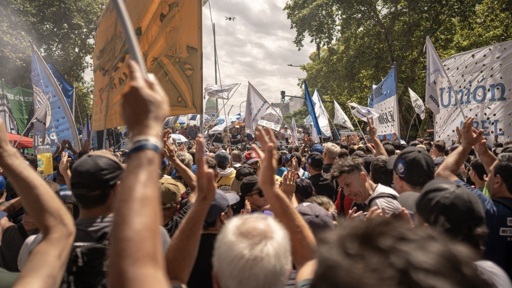
Argentina’s far-right president, Javier Milei, is accelerating his neoliberal agenda. The latest “conquest” of the libertarian right-wing president has been the approval of labor reform, which paves the way for a radical weakening of workers’ rights in the South American country.
The Argentine president said in an official statement that the reform represents a turning point in Argentine history: “After years of labor litigation that benefited a few, excessive bureaucracy, and outdated regulations in the face of profound economic and technological changes, we are now facing a profound transformation that restores predictability, dynamism, and freedom to the labor market.”
The opposition has categorically rejected the decision of the presidency and the Senate. Axel Kicillof, governor of the province of Buenos Aires, said during the massive demonstrations against the reform: “If severance pay, overtime, and vacation time – everything that has been won over time – are put at risk, it will not improve the situation of any worker … We are surrounded by a crowd that is doing what needs to be done: demonstrating to express that workers’ rights are at stake.”
For his part, left-wing congressman Nicolás del Caño affirmed: “The labor reform does not create jobs or benefit any workers. It is a slave-like labor reform.” He also called on workers to organize a major national strike: “Let it be a historic day. A great uprising of all workers.”
What does the labor reform change?
On February 12, the Argentine Senate approved Milei’s labor reform with 42 votes in favor and 30 against. According to Milei, the reform will bring more jobs by making labor more flexible, reducing the cost of layoffs, and allowing the working day to be increased to 12 hours, something that directly undermines the labor rights won through decades of struggle.
Another aspect considered by the labor reform (which the opposition describes as a law that benefits large companies at the expense of Argentine workers) is the reduction of contributions that companies must pay to cover other matters, such as social security.
Now, companies will deduct 1 to 2.5% of workers’ salaries for the labor assistance fund, which will cover the costs of layoffs. In other words, companies no longer bear the cost of layoffs; instead, these costs will now be paid by the workers themselves.
The reform also opens the door for companies to stop paying overtime and instead compensate workers with days off or reduced working hours. Vacations, which were usually offered in the summer, can now be spread out throughout the year.
Another issue that has provoked much rejection among workers is that wages can now be paid in any currency, kind, food, or lodging, which has been compared to pre-capitalist forms of payment.
The reform aims directly at weakening the power of trade unions, which have played a historic role in defending rights in Argentina. For example, agreements within each company will now take precedence over collective agreements by sector of activity. Sectoral agreements allow for greater collective defense of labor rights. In addition, it states that such agreements will be immediately nullified if no agreement is reached between the parties, which could be used by some companies as a means to boycott agreements.
The right to strike is also threatened, as unions will now have to guarantee 75% of operations in essential services, such as health, education, energy, transportation, and water, and 50% in the case of banks, mining, industry, and e-commerce. The unions claim that this is a way of destroying collective and mass mobilization in order to weaken the political power of workers.
However, before the labor reform can come into effect, it must be approved by the Chamber of Deputies. The legislature must now decide whether to pass a reform that has been heavily criticized by Argentine workers or whether to satisfy the wishes of Milei, the International Monetary Fund, and a large number of big business leaders.
Resistance in the streets of Buenos Aires
This is how thousands of Argentine workers have seen it, taking to the streets to express their opposition to the new neoliberal law. The call for demonstrations was made by several unions and political movements, which have denounced the law’s approval as a direct attack on workers’ dignity.
As has become commonplace in the streets of Buenos Aires, the demonstrations on Wednesday were heavily repressed by the police. According to reports, at least 71 people were arrested.
In an official statement, the General Confederation of Labor (CGT) harshly criticized the senators’ decision: “They approved a bill that sets back labor relations in our country: it is a step backward in collective rights, in individual rights, and, as if that were not enough, it seeks to advance a brutal transfer of resources from labor to capital.”
In addition, the CGT affirmed: “We affirm that this real setback in labor rights will not be remedied in any way other than through a political project that puts workers and their dignity back at the center.”
For his part, Hugo Yasky, secretary general of the Argentine Workers’ Central Union (a major labor confederation), said: “The labor reform is an attack on workers. They want to starve our people. What we are experiencing today is a kind of dictatorship imposed by the most powerful groups inside and outside the country, and we have to recover our labor rights, but we also have to recover our wages, the income of retirees, and public education.”
The post Amid fierce protests, Milei’s neoliberal labor reform advances appeared first on Peoples Dispatch.
From Peoples Dispatch via this RSS feed
You must log in or # to comment.