

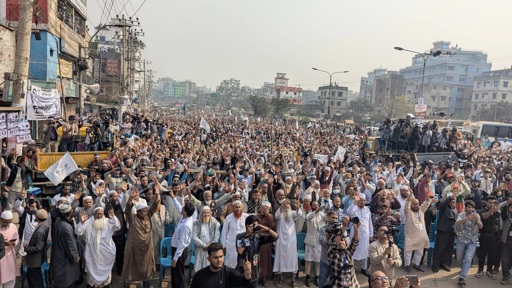
Conservative Bangladesh Nationalist Party (BNP) secured an over two-thirds majority in Bangladesh’s National Assembly (Jatiya Sangsad) elections held on Thursday, February 12. Its leader, Tarique Rahman, is set to become the prime minister of the country.
As per the official results announced by the Elections Commission of Bangladesh (ECB) on Friday afternoon, the BNP-led alliance has secured 212 seats out of the 297.
The 11-party alliance, led by the right-wing Islamist Jamaat-e-Islami (JI), or simply Jamaat, has secured 77 seats in total with the rest of the seats going to smaller parties and independent candidates.
Though there are 350 seats in the National Assembly, only 300 are decided by popular vote. This time, elections were held for 299 seats as the election for one seat was cancelled due to the death of a candidate.
The ECB has suspended the counting for the other two seats due to court cases, Bengali newspaper Prothom Alo reported.
The 50 remaining seats are reserved for women. These seats are allocated to the parties/alliances on the basis of their proportion of votes secured in the popular elections.
According to the ECB, around 60% of the 127 million registered voters in the country exercised their franchise on Thursday, February 12. This was much higher than the last national elections in January 2024 when only around 40% of the electorate voted.
This was the first national election held after the July 2024 uprising, which forced Prime Minister Sheikh Hasina to resign and leave the country in early August of that year.
The country has been run under an interim administration led by Nobel laureate Mohammad Yunus since then.
Tarique Rahman is set to become prime minister
The BNP leader and grandson of former military commander and president Ziaur Rahman (1977-81), and son of three time former prime minister Khaleda Zia Tarique Rahman (60), is set to become the new prime minister of Bangladesh.
A party or an alliance needs to win more than 150 seats in the National Assembly to form a government.
The BNP has been out of power for nearly two decades. Rahman himself was living in exile in London for the last 17 years and returned to the country only in December.
During election campaigns, Rahman has promised a democratic and corruption-free administration in the country with a strong focus on economic development.
NCP emerges as minor player
The National Citizen Party (NCP), founded by the student leaders of the July uprising, contested the elections as a part of the Jamaat-led alliance.
It was contesting just 30 seats, out of which it was able to win six with some of the prominent faces of the July mass uprising, including Nahid Islam and Akhter Hossen winning their respective seats in Dhaka and Rangpur, Prothom Alo reported.
Read more: The conundrums of Bangladeshi politics
Several left groups, such as the Workers Party of Bangladesh (WPB) had called for a boycott and refused to contest the elections, claiming that conditions did not exist for free and fair elections in the country due to political persecution.
The Awami League, which ruled the country for most of the years since its independence from Pakistan in 1971, was banned from contesting the elections. Awami League leader Sheikh Hasina was sentenced to death, charged with the death of protesters in July-August 2024, and has been in exile in India since she was forced to resign.
Ahead of the elections, polls had predicted that the majority of swing voters would choose the BNP over the ultra-right-wing Jamaat in the absence of Awami League, which improved electoral prospects for the conservative party.
Referendum on reforms accepted
Meanwhile, Bangladesh also accepted the referendum on the July Charter held along with the elections for the National Assembly.
According to the ECB, over 65% of the electorate voted in favor of reforms proposed in the July National Charter, adopted in October last year.
The July charter is a scheme of substantial changes in the country’s constitution and political system, including the introduction of a bicameral parliament, a fixed term for the prime minister, increased representation for women, among others.
Most of the parties, including the BNP, have supported the yes vote. However, there are apprehensions about their intent and ability to really carry out those reforms.
The post Conservative BNP sweeps Bangladesh elections with over two-thirds majority in the parliament appeared first on Peoples Dispatch.
From Peoples Dispatch via this RSS feed