
Eliot Whittington is Executive Director of Cambridge Institute for Sustainability Leadership.
Last week, the Trump Administration reversed the critical finding that greenhouse gases threaten the public health and welfare of current and future generations, a scientific and legal foundation that has underpinned US climate regulations since 2009.
In doing so, the US government not only lost its ability to regulate emissions from vehicles, power plants and heavy industry, but created massive uncertainty for businesses and jeopardises the benefits of the energy transition.
This action is the latest step in a growing battle over the future of climate and energy policy that extends far beyond the US borders and is currently increasing challenging UK and European policy makers.
The so called “endangerment finding” was based on overwhelming evidence and widely discussed when it was introduced – with over 380,000 public comments. A rigorous analysis or critique would not overturn it, given the huge and still-growing body of evidence showing the impact of emissions.
But repealing the finding is not evidence-based policy making; it is bad policy, terrible economics and incorrect science, driven by an ideology that is seeing the US pour money into uneconomic coal power plants.
 Feb 13, 2026 Comment
The more Europe relies on the US for energy, the more it’s vulnerable to pressure by Trump
Risking energy security suicide through dependency on US gas, Europe’s leaders must instead reject resource colonialismRead more Feb 13, 2026 Politics
After disappointing COP30, EU mulls “less naive” strategy for climate talks
EU environment ministers are discussing how to show more “realism” and “pragmatism” in international climate negotiationsRead more Feb 12, 2026 News
Climate action is “weapon” for security in unstable world, UN climate chief says
With geopolitical tensions rising, Simon Stiell urges leaders to accelerate global climate cooperation in pursuit of a safer worldRead more
US firms face uncertainty and regulatory chaos
Even the most powerful politician cannot change scientific reality, and attempts to do so undermine the health, wealth, and safety of Americans and, ultimately, people everywhere.
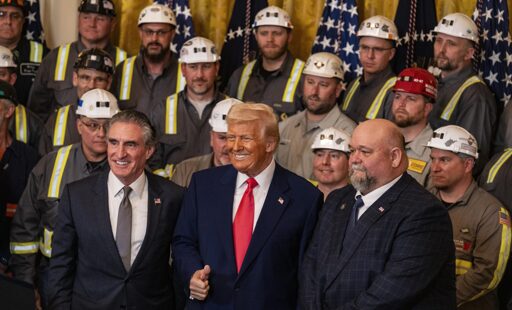
Trump has been celebrated by the coal industry as its strongest champion and has thrown his weight behind fossil fuels, but that has not and will not stop the US’s energy transition. Even in his first term, there were record coal retirements, and the US shows no sign of a coal renaissance any time soon.
Instead, Trump’s actions take a wrecking ball to US regulation, one that is likely to be challenged in court, leaving companies facing years of uncertainty, delaying investment and risking the loss of innovation to global competitors.
Repealing the “endangerment finding” is a self-inflicted wound to climate action and a strategic error as the energy system is rewired around technologies like solar, wind, electric vehicles, heat pumps, batteries, and digitalised grids. These are increasingly outcompeting fossil fuels on efficiency and cost.
The US government setting its weight against the market will not hold back the tide, but it will lead to regulatory chaos, cede ground to competitors, and slash the benefits the US could reap.
Clean technologies outcompete incumbents
While the US has chosen slow innovation and investment in the clean economy, China is pursuing the industries of the future and leading on solar power, batteries, electric vehicles and more.
New analysis shows its emissions are now flat or possibly even falling and, while it will take time for this clean energy juggernaut to push coal and industry emissions out of the system, the direction of travel is becoming ever clearer.
China is not just doing this because it is good for the climate. Clean technologies and an electricity-centred economy outcompete the incumbents.
 Feb 9, 2026 Clean Energy Frontier
China maximises battery recycling to shore up critical mineral supplies
Beijing is bracing for a tsunami of spent EV batteries by taking steps to boost recycling – a strategy that could also cut its reliance on imports of clean energy mineralsRead more Feb 10, 2026 Finance
Explainer: What is the petrodollar and why is it under pressure?
As the US seeks to carve out a sphere of influence in the Western Hemisphere, questions grow about the dollar’s future as the lynchpin of the global economyRead more Dec 10, 2025 Clean Energy Frontier
EU weakening of corporate sustainability rules ‘jeopardises’ climate action, critics say
A major revision to the EU’s law on corporate due diligence removes a requirement for large companies to publish plans to align their business model with global climate goalsRead more
Analysis by energy think tank Ember shows that these clean, electricity based technologies are three times more efficient than burning fuels. Not only this, but costs are also falling and domestic production bolsters energy security, providing a competitive edge.
The US will find itself isolated in its return to fossil fuels. In 2024, clean power surpassed 40% of global electricity, led by record solar growth, while electrification is now responsible for almost all the demand growth in road transport and is surging in buildings and parts of industry.
With China – and a growing group of other emerging markets – progressing in their energy transitions, and the US turning its back, incumbent clean-economy champions, the UK and Europe, seem caught in the headlights, wanting to simultaneously leap forward while also glancing back at supposedly affordable fossil fuel resources.
It is paramount that they resist the urge to take a leaf from Donald Trump’s book and legislate for a fossil fuel ideal rather than a clean energy reality. Instead, they need to ensure the investment and political will to be brave and walk the road ahead without the US.
The post As China builds the future, Trump’s repeal of climate finding is self-inflicted wound appeared first on Climate Home News.
From Climate Home News via this RSS feed